







Question: please answer the last part Another way to dene a fair game is that a player's probability of winning must be equal to the player's
please answer the last part
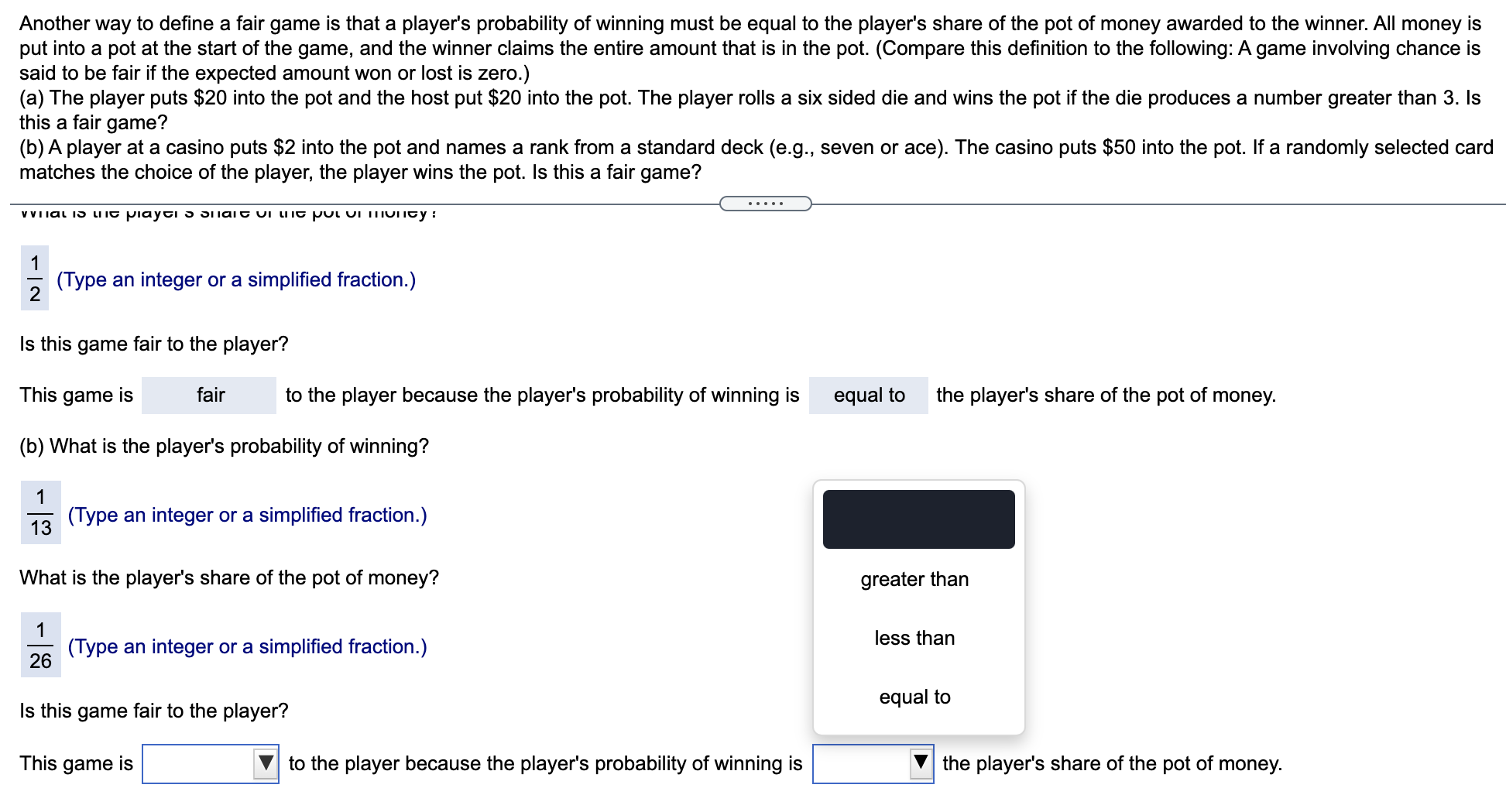
Another way to dene a fair game is that a player's probability of winning must be equal to the player's share of the pot of money awarded to the winner. All money is put into a pot at the start of the game, and the winner claims the entire amount that is in the pot. (Compare this denition to the following: A game involving chance is said to be fair if the expected amount won or lost is zero.) (a) The player puts $20 into the pot and the host put $20 into the pot. The player rolls a six sided die and wins the pot if the die produces a number greater than 3. Is this a fair game? (b) A player at a casino puts $2 into the pot and names a rank from a standard deck (e.g., seven or ace). The casino puts $50 into the pot. If a randomly selected card matches the choice of the player, the player wins the pot. Is this a fair game? mm .s we ylaycl s sums u. we W. o. ...u..e,. 2 (Type an integer or a simplied fraction.) Is this game fair to the player? This game is fair to the player because the player's probability of winning is equal to the player's share of the pot of money. (b) What is the player's probability of winning? 1 E (Type an integer or a simplied fraction.) - What is the player's share of the pot of money? greater than 26 (Type an integer or a simplied fraction.) less than equal to Is this game fair to the player? This game is V to the player because the player's probability of winning is V the player's share of the pot of money
Step by Step Solution
There are 3 Steps involved in it

Get step-by-step solutions from verified subject matter experts
 Study Help