







Question: Please answer the last question! Due to the same late cancellations problem, you decide to reduce the price of your rooms to $150 and request
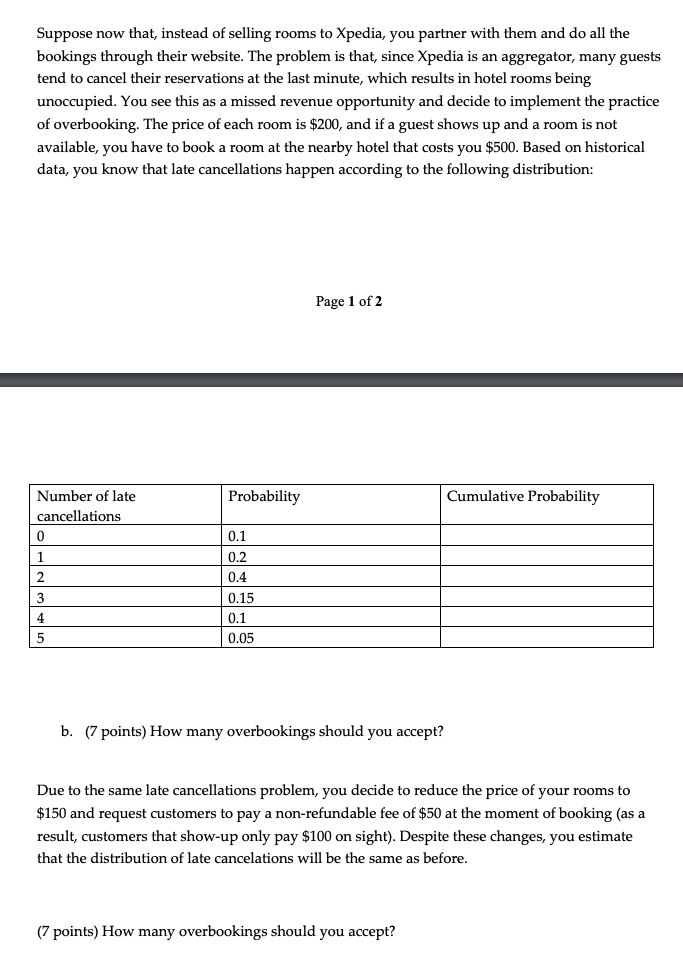
Please answer the last question! Due to the same late cancellations problem, you decide to reduce the price of your rooms to $150 and request customers to pay a non-refundable fee of $50 at the moment of booking (as a result, customers that show-up only pay $100 on sight). Despite these changes, you estimate that the distribution of late cancelations will be the same as before. How many overbookings should you accept?
Suppose now that, instead of selling rooms to Xpedia, you partner with them and do all the bookings through their website. The problem is that, since Xpedia is an aggregator, many guests tend to cancel their reservations at the last minute, which results in hotel rooms being unoccupied. You see this as a missed revenue opportunity and decide to implement the practice of overbooking. The price of each room is $200, and if a guest shows up and a room is not available, you have to book a room at the nearby hotel that costs you $500. Based on historical data, you know that late cancellations happen according to the following distribution: Page 1 of 2 Probability Cumulative Probability Number of late cancellations 0.1 0.2 0.4 0.15 0.1 0.05 b. (7 points) How many overbookings should you accept? Due to the same late cancellations problem, you decide to reduce the price of your rooms to $150 and request customers to pay a non-refundable fee of $50 at the moment of booking (as a result, customers that show-up only pay $100 on sight). Despite these changes, you estimate that the distribution of late cancelations will be the same as before. (7 points) How many overbookings should you accept? GAWNEOR 0 1 2 3 4 5Step by Step Solution
There are 3 Steps involved in it
1 Expert Approved Answer
Step: 1 Unlock

Question Has Been Solved by an Expert!
Get step-by-step solutions from verified subject matter experts
Step: 2 Unlock
Step: 3 Unlock
 Study Help