







Question: Please Answer the multiple-choice in order: John Hall tried to unclog a floor drain in the kitchen of the restaurant where he worked. He used
Please Answer the multiple-choice in order: John Hall tried to unclog a floor drain in the kitchen of the restaurant where he worked. He used a drain cleaner called Zaps Blue Lye that contained crystalline sodium hydroxide (the chemical name for lye). The product label said to wear eye protection, to put one tablespoon of lye directly into the drain, and to keep ones face away from the drain because there could be dangerous backsplash. Without eye protection, Hall mixed three tablespoons of the lye with water and poured that mixture down the drain while bending over it. Liquid splashed back into his face, causing injury.
He brought a product liability suit based on design defect and inadequate warning. At trial, an expert for Hall stated that the product was defective because it had a tendency to backsplash. Witnesses for the company testified that lye is the most effective chemical drain cleaner and that there is no way to create an effective drain cleaner with lye and eliminate the risk of backsplash. The company executives testified that this inability to eliminate backsplash was the reason for the warning label.
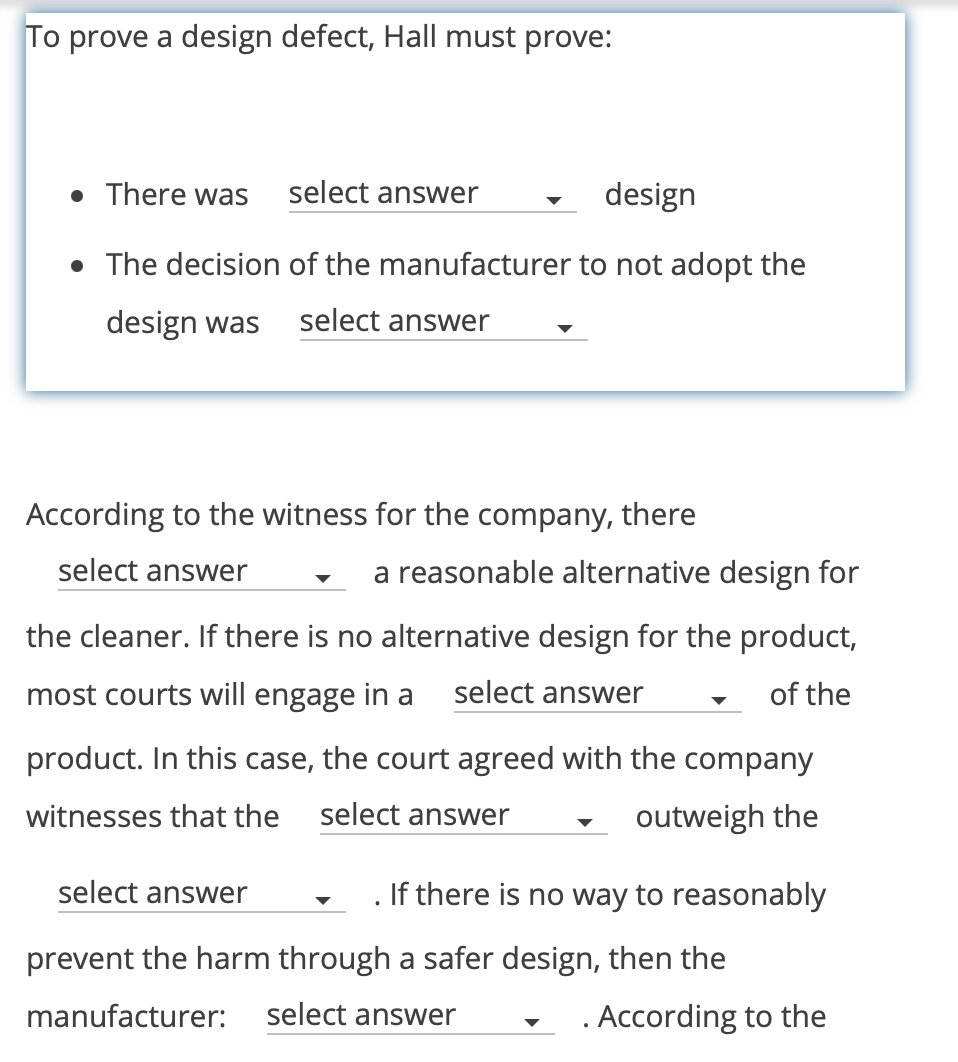
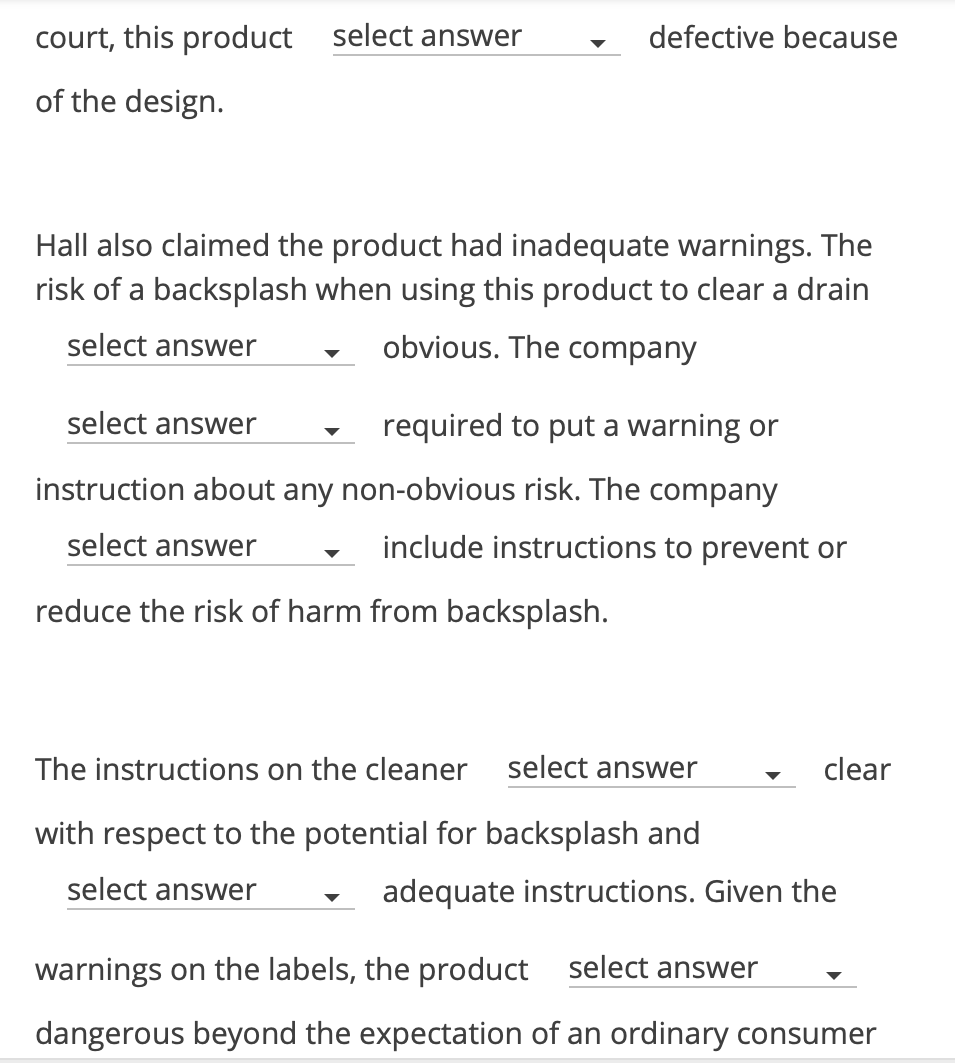
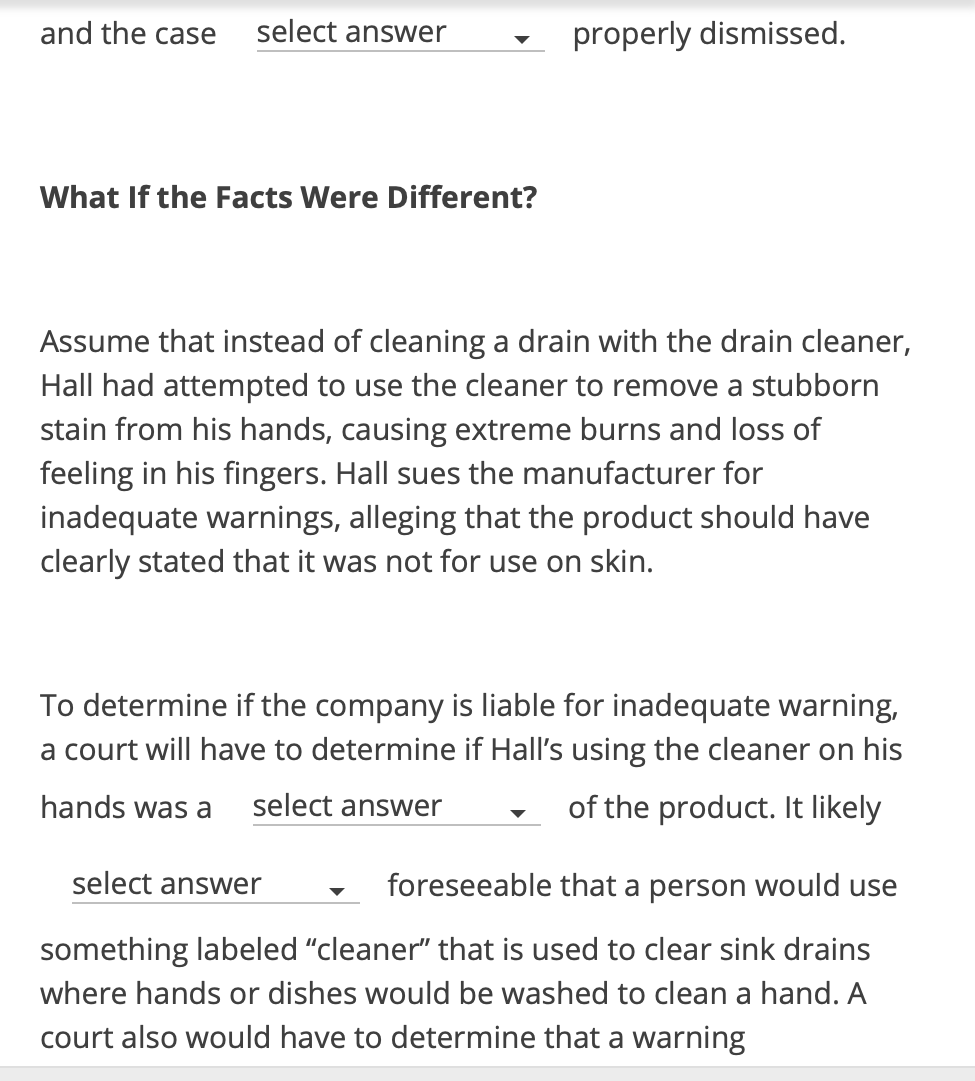
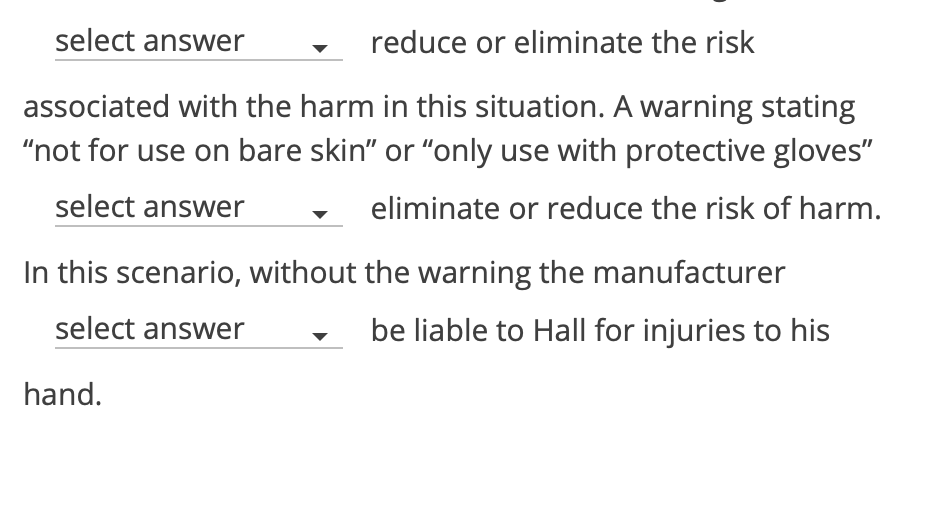
To prove a design defect, Hall must prove: There was select answer design The decision of the manufacturer to not adopt the design was select answer According to the witness for the company, there select answer a reasonable alternative design for the cleaner. If there is no alternative design for the product, most courts will engage in a select answer of the product. In this case, the court agreed with the company witnesses that the select answer outweigh the select answer If there is no way to reasonably prevent the harm through a safer design, then the manufacturer: select answer . According to the court, this product select answer defective because of the design. Hall also claimed the product had inadequate warnings. The risk of a backsplash when using this product to clear a drain select answer obvious. The company select answer required to put a warning or instruction about any non-obvious risk. The company select answer include instructions to prevent or reduce the risk of harm from backsplash. The instructions on the cleaner select answer clear with respect to the potential for backsplash and select answer adequate instructions. Given the warnings on the labels, the product select answer dangerous beyond the expectation of an ordinary consumer and the case select answer properly dismissed. What If the Facts Were Different? Assume that instead of cleaning a drain with the drain cleaner, Hall had attempted to use the cleaner to remove a stubborn stain from his hands, causing extreme burns and loss of feeling in his fingers. Hall sues the manufacturer for inadequate warnings, alleging that the product should have clearly stated that it was not for use on skin. To determine if the company is liable for inadequate warning, a court will have to determine if Hall's using the cleaner on his hands was a select answer of the product. It likely select answer foreseeable that a person would use something labeled "cleaner" that is used to clear sink drains where hands or dishes would be washed to clean a hand. A court also would have to determine that a warning select answer reduce or eliminate the risk associated with the harm in this situation. A warning stating "not for use on bare skin" or "only use with protective gloves" select answer eliminate or reduce the risk of harm. In this scenario, without the warning the manufacturer select answer be liable to Hall for injuries to his hand
Step by Step Solution
There are 3 Steps involved in it

Get step-by-step solutions from verified subject matter experts
 Study Help