







Question: Please answer the parts A, B, C, and E only. CASE 1 You are the internal audit senior responsible for conducting an assurance engagement of
Please answer the parts A, B, C, and E only.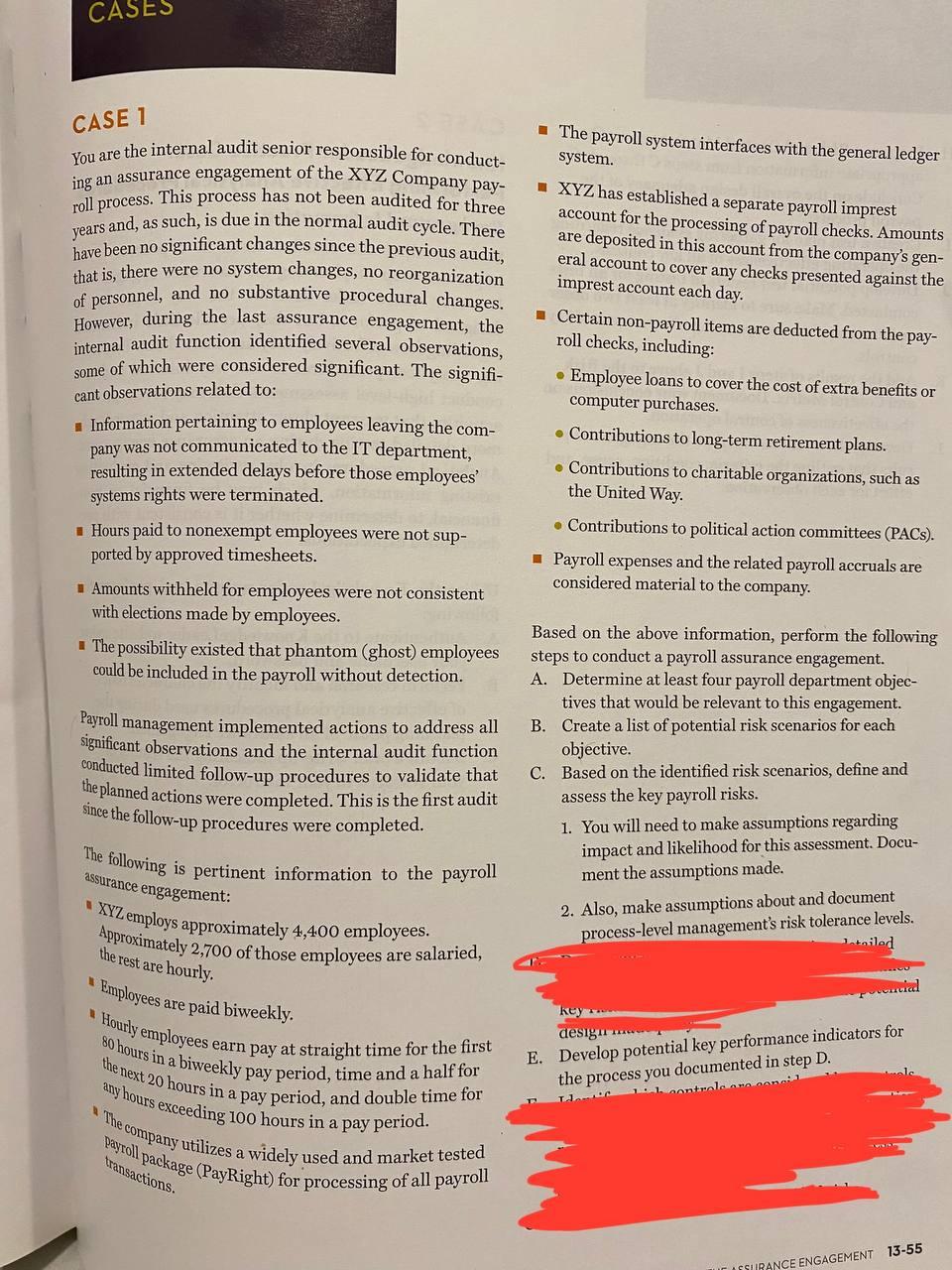
CASE 1 You are the internal audit senior responsible for conducting an assurance engagement of the XYZ Company payroll process. This process has not been audited for three years and, as such, is due in the normal audit cycle. There have been no significant changes since the previous audit, that is, there were no system changes, no reorganization of personnel, and no substantive procedural changes. However, during the last assurance engagement, the internal audit function identified several observations, some of which were considered significant. The significant observations related to: - Information pertaining to employees leaving the company was not communicated to the IT department, resulting in extended delays before those employees' systems rights were terminated. - Hours paid to nonexempt employees were not supported by approved timesheets. - Amounts withheld for employees were not consistent with elections made by employees. - The possibility existed that phantom (ghost) employees could be included in the payroll without detection. Payroll management implemented actions to address all significant observations and the internal audit function conducted limited follow-up procedures to validate that the planned actions were completed. This is the first audit since the follow-up procedures were completed. The following is pertinent information to the payroll assurance engagement: - XYZ employs approximately 4,4.00 employees. Approximately 2,700 the rest are 2,700 of those employees are salaried, *mployees are paid biweekly. Hourly employees earn pay at straight time for the first 80 hours in a biweekly pay period, time and a half for the next 20 hours in a pay period, and double time for "The company utilizes a widely used and market tested Payroll packy utilizes a widely used and market tested trinsactions. - The payroll system interfaces with the general ledger system. XY has established a separate payroll imprest account for the processing of payroll checks. Amounts are deposited in this account from the company's general account to cover any checks presented against the imprest account each day. - Certain non-payroll items are deducted from the payroll checks, including: - Employee loans to cover the cost of extra benefits or computer purchases. - Contributions to long-term retirement plans. - Contributions to charitable organizations, such as the United Way. - Contributions to political action committees (PACs). Payroll expenses and the related payroll accruals are considered material to the company. Based on the above information, perform the following steps to conduct a payroll assurance engagement. A. Determine at least four payroll department objectives that would be relevant to this engagement. B. Create a list of potential risk scenarios for each objective. C. Based on the identified risk scenarios, define and assess the key payroll risks. 1. You will need to make assumptions regarding impact and likelihood for this assessment. Document the assumptions made. 2. Also, make assumptions about and document process-level management's risk tolerance levels. (r. 1.- E. Develop potential key performance indicators for the process you documented in step D. CASE 1 You are the internal audit senior responsible for conducting an assurance engagement of the XYZ Company payroll process. This process has not been audited for three years and, as such, is due in the normal audit cycle. There have been no significant changes since the previous audit, that is, there were no system changes, no reorganization of personnel, and no substantive procedural changes. However, during the last assurance engagement, the internal audit function identified several observations, some of which were considered significant. The significant observations related to: - Information pertaining to employees leaving the company was not communicated to the IT department, resulting in extended delays before those employees' systems rights were terminated. - Hours paid to nonexempt employees were not supported by approved timesheets. - Amounts withheld for employees were not consistent with elections made by employees. - The possibility existed that phantom (ghost) employees could be included in the payroll without detection. Payroll management implemented actions to address all significant observations and the internal audit function conducted limited follow-up procedures to validate that the planned actions were completed. This is the first audit since the follow-up procedures were completed. The following is pertinent information to the payroll assurance engagement: - XYZ employs approximately 4,4.00 employees. Approximately 2,700 the rest are 2,700 of those employees are salaried, *mployees are paid biweekly. Hourly employees earn pay at straight time for the first 80 hours in a biweekly pay period, time and a half for the next 20 hours in a pay period, and double time for "The company utilizes a widely used and market tested Payroll packy utilizes a widely used and market tested trinsactions. - The payroll system interfaces with the general ledger system. XY has established a separate payroll imprest account for the processing of payroll checks. Amounts are deposited in this account from the company's general account to cover any checks presented against the imprest account each day. - Certain non-payroll items are deducted from the payroll checks, including: - Employee loans to cover the cost of extra benefits or computer purchases. - Contributions to long-term retirement plans. - Contributions to charitable organizations, such as the United Way. - Contributions to political action committees (PACs). Payroll expenses and the related payroll accruals are considered material to the company. Based on the above information, perform the following steps to conduct a payroll assurance engagement. A. Determine at least four payroll department objectives that would be relevant to this engagement. B. Create a list of potential risk scenarios for each objective. C. Based on the identified risk scenarios, define and assess the key payroll risks. 1. You will need to make assumptions regarding impact and likelihood for this assessment. Document the assumptions made. 2. Also, make assumptions about and document process-level management's risk tolerance levels. (r. 1.- E. Develop potential key performance indicators for the process you documented in step D
Step by Step Solution
There are 3 Steps involved in it

Get step-by-step solutions from verified subject matter experts
 Study Help