







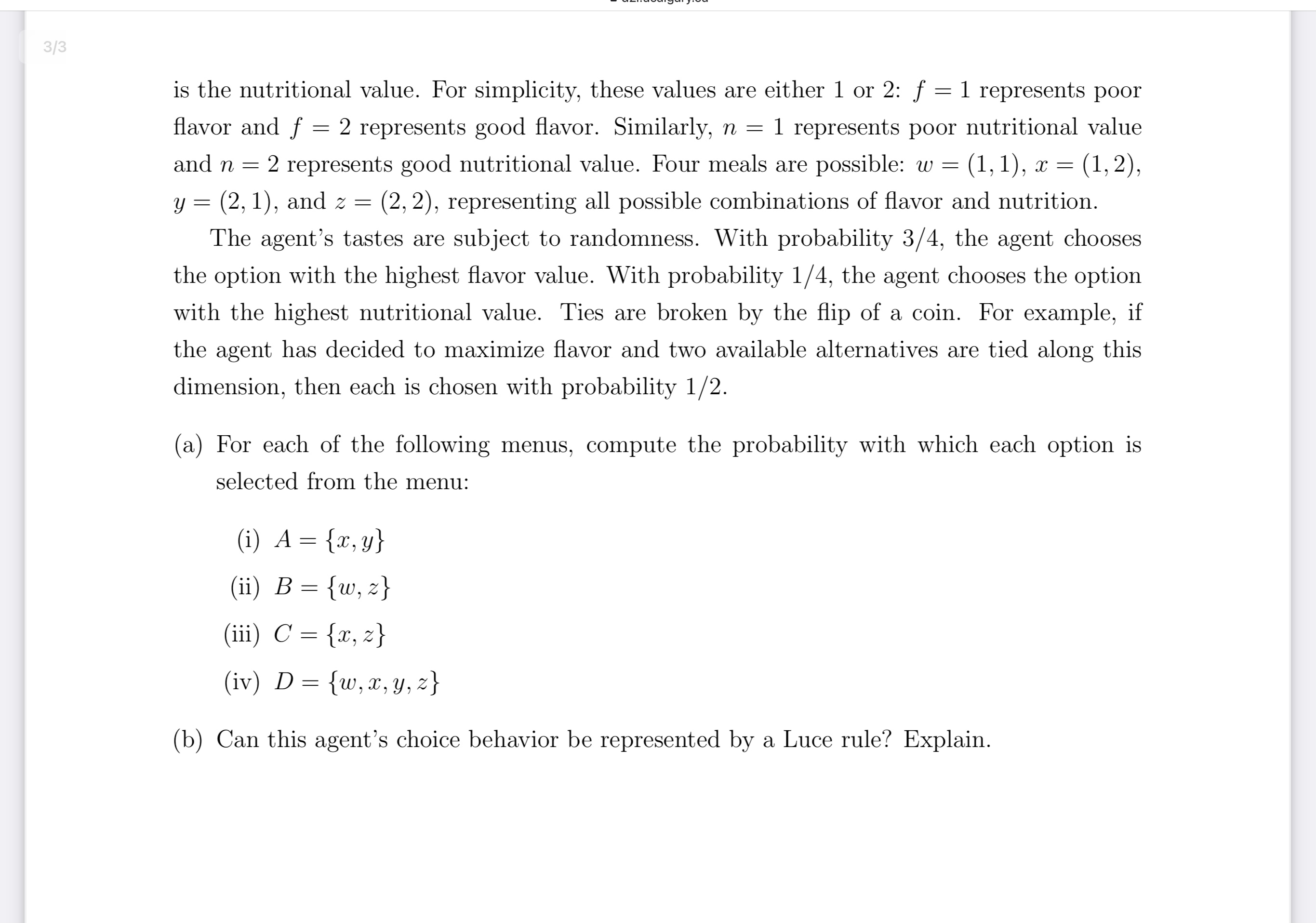
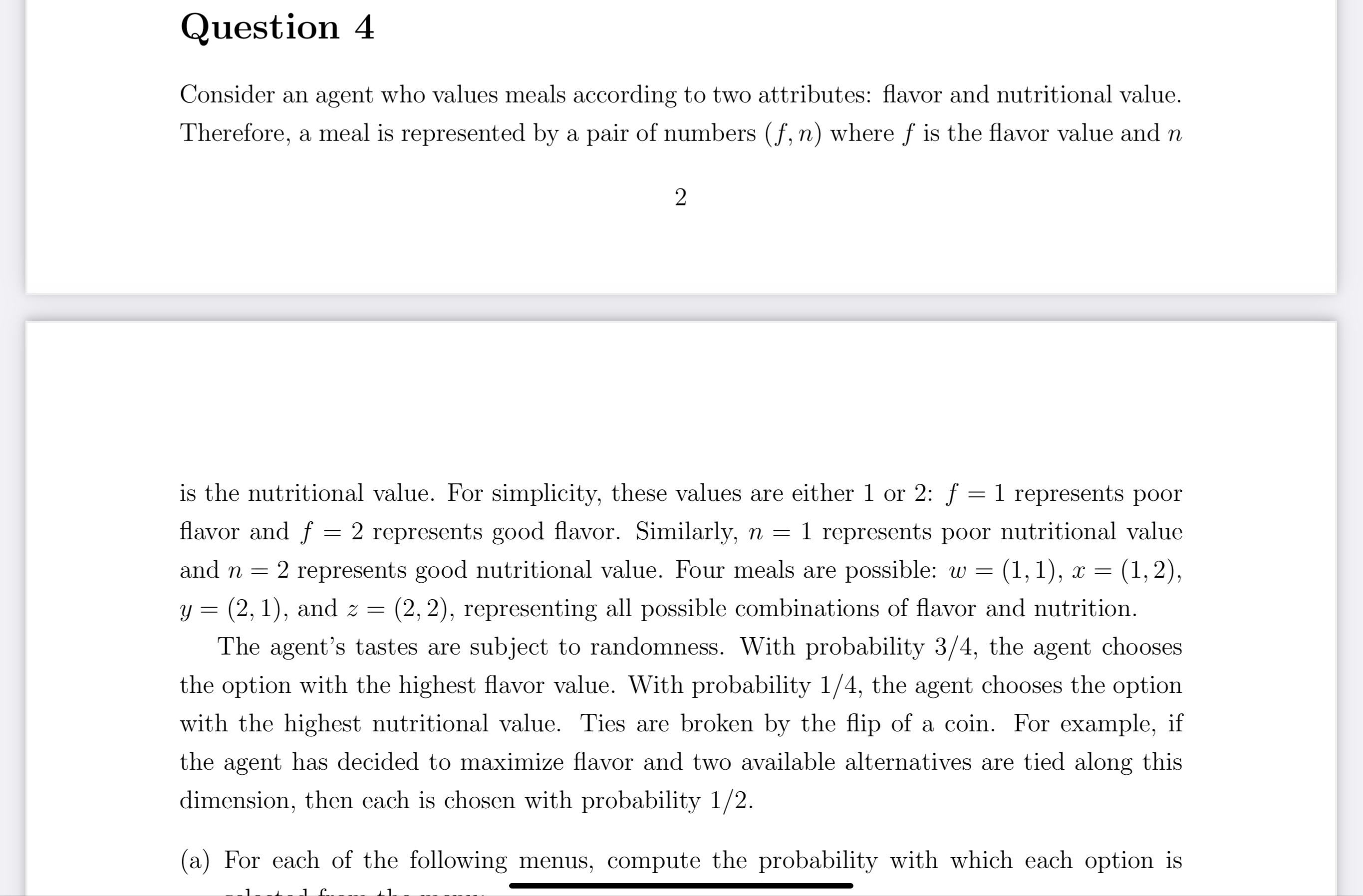
Question: Please answer the question 3/3 is the nutritional value. For simplicity, these values are either 1 or 2: f = 1 represents poor flavor and
Please answer the question
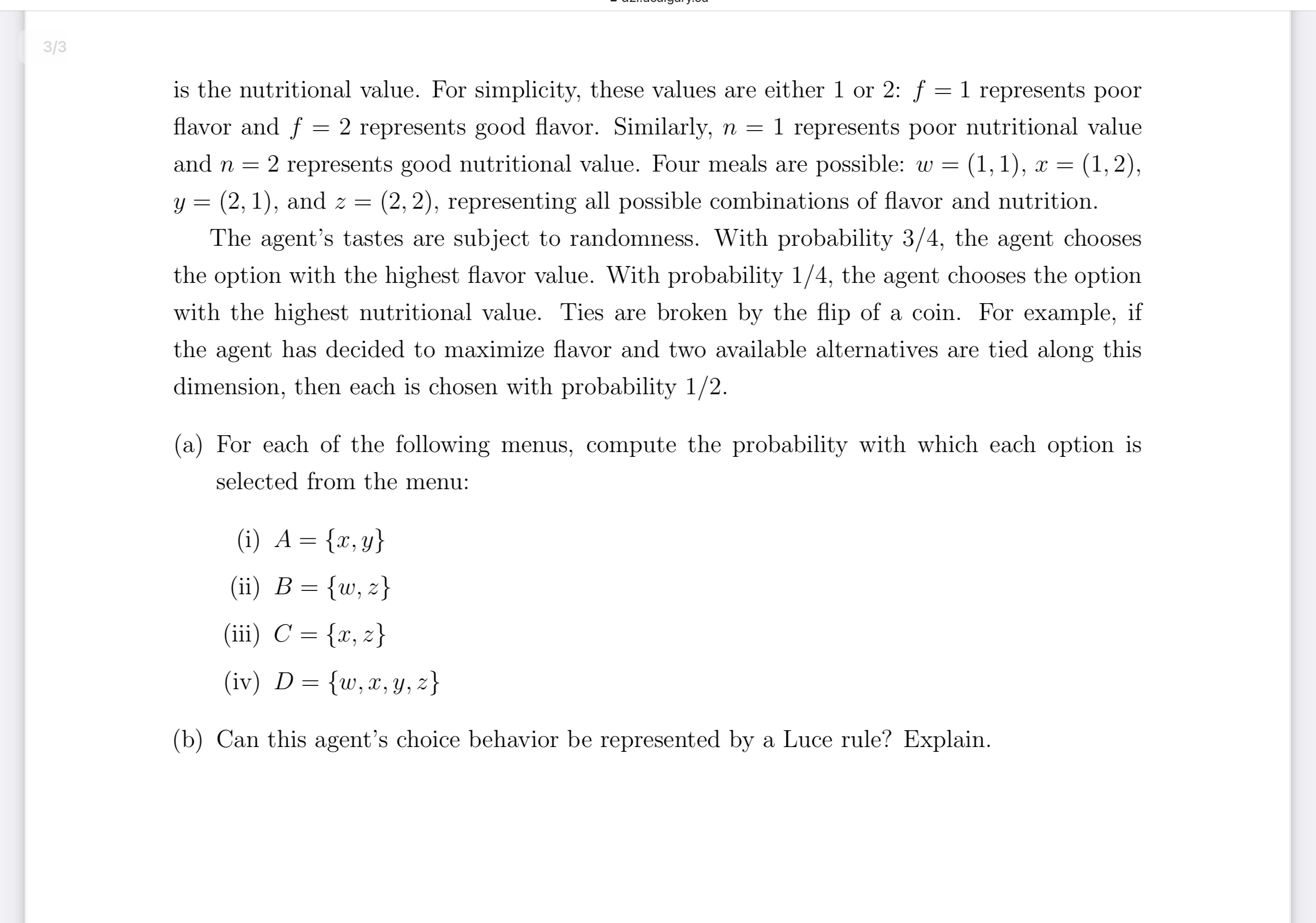
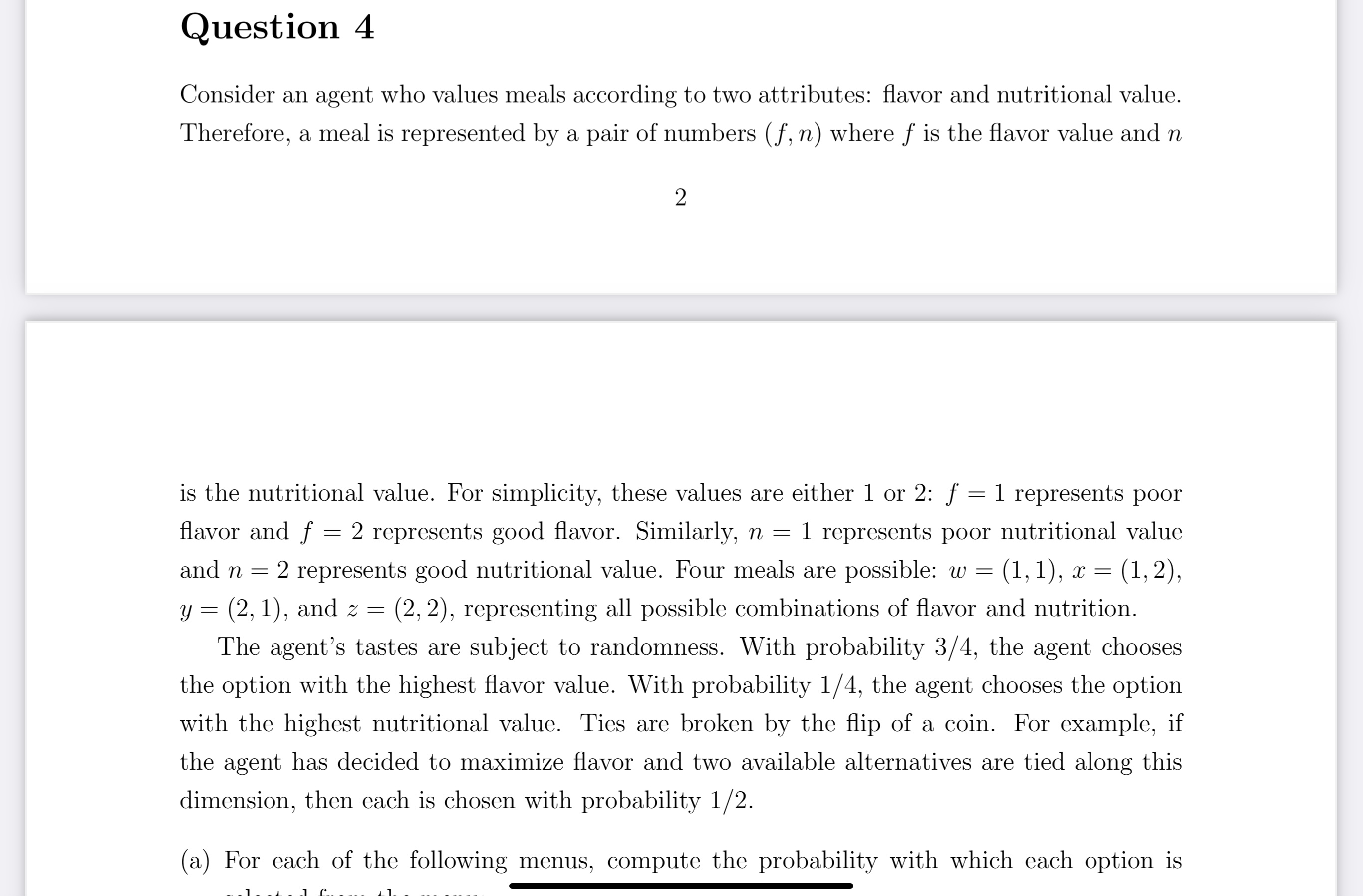
3/3 is the nutritional value. For simplicity, these values are either 1 or 2: f = 1 represents poor flavor and f = 2 represents good flavor. Similarly, n = 1 represents poor nutritional value and n = 2 represents good nutritional value. Four meals are possible: w = (1, 1), x = (1, 2), y = (2, 1), and z = (2, 2), representing all possible combinations of flavor and nutrition. The agent's tastes are subject to randomness. With probability 3/4, the agent chooses the option with the highest flavor value. With probability 1/4, the agent chooses the option with the highest nutritional value. Ties are broken by the flip of a coin. For example, if the agent has decided to maximize flavor and two available alternatives are tied along this dimension, then each is chosen with probability 1/2. (a) For each of the following menus, compute the probability with which each option is selected from the menu: (i) A = {x, y} (ii) B = {w, z} (iii) C = {x, z} (iv) D = {w, x, y, z } (b) Can this agent's choice behavior be represented by a Luce rule? Explain.Question 4 Consider an agent who values meals according to two attributes: flavor and nutritional value. Therefore, a meal is represented by a pair of numbers (f, n) where f is the flavor value and n 2 is the nutritional value. For simplicity, these values are either 1 or 2: f = 1 represents poor flavor and f = 2 represents good flavor. Similarly, n = 1 represents poor nutritional value and n = 2 represents good nutritional value. Four meals are possible: w = (1, 1), x = (1, 2), y = (2, 1), and z = (2, 2), representing all possible combinations of flavor and nutrition. The agent's tastes are subject to randomness. With probability 3/4, the agent chooses the option with the highest flavor value. With probability 1/4, the agent chooses the option with the highest nutritional value. Ties are broken by the flip of a coin. For example, if the agent has decided to maximize flavor and two available alternatives are tied along this dimension, then each is chosen with probability 1/2. (a) For each of the following menus, compute the probability with which each option is
Step by Step Solution
There are 3 Steps involved in it

Get step-by-step solutions from verified subject matter experts
 Study Help