







Question: Please answer the question (a) A bag contains 3 green balls, 4 red balls, and no other balls. Victor removes balls randomly from the bag,
Please answer the question
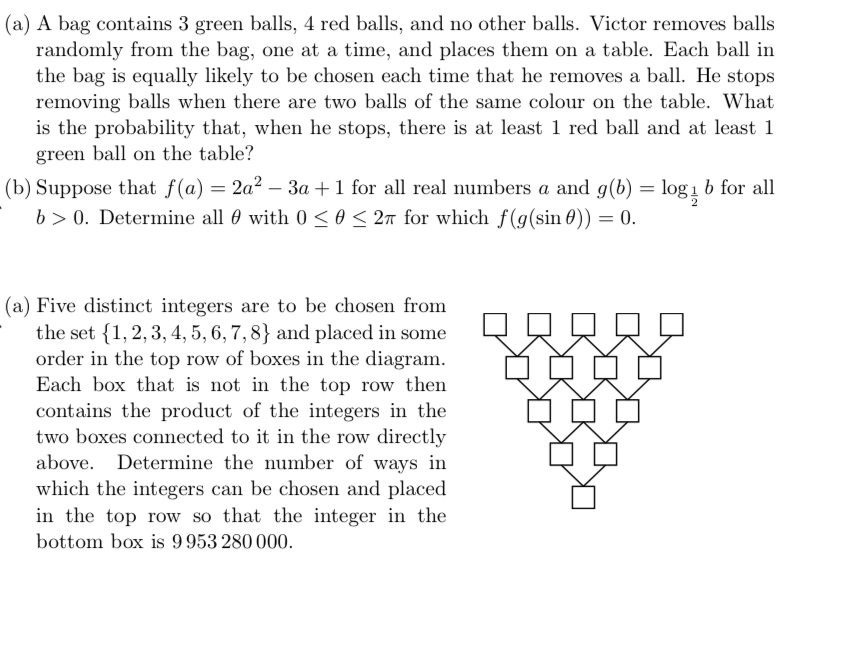
(a) A bag contains 3 green balls, 4 red balls, and no other balls. Victor removes balls randomly from the bag, one at a time, and places them on a table. Each ball in the bag is equally likely to be chosen each time that he removes a ball. He stops removing balls when there are two balls of the same colour on the table. What is the probability that, when he stops, there is at least 1 red ball and at least 1 green ball on the table? (b) Suppose that f(n.) = 2:12 3n + 1 for all real numbers a and gr) = log % h for all L l) > U. DBtermine all I? with U 3 l9 5 211' for which f(g(sin 3)) = U. (a) Five distinct integers are to be chosen from the set {1, 2, 3, 4, 5, 6, 7, 8} and placed in some order in the top row of boxes in the diagram. Each box that is not in the top row then contains the product of the integers in the two boxes connected to it in the row directly above. Determine the number of ways in which the integers can be chosen and placed in the top row so that the integer in the bottom box is 9953 280 000
Step by Step Solution
There are 3 Steps involved in it

Get step-by-step solutions from verified subject matter experts
 Study Help