





Question: Please answer the question in steps Consider a two-period (t and t +1) problem facing the representative household: ma (boc.) - **) - mc.) -
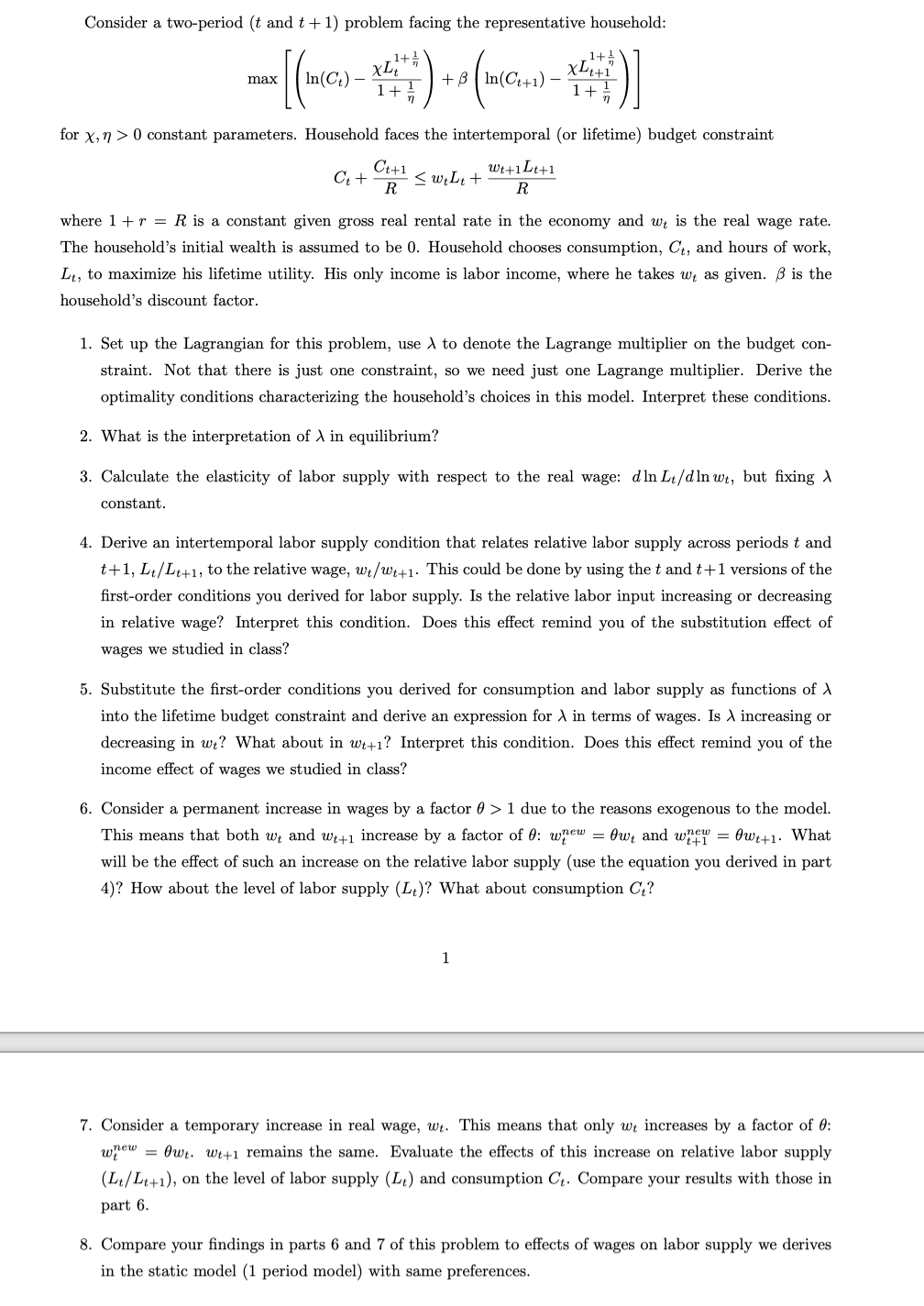
 Please answer the question in steps Consider a two-period (t and

Please answer the question in steps

Consider a two-period (t and t +1) problem facing the representative household: ma (boc.) - **) - mc.) - **)] [ ( 1+ XL 1+1 1+1 XLt+1 +B In(Ct+1) 1+ for X, n > 0 constant parameters. Household faces the intertemporal (or lifetime) budget constraint Ct+1 Wt+1Lt+1 Ct+ 1 due to the reasons exogenous to the model. This means that both wt and Wt+1 increase by a factor of 0: wrew = Owt and when = Owe+1. What will be the effect of such an increase on the relative labor supply (use the equation you derived in part 4)? How about the level of labor supply (Lt)? What about consumption C? 1 7. Consider a temporary increase in real wage, wt. This means that only wt increases by a factor of 0: wnew = Owt. Wt+1 remains the same. Evaluate the effects of this increase on relative labor supply (L/L4+1), on the level of labor supply (L) and consumption Ct. Compare your results with those in part 6. 8. Compare your findings in parts 6 and 7 of this problem to effects of wages on labor supply we derives in the static model (1 period model) with same preferences. Consider a two-period (t and t +1) problem facing the representative household: ma (boc.) - **) - mc.) - **)] [ ( 1+ XL 1+1 1+1 XLt+1 +B In(Ct+1) 1+ for X, n > 0 constant parameters. Household faces the intertemporal (or lifetime) budget constraint Ct+1 Wt+1Lt+1 Ct+ 1 due to the reasons exogenous to the model. This means that both wt and Wt+1 increase by a factor of 0: wrew = Owt and when = Owe+1. What will be the effect of such an increase on the relative labor supply (use the equation you derived in part 4)? How about the level of labor supply (Lt)? What about consumption C? 1 7. Consider a temporary increase in real wage, wt. This means that only wt increases by a factor of 0: wnew = Owt. Wt+1 remains the same. Evaluate the effects of this increase on relative labor supply (L/L4+1), on the level of labor supply (L) and consumption Ct. Compare your results with those in part 6. 8. Compare your findings in parts 6 and 7 of this problem to effects of wages on labor supply we derives in the static model (1 period model) with same preferences

Step by Step Solution

There are 3 Steps involved in it

1 Expert Approved Answer
Step: 1 Unlock blur-text-image
Question Has Been Solved by an Expert!

Get step-by-step solutions from verified subject matter experts

Step: 2 Unlock
Step: 3 Unlock

Students Have Also Explored These Related Accounting Questions!