







Question: please answer the question in the same format as the excel document thanks! Campbell Company manufactures and sells adjustable canopies that attach to motor homes
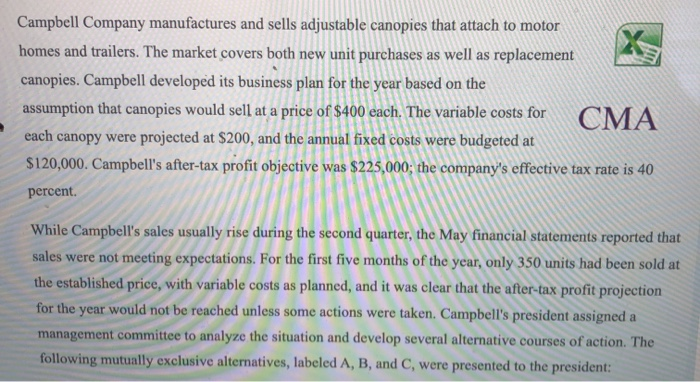
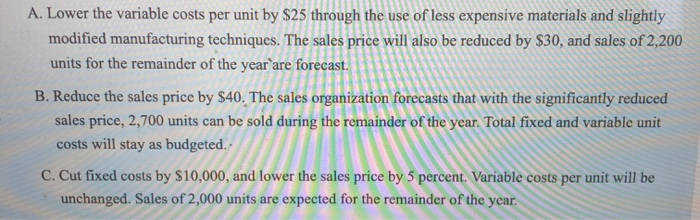
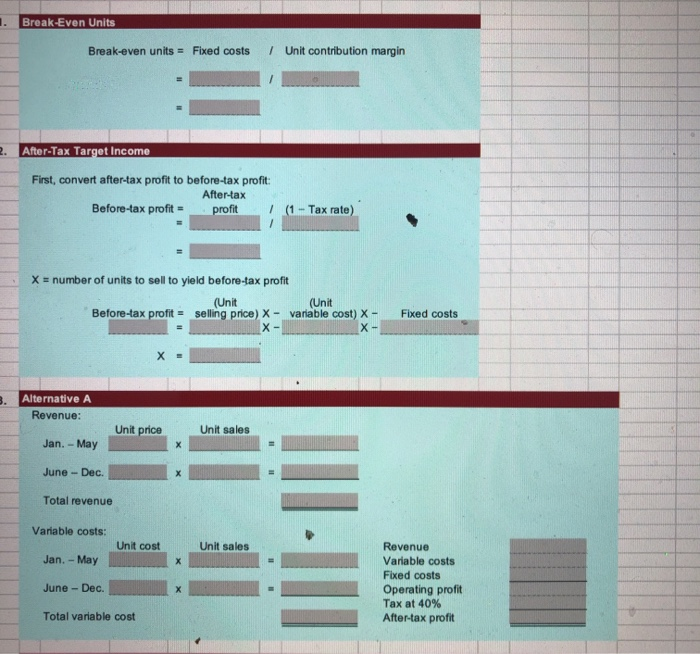
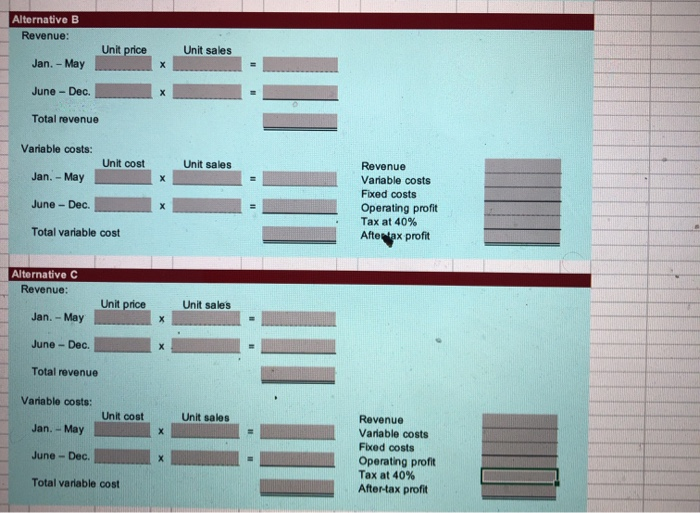
Campbell Company manufactures and sells adjustable canopies that attach to motor homes and trailers. The market covers both new unit purchases as well as replacement canopies. Campbell developed its business plan for the year based on the assumption that canopies would sell at a price of $400 each. The variable costs for each canopy were projected at $200, and the annual fixed costs were budgeted at $120,000. Campbell's after-tax profit objective was $225,000; the company's effective tax rate is 40 percent. While Campbell's sales usually rise during the second quarter, the May financial statements reported that sales were not meeting expectations. For the first five months of the year, only 350 units had been sold at the established price, with variable costs as planned, and it was clear that the after-tax profit projection for the year would not be reached unless some actions were taken. Campbell's president assigned a management committee to analyze the situation and develop several alternative courses of action. The following mutually exclusive alternatives, labeled A, B, and C, were presented to the president: A. Lower the variable costs per unit by $25 through the use of less expensive materials and slightly modified manufacturing techniques. The sales price will also be reduced by $30, and sales of 2,200 units for the remainder of the year are forecast. B. Reduce the sales price by $40. The sales organization forecasts that with the significantly reduced sales price, 2,700 units can be sold during the remainder of the year. Total fixed and variable unit costs will stay as budgeted. C. Cut fixed costs by $10,000, and lower the sales price by 5 percent. Variable costs per unit will be unchanged. Sales of 2,000 units are expected for the remainder of the year. 1. Break-Even Units Break-even units = Fixed costs 1 Unit contribution margin 2. After-Tax Target Income First, convert after-tax profit to before-tax profit: After-tax Before-tax profit profit 1 (1 - Tax rate) X = number of units to sell to yield before-tax profit (Unit (Unit Before-tax profit = selling price) - variable cost) X- X- X- Fixed costs X 3. Alternative A Revenue: Unit price Unit sales Jan. - May June - Dec. Total revenue Variable costs: Unit cost Unit sales Jan. - May June Dec. Revenue Variable costs Fixed costs Operating profit Tax at 40% After-tax profit Total variable cost Alternative B Revenue: Unit price Unit sales Jan. - May June - Dec. Total revenue Variable costs: Unit cost Unit sales Jan. - May June - Dec. Revenue Variable costs Fixed costs Operating profit Tax at 40% Aftentax profit Total variable cost Alternative C Revenue: Unit price Unit sales Jan. -May June - Dec. Total revenue Variable costs: Unit cost Unit sales Jan. - May X June - Dec. X Revenue Variable costs Fixed costs Operating profit Tax at 40% After-tax profit Total variable cost
Step by Step Solution
There are 3 Steps involved in it

Get step-by-step solutions from verified subject matter experts
 Study Help