







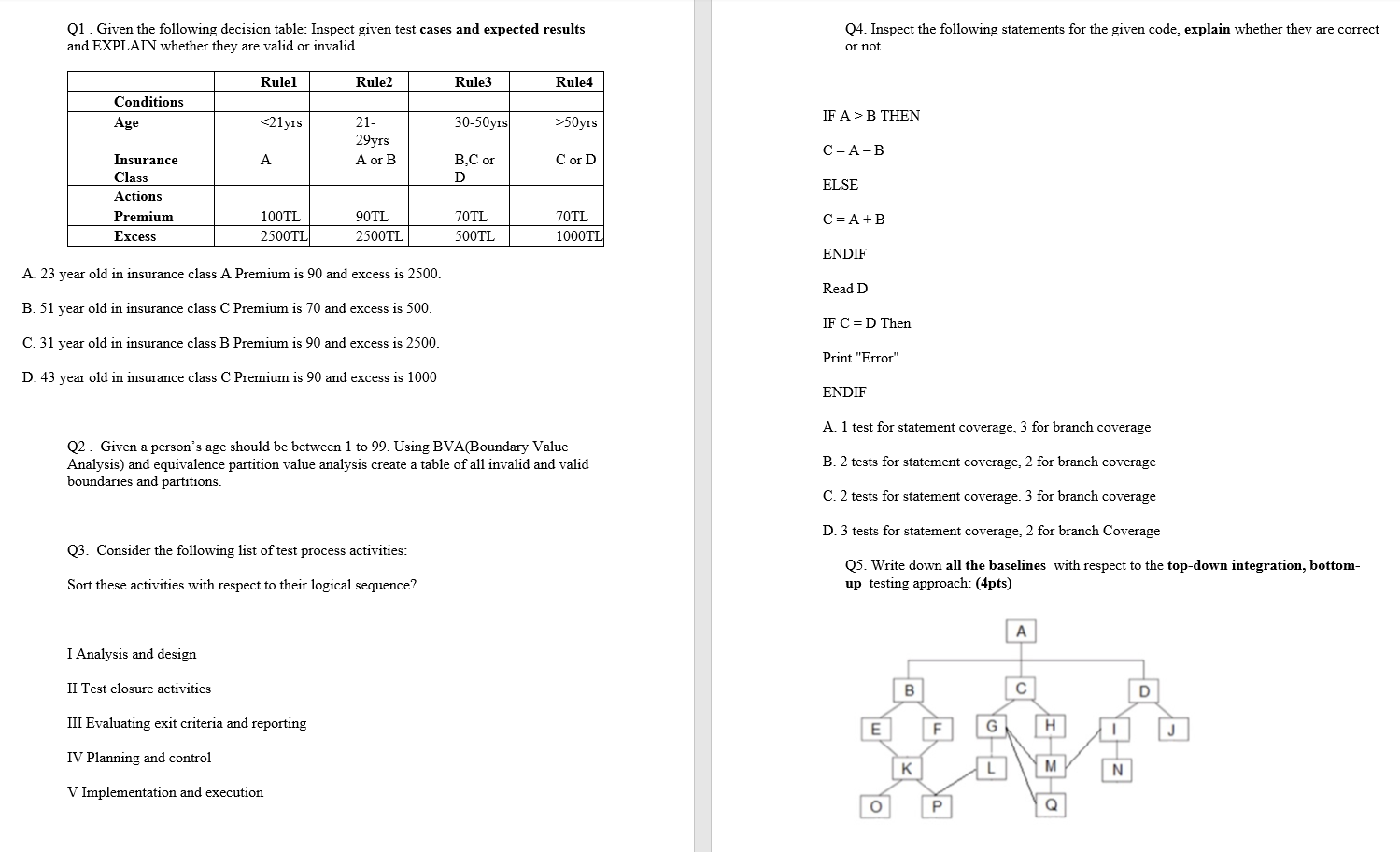
Question: Please answer the question Q1. Given the following decision table: Inspect given test cases and expected results and EXPLAIN whether they are valid or invalid.
Please answer the question
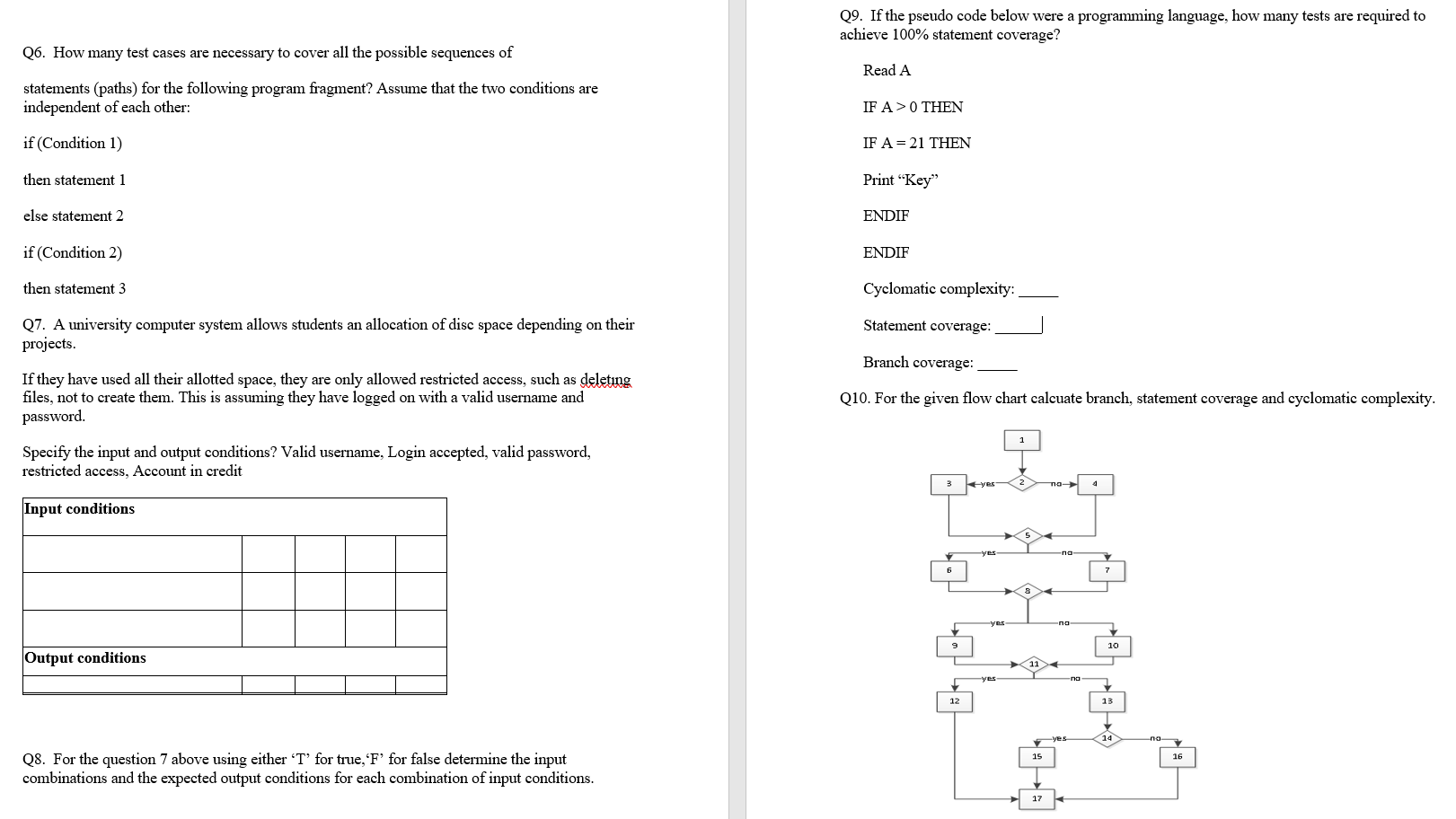
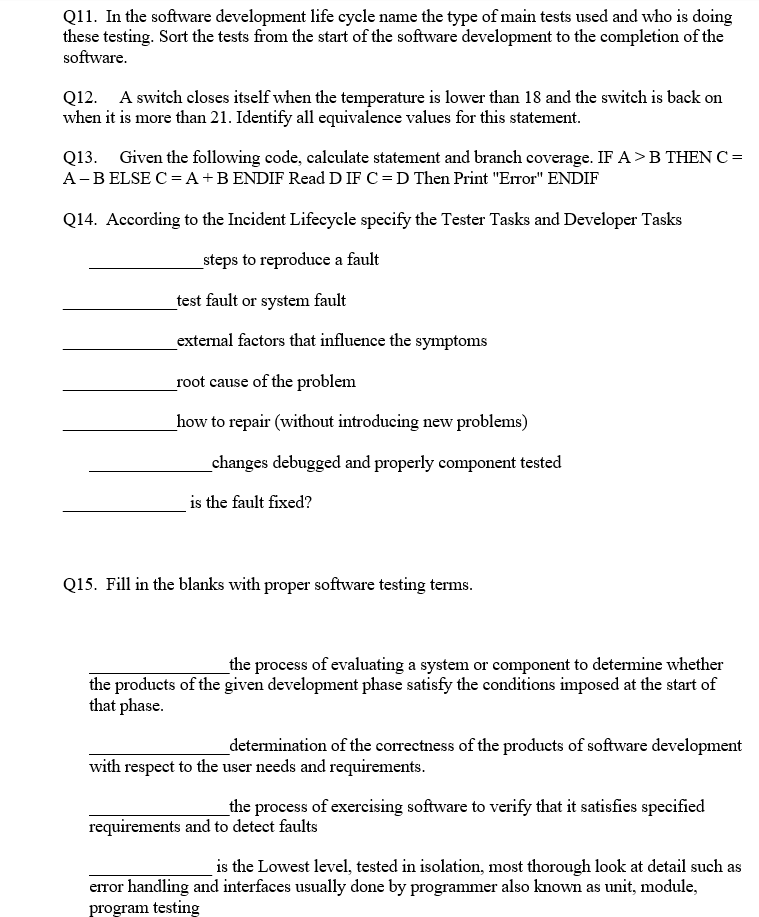
Q1. Given the following decision table: Inspect given test cases and expected results and EXPLAIN whether they are valid or invalid. Q4. Inspect the following statements for the given code, explain whether they are correct or not. Rulel Rule2 Rule3 Rule4 Conditions Age 50yrs IF A>B THEN 21- 29yrs A or B C=A-B A C or D B,C or D ELSE Insurance Class Actions Premium Excess 100TL 2500TL 90TL 2500TL 70TL 500TL C=A+B 70TL 1000TL ENDIF A. 23 year old in insurance class A Premium is 90 and excess is 2500. Read D B. 51 year old in insurance class C Premium is 70 and excess is 500. IF C=D Then C. 31 year old in insurance class B Premium is 90 and excess is 2500. Print "Error" D. 43 year old in insurance class C Premium is 90 and excess is 1000 ENDIF A. 1 test for statement coverage, 3 for branch coverage Q2. Given a person's age should be between 1 to 99. Using BVA(Boundary Value Analysis) and equivalence partition value analysis create a table of all invalid and valid boundaries and partitions. B. 2 tests for statement coverage, 2 for branch coverage C. 2 tests for statement coverage. 3 for branch coverage D. 3 tests for statement coverage, 2 for branch Coverage Q3. Consider the following list of test process activities: Sort these activities with respect to their logical sequence? Q5. Write down all the baselines with respect to the top-down integration, bottom- up testing approach: (4pts) A I Analysis and design II Test closure activities B D III Evaluating exit criteria and reporting F E G H J HO IV Planning and control K M N V Implementation and execution Yo UK Q 09. If the pseudo code below were a programming language, how many tests are required to achieve 100% statement coverage? Q6. How many test cases are necessary to cover all the possible sequences of Read A statements (paths) for the following program fragment? Assume that the two conditions are independent of each other: IF A> 0 THEN if (Condition 1) IF A = 21 THEN then statement 1 Print "Key" else statement 2 ENDIF if (Condition 2) ENDIF then statement 3 Cyclomatic complexity: Statement coverage: Branch coverage: Q7. A university computer system allows students an allocation of disc space depending on their projects. If they have used all their allotted space, they are only allowed restricted access, such as deleting files, not to create them. This is assuming they have logged on with a valid username and password. Q10. For the given flow chart calcuate branch, statement coverage and cyclomatic complexity. Specify the input and output conditions? Valid username, Login accepted, valid password, restricted access, Account in credit Input conditions 7 9 10 Output conditions yes na 12 13 VE 14 na 15 16 Q8. For the question 7 above using either T' for true, 'F' for false determine the input combinations and the expected output conditions for each combination of input conditions. 17 Q11. In the software development life cycle name the type of main tests used and who is doing these testing. Sort the tests from the start of the software development to the completion of the software. Q12. A switch closes itself when the temperature is lower than 18 and the switch is back on when it is more than 21. Identify all equivalence values for this statement. Q13. Given the following code, calculate statement and branch coverage. IF A>B THEN C = A-B ELSE C=A+B ENDIF Read D IF C=D Then Print "Error" ENDIF Q14. According to the Incident Lifecycle specify the Tester Tasks and Developer Tasks _steps to reproduce a fault test fault or system fault external factors that influence the symptoms root cause of the problem how to repair (without introducing new problems) changes debugged and properly component tested is the fault fixed? Q15. Fill in the blanks with proper software testing terms. the process of evaluating a system or component to determine whether the products of the given development phase satisfy the conditions imposed at the start of that phase. _determination of the correctness of the products of software development with respect to the user needs and requirements. _the process of exercising software to verify that it satisfies specified requirements and to detect faults is the Lowest level, tested in isolation, most thorough look at detail such as error handling and interfaces usually done by programmer also known as unit, module, program testing
Step by Step Solution
There are 3 Steps involved in it

Get step-by-step solutions from verified subject matter experts
 Study Help