







Question: please answer the question with explanation We have seen in Lecture 1 that if we colour the edges of the complete graph K. on six
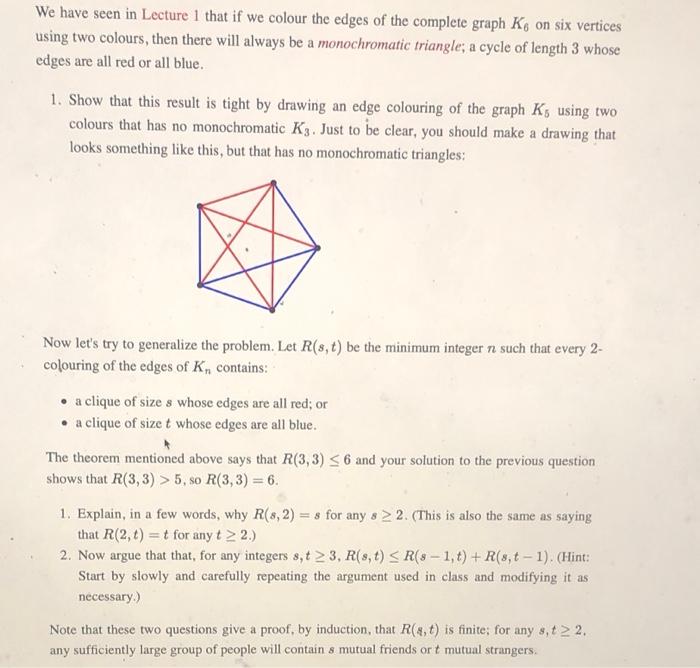
We have seen in Lecture 1 that if we colour the edges of the complete graph K. on six vertices using two colours, then there will always be a monochromatic triangle; a cycle of length 3 whose edges are all red or all blue. 1. Show that this result is tight by drawing an edge colouring of the graph Ks using two colours that has no monochromatic K3. Just to be clear, you should make a drawing that looks something like this, but that has no monochromatic triangles: Now let's try to generalize the problem. Let R(s, t) be the minimum integer n such that every 2- colouring of the edges of K, contains: a clique of size 8 whose edges are all red; or a clique of size t whose edges are all blue. The theorem mentioned above says that R(3, 3) 5, so R(3,3) = 6. 1. Explain, in a few words, why R(8, 2) = 8 for any 8 > 2. (This is also the same as saying that R(2,6) = t for any t > 2.) 2. Now argue that that, for any integers 8,t > 3, R(s, t)
Step by Step Solution
There are 3 Steps involved in it

Get step-by-step solutions from verified subject matter experts
 Study Help