







Question: Please answer the questions below Question 1: When comparing the means of two populations we can construct a condence interval using which 3 assumptions (choose
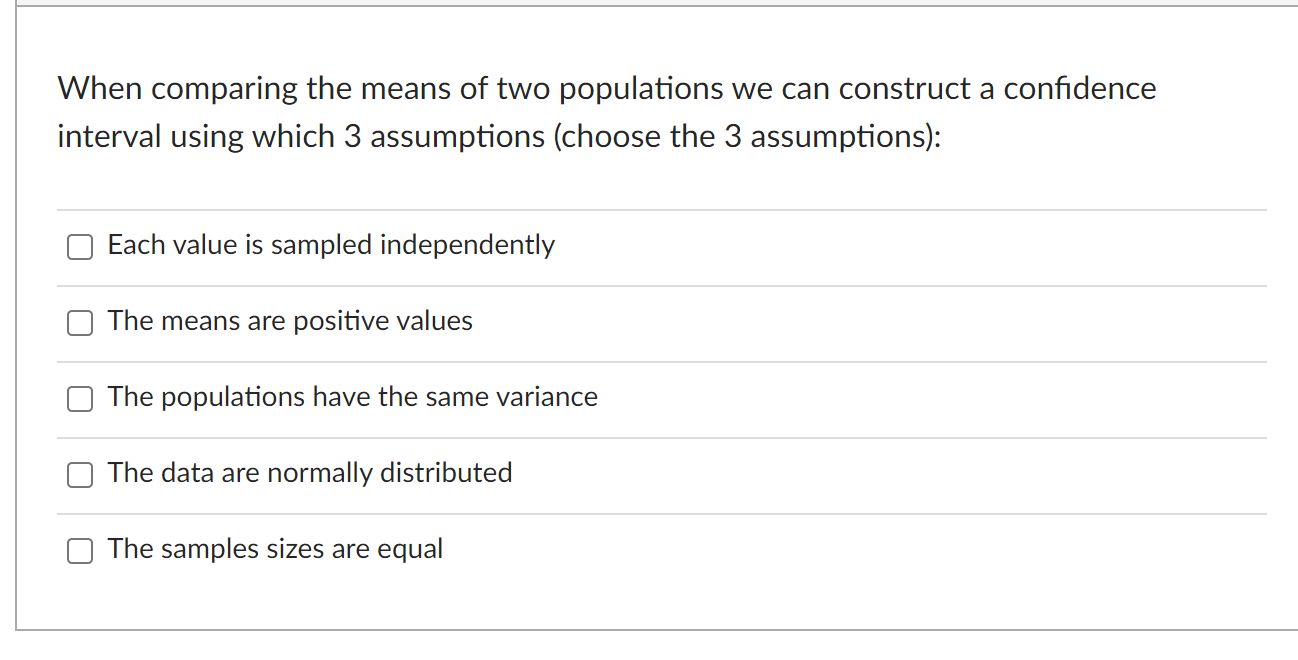
![(choose the 3 assumptions): C] Each value is sampled independently C] The](https://s3.amazonaws.com/si.experts.images/answers/2024/06/666850c46c621_452666850c45023c.jpg)
Please answer the questions below
Question 1:
![means are positive values C] The populations have the same variance C]](https://s3.amazonaws.com/si.experts.images/answers/2024/06/666850c4b43b1_452666850c4a5a57.jpg)
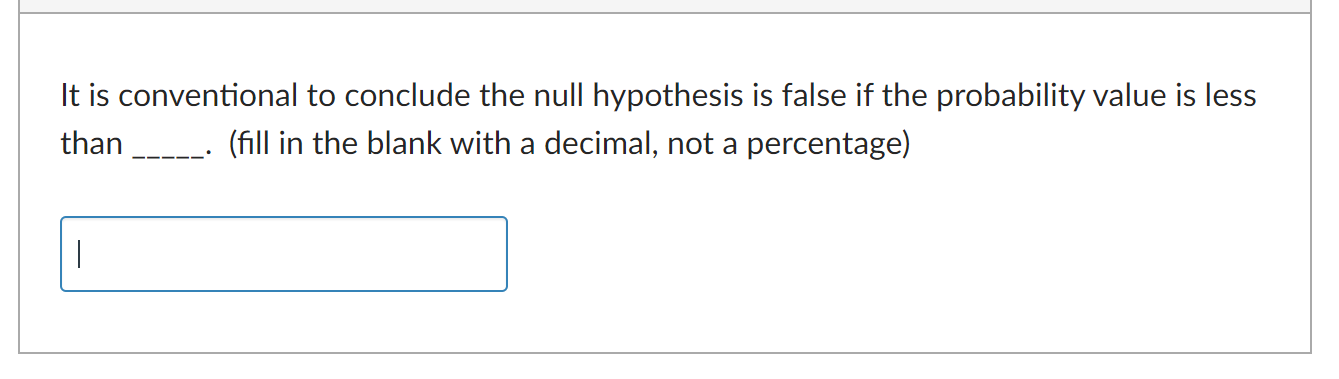
![The data are normally distributed C] The samples sizes are equal It](https://s3.amazonaws.com/si.experts.images/answers/2024/06/666850c521bb6_453666850c50bdd8.jpg)
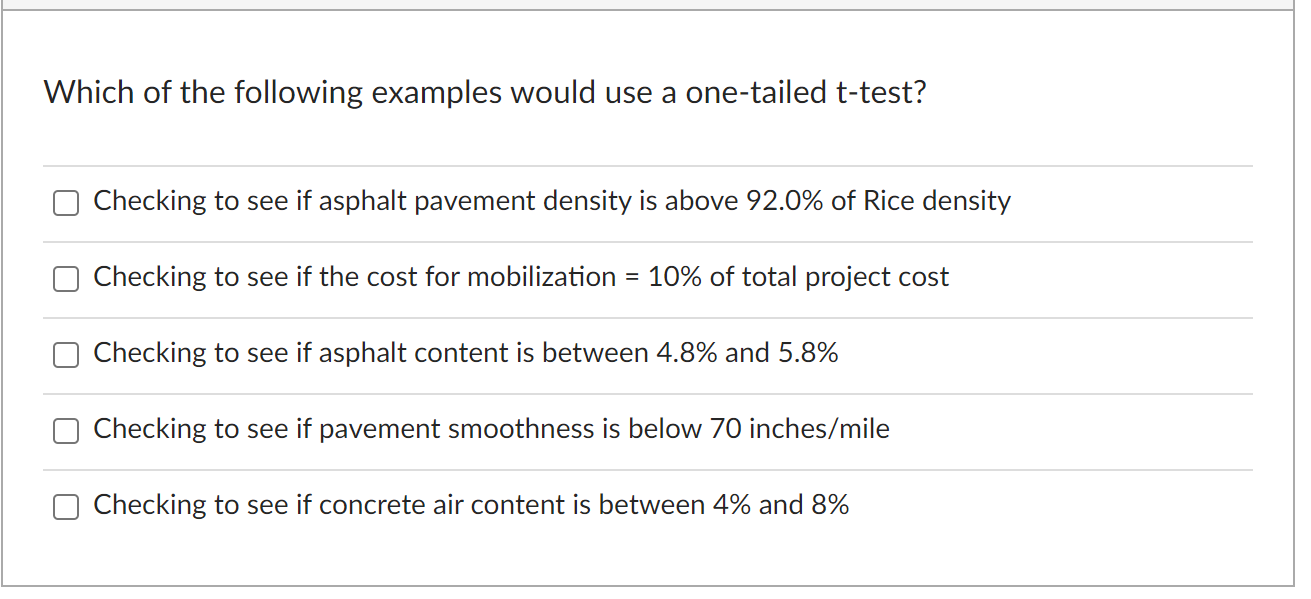
When comparing the means of two populations we can construct a condence interval using which 3 assumptions (choose the 3 assumptions): C] Each value is sampled independently C] The means are positive values C] The populations have the same variance C] The data are normally distributed C] The samples sizes are equal It is conventional to conclude the null hypothesis is false if the probability value is less than _____ . (ll in the blank with a decimal, not a percentage) Which of the following examples would use a one-tailed t-test? C] Checking to see if asphalt pavement density is above 92.0% of Rice density C] Checking to see if the cost for mobilization = 10% of total project cost C] Checking to see if asphalt content is between 4.8% and 5.8% C] Checking to see if pavement smoothness is below 70 inches/mile C] Checking to see if concrete air content is between 4% and 8%
Step by Step Solution
There are 3 Steps involved in it

Get step-by-step solutions from verified subject matter experts
 Study Help