







Question: Please answer the questions listed. D Pie Chart 6. Perform an error calculation and discuss possible sources of error. Speed Speed Stick to Track 7.2
Please answer the questions listed.
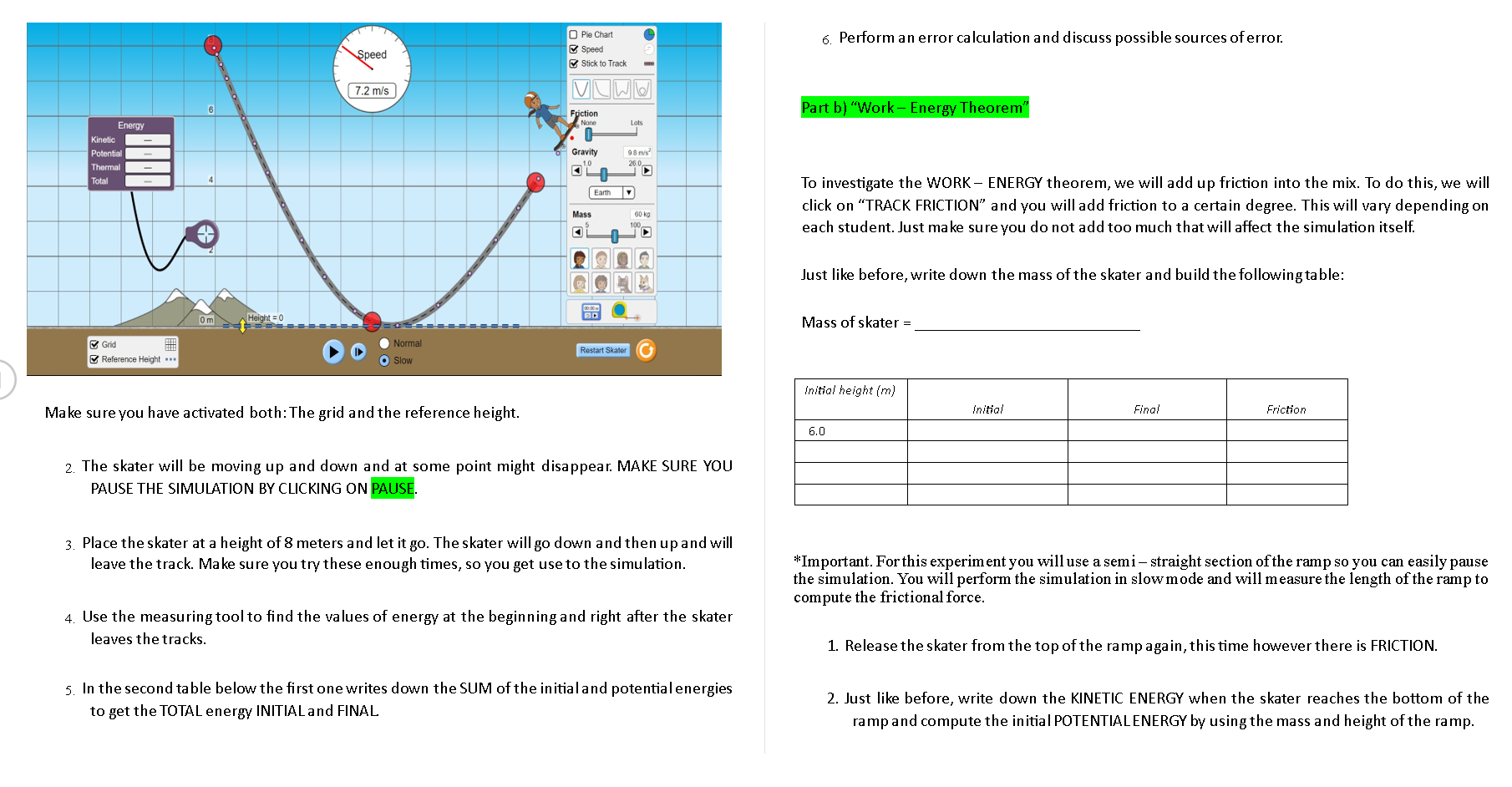
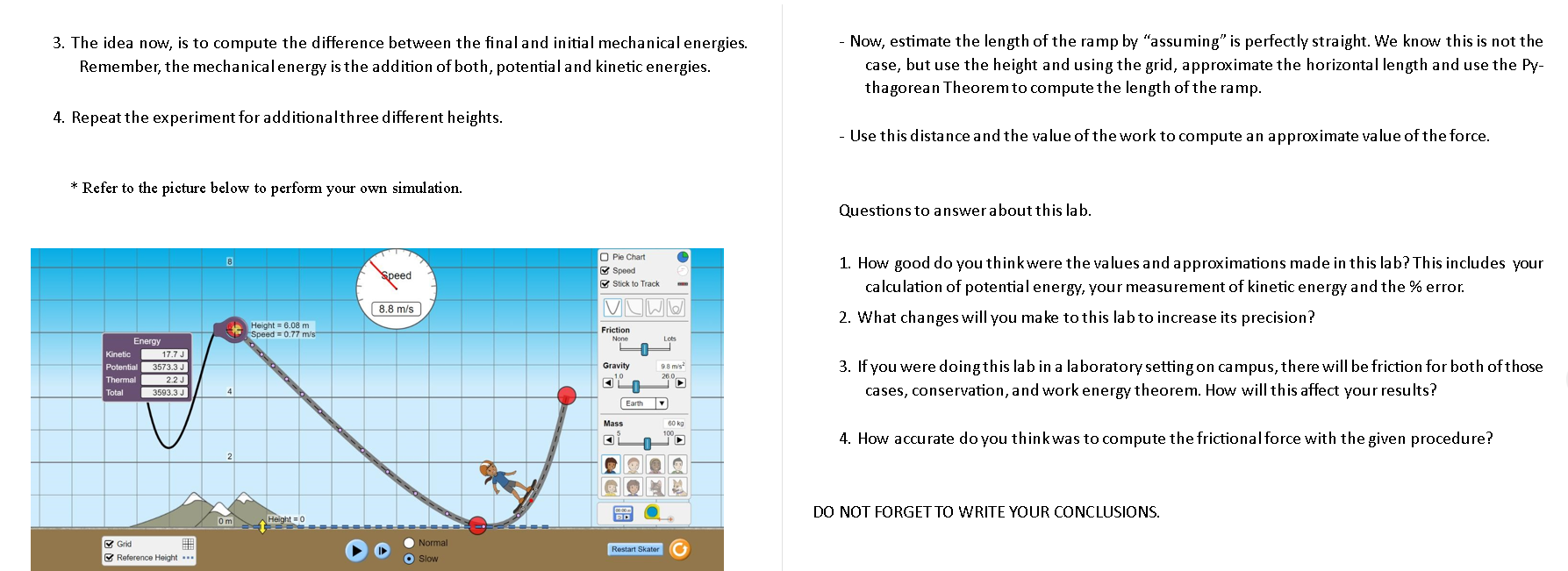
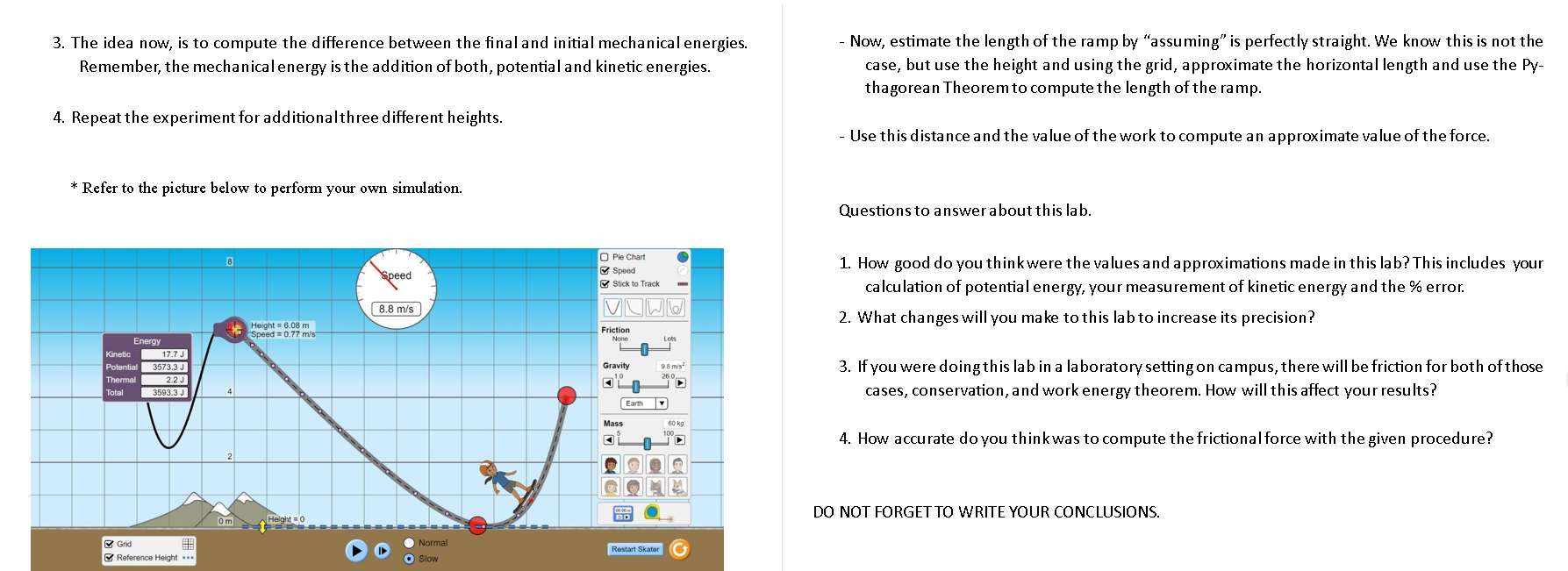
D Pie Chart 6. Perform an error calculation and discuss possible sources of error. Speed Speed Stick to Track 7.2 m/s 6 Friction Part b) "Work- Energy Theorem" Energy None Lots Kinetic Potential Gravity 98 mis Thermal 260 Total Earth To investigate the WORK - ENERGY theorem, we will add up friction into the mix. To do this, we will Mass 60 kg click on "TRACK FRICTION" and you will add friction to a certain degree. This will vary depending on each student. Just make sure you do not add too much that will affect the simulation itself. Just like before, write down the mass of the skater and build the following table: om Height =0 Mass of skater = Grid Normal Restart Skater Reference Height ... Slow Initial height (m) Make sure you have activated both: The grid and the reference height. Initial Final Friction 6.0 2. The skater will be moving up and down and at some point might disappear. MAKE SURE YOU PAUSE THE SIMULATION BY CLICKING ON PAUSE. 3. Place the skater at a height of 8 meters and let it go. The skater will go down and then up and will leave the track. Make sure you try these enough times, so you get use to the simulation. *Important. For this experiment you will use a semi - straight section of the ramp so you can easily pause the simulation. You will perform the simulation in slow mode and will measure the length of the ramp to compute the frictional force. 4. Use the measuring tool to find the values of energy at the beginning and right after the skater leaves the tracks. 1. Release the skater from the top of the ramp again, this time however there is FRICTION. 5. In the second table below the first one writes down the SUM of the initial and potential energies 2. Just like before, write down the KINETIC ENERGY when the skater reaches the bottom of the to get the TOTAL energy INITIAL and FINAL ramp and compute the initial POTENTIAL ENERGY by using the mass and height of the ramp.3. The idea now, is to compute the difference between the final and initial mechanical energies. Now, estimate the length of the ramp by "assuming" is perfectly straight. We know this is not the Remember, the mechanical energy is the addition of both, potential and kinetic energies. case, but use the height and using the grid, approximate the horizontal length and use the Py- thagorean Theorem to compute the length of the ramp. 4. Repeat the experiment for additional three different heights. - Use this distance and the value of the work to compute an approximate value of the force. * Refer to the picture below to perform your own simulation. Questions to answer about this lab. 8 Pie Chart Speed Speed 1. How good do you think were the values and approximations made in this lab? This includes your Stick to Track calculation of potential energy, your measurement of kinetic energy and the % error. 8.8 m/s Height = 6.08 m 2. What changes will you make to this lab to increase its precision? Speed = 0.77 mis Friction Energy None Kinetic 17.7 J Potential 3573.3 J Gravity 98 m/'s 3. If you were doing this lab in a laboratory setting on campus, there will be friction for both of those Thermal 2.2J 260 Total 3593.3 J cases, conservation, and work energy theorem. How will this affect your results? Earth Mass 60 kg 4. How accurate do you think was to compute the frictional force with the given procedure? Height = 0 DO NOT FORGET TO WRITE YOUR CONCLUSIONS. Grid Normal Reference Height . .. Restart Skater Slow
Step by Step Solution
There are 3 Steps involved in it

Get step-by-step solutions from verified subject matter experts
 Study Help