







Question: Please answer the questions step by step and answer all parts with clear answer Question 2 6 reporters Adam (A), Becky (B), Chris (C), David
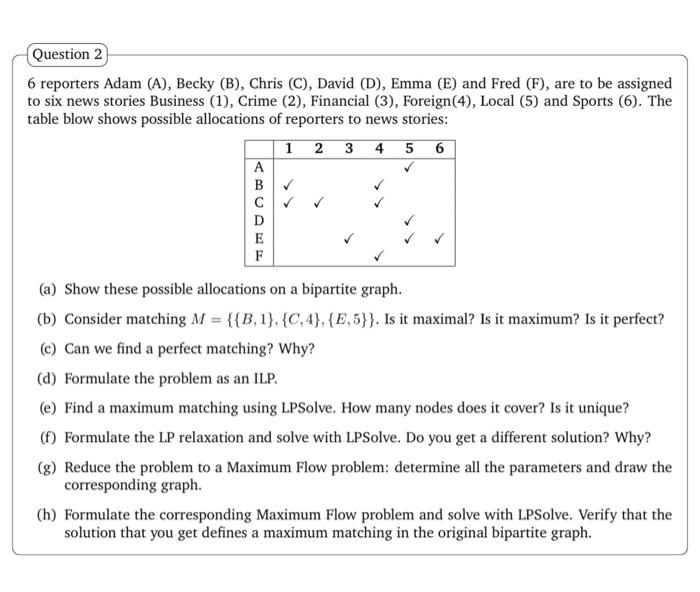
Question 2 6 reporters Adam (A), Becky (B), Chris (C), David (D), Emma (E) and Fred (F), are to be assigned to six news stories Business (1), Crime (2), Financial (3), Foreign(4), Local (5) and Sports (6). The table blow shows possible allocations of reporters to news stories: 1 2 3 4 5 6 A B C D E F (a) Show these possible allocations on a bipartite graph. (b) Consider matching M = {{B,1},{C,4}, {E,5}}. Is it maximal? Is it maximum? Is it perfect? (c) Can we find a perfect matching? Why? (d) Formulate the problem as an ILP. (e) Find a maximum matching using LPSolve. How many nodes does it cover? Is it unique? (f) Formulate the LP relaxation and solve with LPSolve. Do you get a different solution? Why? (g) Reduce the problem to a Maximum Flow problem: determine all the parameters and draw the corresponding graph. (h) Formulate the corresponding Maximum Flow problem and solve with LPSolve. Verify that the solution that you get defines a maximum matching in the original bipartite graph. Question 2 6 reporters Adam (A), Becky (B), Chris (C), David (D), Emma (E) and Fred (F), are to be assigned to six news stories Business (1), Crime (2), Financial (3), Foreign(4), Local (5) and Sports (6). The table blow shows possible allocations of reporters to news stories: 1 2 3 4 5 6 A B C D E F (a) Show these possible allocations on a bipartite graph. (b) Consider matching M = {{B,1},{C,4}, {E,5}}. Is it maximal? Is it maximum? Is it perfect? (c) Can we find a perfect matching? Why? (d) Formulate the problem as an ILP. (e) Find a maximum matching using LPSolve. How many nodes does it cover? Is it unique? (f) Formulate the LP relaxation and solve with LPSolve. Do you get a different solution? Why? (g) Reduce the problem to a Maximum Flow problem: determine all the parameters and draw the corresponding graph. (h) Formulate the corresponding Maximum Flow problem and solve with LPSolve. Verify that the solution that you get defines a maximum matching in the original bipartite graph
Step by Step Solution
There are 3 Steps involved in it

Get step-by-step solutions from verified subject matter experts
 Study Help