







Question: Please answer the questions with formula which can show the steps (*Not excel) The Evergreen Chemical Corporation, established in 1990, has managed to earn a
Please answer the questions with formula which can show the steps (*Not excel)
The Evergreen Chemical Corporation, established in 1990, has managed to earn a consistently high rate of return on its investments. The secret of its success has been the strategic and timely development, manufacturing, and marketing of innovative chemical products that have been used in various industries. Currently, the management of the company is considering the manufacture of a thermosetting resin as packaging material for mobile devices. The Company's Research and Development Department has come up with two alternatives: an epoxy resin, which would have a lower startup cost, and a synthetic resin, which would cost more to produce initially but would have greater economies of scale. At the initial presentation, the project leaders of both teams presented their cash flow projections and provided sufficient documentation in support of their proposals. However, since the products are mutually exclusive, the firm can only fund one proposal.
In order to resolve this dilemma, Tim Lui, the Assistant Treasurer, and a recent MBA from a prestigious university has been assigned the task of analyzing the costs and benefits of the two proposals and presenting his findings to the board of directors. Tim knows that this will be a difficult task, since the board members are not all familiar with financial concepts. The Board has historically had a strong preference for using rates of return as its decision criteria. On occasions it has also used the payback period approach to decide between competing projects when they are close competitors. However, Tim is convinced that the net present value (NPV) method is the best and when used correctly will always create the most value to the company.
After obtaining the cash flow projections for each project (see Tables 1 & 2), and crunching out the numbers, Tim realizes that the presentation is more difficult than he thought. The various capital budgeting techniques, when applied to the two series of cash flows, provide inconsistent results. The project with the higher NPV has a longer payback period, as well as a lower Internal Rate of Return (lRR). Tim scratches his head, wondering how he can convince the Board that the IRR and Payback Period can often lead to incorrect decisions.
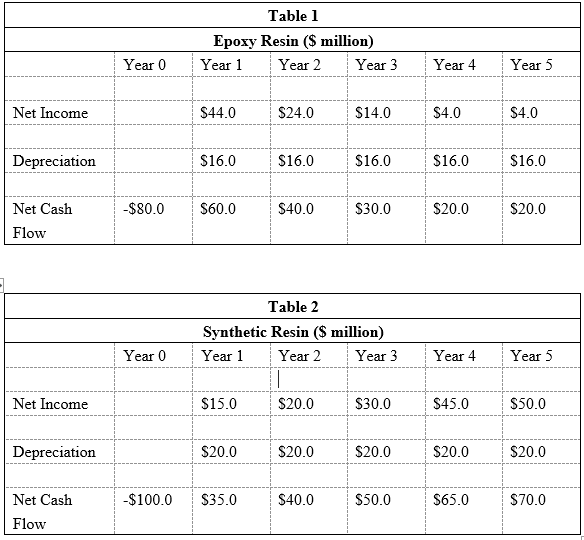
Required:
1. Calculate the Payback Period of each project. Explain what argument Tim should make to show that the Payback Period is not appropriate in this case.
2. Calculate the Discounted Payback Period (DPP) using 10% as the discount rate. Should Tim ask the Board to use DPP as the deciding factor? Explain.
3. Calculate the two projects' IRR. How should Tim convince the Board that the IRR measure could be misleading?
4. Calculate the NPV profiles for the two projects and explain the relevance of the crossover point. How should Tim convince the Board that the NPV method is the way to go?
Table 1 Epoxy Resin ($ million) Year 1 Year 2 Year 3 Year 0 Year 4 Year 5 Net Income $44.0 $24.0 $14.0 $4.0 $4.0 Depreciation $16.0 $16.0 $16.0 $16.0 $16.0 $80.0 $60.0 $40.0 $30.0 $20.0 $20.0 Net Cash Flow Table 2 Synthetic Resin ($ million) Year 1 Year 2 Year 3 Year 0 Year 4 Year 5 Net Income $15.0 $20.0 $30.0 $45.0 $50.0 Depreciation $20.0 $20.0 $20.0 $20.0 $20.0 Net Cash $100.0 $35.0 $40.0 $50.0 $65.0 $70.0 Flow
Step by Step Solution
There are 3 Steps involved in it

Get step-by-step solutions from verified subject matter experts
 Study Help