







Question: Please answer the second part of the question, the answer for the first one is the borrowed reserve(BR) is $141, 428 billion and money base(MB)
Please answer the second part of the question, the answer for the first one is the borrowed reserve(BR) is $141, 428 billion and money base(MB) is $1131.428 billion.
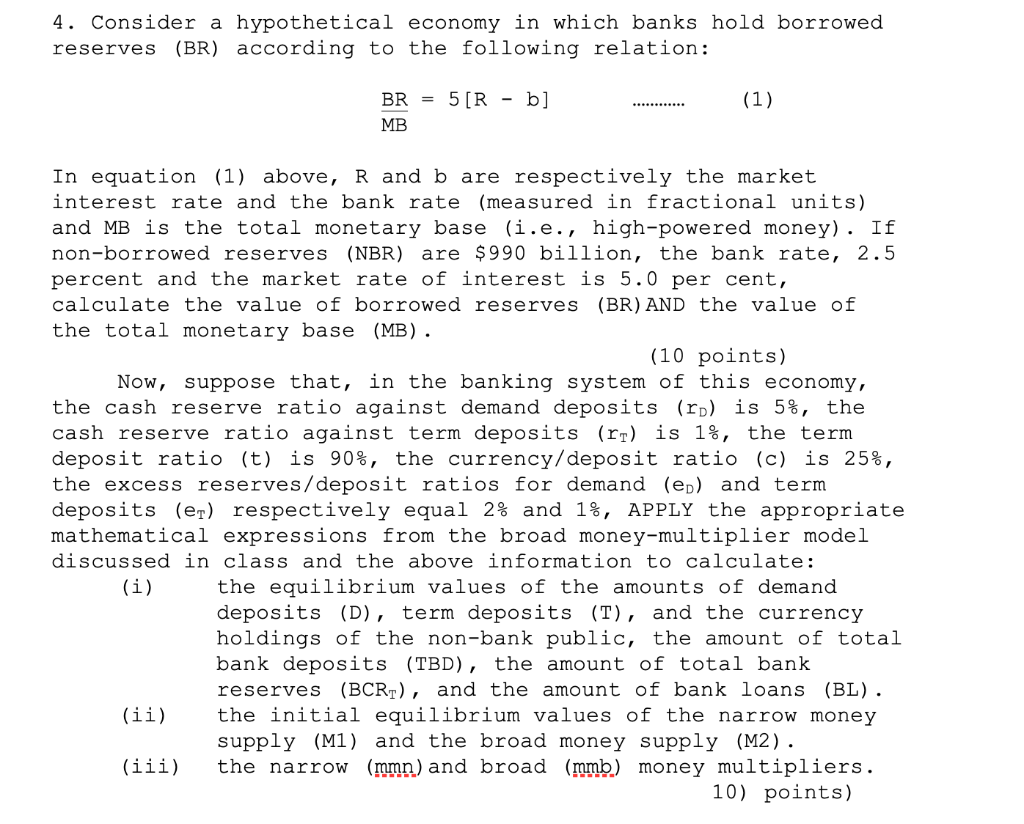
4. Consider a hypothetical economy in which banks hold borrowed reserves (BR) according to the following relation: ....... BR = 5[R - b] MB (1) In equation (1) above, R and b are respectively the market interest rate and the bank rate (measured in fractional units) and MB is the total monetary base (i.e., high-powered money). If non-borrowed reserves (NBR) are $990 billion, the bank rate, 2.5 percent and the market rate of interest is 5.0 per cent, calculate the value of borrowed reserves (BR) AND the value of the total monetary base (MB). (10 points) Now, suppose that, in the banking system of this economy, the cash reserve ratio against demand deposits (rp) is 5%, the cash reserve ratio against term deposits (r) is 1%, the term deposit ratio (t) is 90%, the currency/deposit ratio (c) is 25%, the excess reserves/deposit ratios for demand (ep) and term deposits (er) respectively equal 2% and 1%, APPLY the appropriate mathematical expressions from the broad money-multiplier model discussed in class and the above information to calculate: (i) the equilibrium values of the amounts of demand deposits (D), term deposits (T), and the currency holdings of the non-bank public, the amount of total bank deposits (TBD), the amount of total bank reserves (BCRT), and the amount of bank loans (BL). (ii) the initial equilibrium values of the narrow money supply (M1) and the broad money supply (M2). (iii) the narrow (mmn) and broad (mmb) money multipliers. 10) points) 4. Consider a hypothetical economy in which banks hold borrowed reserves (BR) according to the following relation: ....... BR = 5[R - b] MB (1) In equation (1) above, R and b are respectively the market interest rate and the bank rate (measured in fractional units) and MB is the total monetary base (i.e., high-powered money). If non-borrowed reserves (NBR) are $990 billion, the bank rate, 2.5 percent and the market rate of interest is 5.0 per cent, calculate the value of borrowed reserves (BR) AND the value of the total monetary base (MB). (10 points) Now, suppose that, in the banking system of this economy, the cash reserve ratio against demand deposits (rp) is 5%, the cash reserve ratio against term deposits (r) is 1%, the term deposit ratio (t) is 90%, the currency/deposit ratio (c) is 25%, the excess reserves/deposit ratios for demand (ep) and term deposits (er) respectively equal 2% and 1%, APPLY the appropriate mathematical expressions from the broad money-multiplier model discussed in class and the above information to calculate: (i) the equilibrium values of the amounts of demand deposits (D), term deposits (T), and the currency holdings of the non-bank public, the amount of total bank deposits (TBD), the amount of total bank reserves (BCRT), and the amount of bank loans (BL). (ii) the initial equilibrium values of the narrow money supply (M1) and the broad money supply (M2). (iii) the narrow (mmn) and broad (mmb) money multipliers. 10) points)
Step by Step Solution
There are 3 Steps involved in it

Get step-by-step solutions from verified subject matter experts
 Study Help