Question: Please answer these questions clearly with a box around the answer. fThe dilferential operator D2 7 121) + 37 has the form D2 7 20D

Please answer these questions clearly with a box around the answer.
Please answer these questions clearly with a boxPlease answer these questions clearly with a boxPlease answer these questions clearly with a boxPlease answer these questions clearly with a boxPlease answer these questions clearly with a box
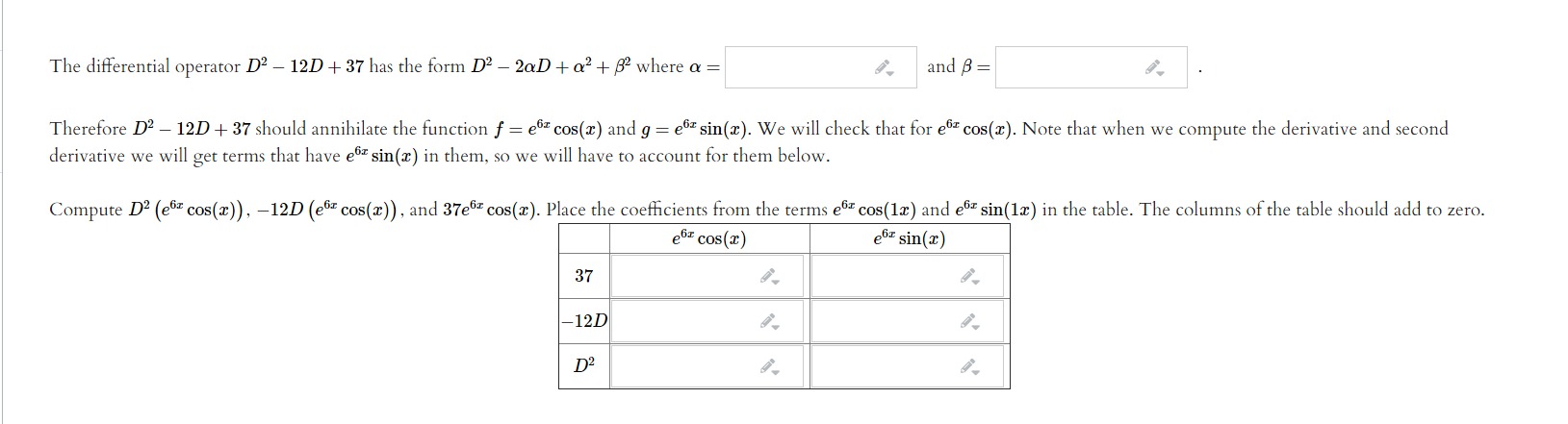
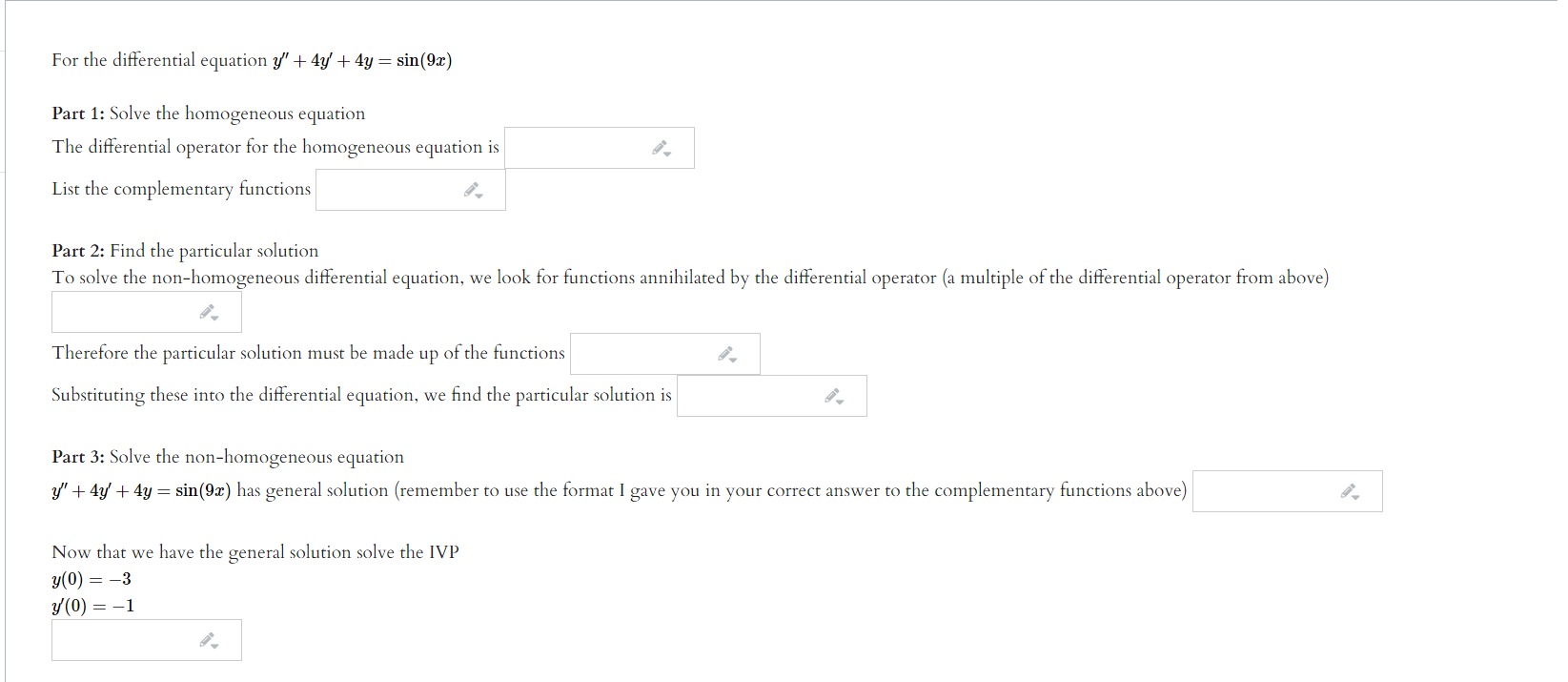
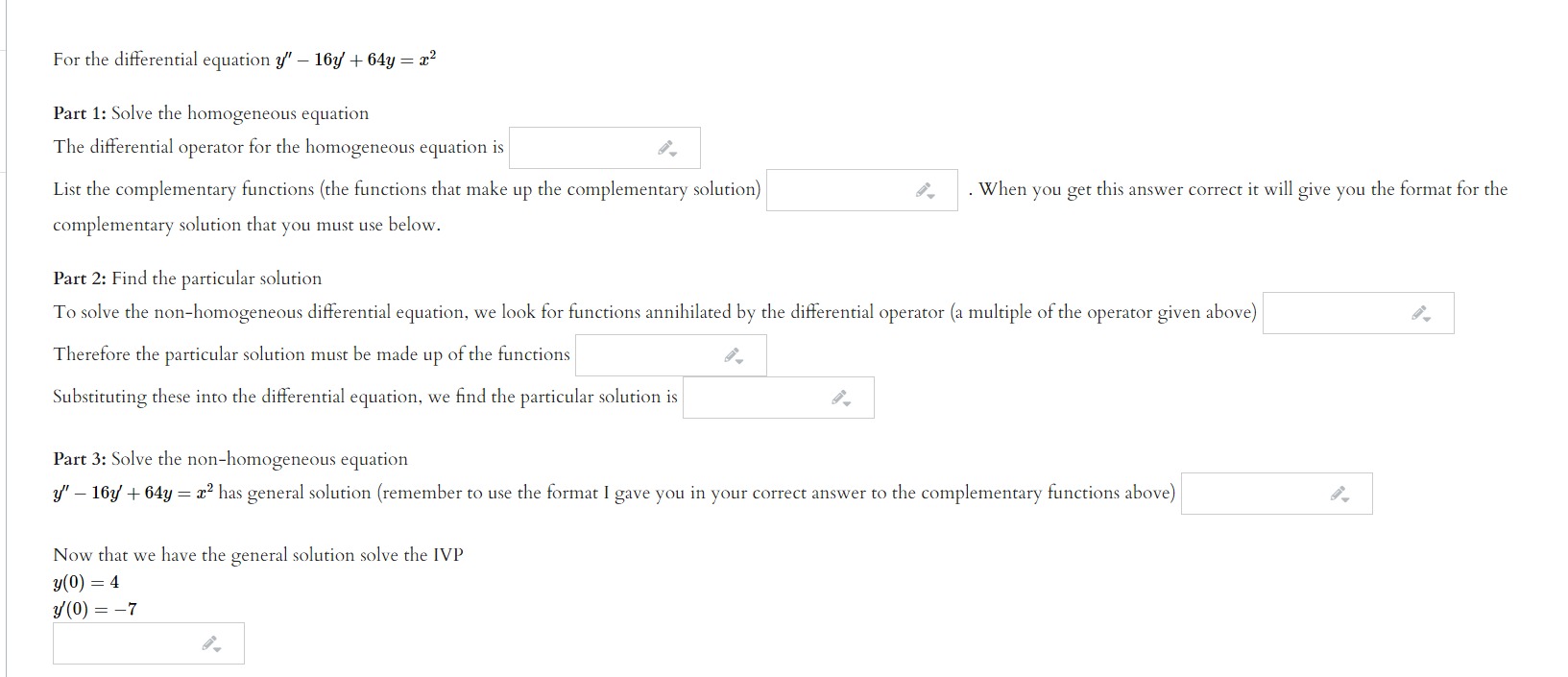
\fThe dilferential operator D2 7 121) + 37 has the form D2 7 20D + a2 + E where a = 9', and:' 9', Therefore D2 12D + 37 should annihilate the function f : e6: cos(:z:) and g : 26" sin(:z:). We will check that for 26': (235(3). Note that when we compute the derivative and second derivative we will get terms that have e"n sin(:) in them, so we will have to account for them below. Compute D2 (26" 005(3)), 71213 (95' 005(3)), and 3795' 005(3). Place the coefcients from the terms 96' 00302:) and ea: sinum) in the table. The columns ofthe table shnuld add to zero. 126" c.0507} er" sin(:r) 37 i. f. 12D .4' D2 i. .e. For the differential equation y" + 4y' + 4y = sin(9x) Part 1: Solve the homogeneous equation The differential operator for the homogeneous equation is List the complementary functions Part 2: Find the particular solution To solve the non-homogeneous differential equation, we look for functions annihilated by the differential operator (a multiple of the differential operator from above) Therefore the particular solution must be made up of the functions Substituting these into the differential equation, we find the particular solution is Part 3: Solve the non-homogeneous equation y" + 4y' + 4y = sin(9r) has general solution (remember to use the format I gave you in your correct answer to the complementary functions above) Now that we have the general solution solve the IVP y(0) = -3 y (0) = -1For the differential equation y" - 16y + 64y = 22 Part 1: Solve the homogeneous equation The differential operator for the homogeneous equation is List the complementary functions (the functions that make up the complementary solution) . When you get this answer correct it will give you the format for the complementary solution that you must use below. Part 2: Find the particular solution To solve the non-homogeneous differential equation, we look for functions annihilated by the differential operator (a multiple of the operator given above Therefore the particular solution must be made up of the functions Substituting these into the differential equation, we find the particular solution is Part 3: Solve the non-homogeneous equation y" - 16y + 64y = 12 has general solution (remember to use the format I gave you in your correct answer to the complementary functions above) Now that we have the general solution solve the IVP y(0) = 4 y(0) = -7\f

Step by Step Solution

There are 3 Steps involved in it

1 Expert Approved Answer
Step: 1 Unlock blur-text-image

Question Has Been Solved by an Expert!

Get step-by-step solutions from verified subject matter experts

Step: 2 Unlock
Step: 3 Unlock

Students Have Also Explored These Related Mathematics Questions!