Question: please answer these questions with explain your opinion . TOTA Ceca Coca-Cola is the largest selling soft drink in the world, but sales vary by
please answer these questions with explain your opinion .
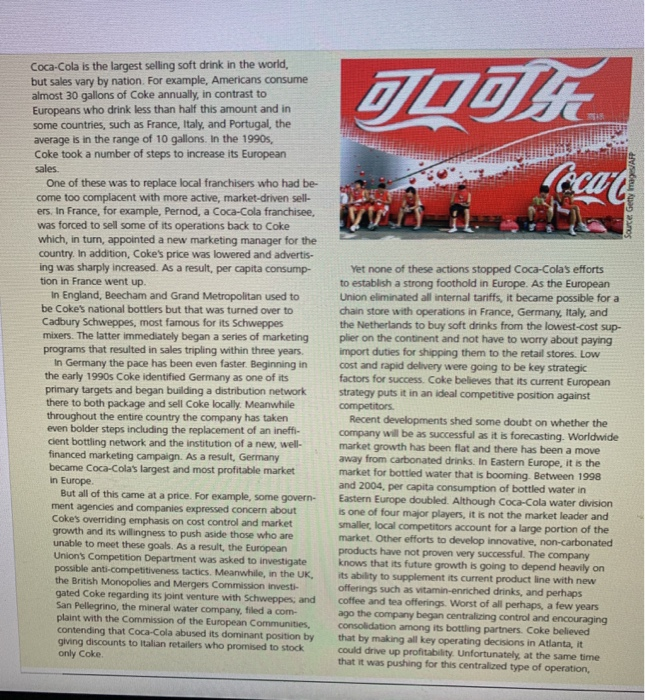
TOTA Ceca Coca-Cola is the largest selling soft drink in the world, but sales vary by nation. For example, Americans consume almost 30 gallons of Coke annually, in contrast to Europeans who drink less than half this amount and in some countries, such as France, Italy, and Portugal, the average is in the range of 10 gallons. In the 1990s, Coke took a number of steps to increase its European sales. One of these was to replace local franchisers who had be- come too complacent with more active, market-driven sell- ers. In France, for example, Pernod, a Coca-Cola franchisee, was forced to sell some of its operations back to Coke which in turn, appointed a new marketing manager for the country. In addition, Coke's price was lowered and advertis- ing was sharply increased. As a result, per capita consump- tion in France went up. In England, Beecham and Grand Metropolitan used to be Coke's national bottlers but that was turned over to Cadbury Schweppes, most famous for its Schweppes mixers. The latter immediately began a series of marketing programs that resulted in sales tripling within three years. In Germany the pace has been even faster. Beginning in the early 1990s Coke identified Germany as one of its primary targets and began building a distribution network there to both package and sell Coke locally. Meanwhile throughout the entire country the company has taken even bolder steps including the replacement of an ineffi- cient bottling network and the institution of a new, well- financed marketing campaign. As a result, Germany became Coca-Cola's largest and most profitable market in Europe But all of this came at a price. For example, some govern- ment agencies and companies expressed concern about Coke's overriding emphasis on cost control and market growth and its willingness to push aside those who are unable to meet these goals. As a result, the European Union's Competition Department was asked to investigate possible anti-competitiveness tactics. Meanwhile, in the UK, the British Monopolies and Mergers Commission investi- gated Coke regarding its joint venture with Schweppes, and San Pellegrino, the mineral water company filed a com- plaint with the Commission of the European Communities, contending that Coca-Cola abused its dominant position by giving discounts to Italian retailers who promised to stock only Coke Yet none of these actions stopped Coca-Cola's efforts to establish a strong foothold in Europe. As the European Union eliminated all internal tariffs, it became possible for a chain store with operations in France, Germany, Italy, and the Netherlands to buy soft drinks from the lowest-cost sup- plier on the continent and not have to worry about paying import duties for shipping them to the retail stores. Low cost and rapid delivery were going to be key strategic factors for success. Coke believes that its current European strategy puts it in an ideal competitive position against competitors Recent developments shed some doubt on whether the company will be as successful as it is forecasting. Worldwide market growth has been flat and there has been a move away from carbonated drinks. In Eastern Europe, it is the market for bottled water that is booming. Between 1998 and 2004. per capita consumption of bottled water in Eastern Europe doubled. Although Coca-Cola water division is one of four major players, it is not the market leader and smaller, local competitors account for a large portion of the market. Other efforts to develop innovative, non-carbonated products have not proven very successful. The company knows that its future growth is going to depend heavily on its ability to supplement its current product line with new offerings such as vitamin-enriched drinks, and perhaps coffee and tea offerings. Worst of all perhaps, a few years ago the company began centralizing control and encouraging consolidation among its bottling partners. Coke believed that by making all key operating decisions in Atlanta, it could drive up profitability. Unfortunately, at the same time that it was pushing for this centralized type of operation, regional markets began demanding that the company be more responsive to local needs. In short, Coke was going global while the market wanted it to go local. Coke is now trying to turn things around. In particular, the firm is now implementing three principles that are de- signed to make it more locally responsive. First, the com- pany is instituting a strategy of "think local, act local" by putting increased decision making in the hands of local managers. Second, the firm is focusing itself as a pure mar- keting company and pushing its brands on a regional basis and local basis rather than on a worldwide basis. Third, Coke is now working to become a model citizen by reaching out to local communities and getting involved in civic and charitable activities. Europe remains an important market for Coke, which de rives about a quarter of its revenues from the region, about the same as the Asia-Pacific region North America, though the dominant market, accounts for just under a third of Coke's revenues In the past, Coke succeeded as a multinational because of its understanding and appeal to global commonalities. Today, it is trying to hold its market share by better under standing and appealing to local differences. Website: www.coca-cola.com, www.cokecce.com www.coca-colahbc.com and www.cadburyschweppes.com Sources Adapted from John Huey "The World's Best Band." Fortune May 31, 1993: Dean Fount and Gerry Khmouch, "Repairing the Coke Machine Business Week, March 19, 2001, pp. 86-88, Kerlin Hope, "Coke Bottler Boosts East European Presence with Purchase from Parent, FaceTimes, y 21/29, 2001, p. 24: Alan Rugman and Richard Hodgetts, "The End of Global Strategy Pureen Management fournal August 2001, p. 336 and "Competition, Coolers, Drive East European Water Sales, Food and Drink Europe, February 2, 2004 Questions: 1- Foreign direct investments (FDI) was the choice of Coke to be in Europe, why? 2- In Europe, demonstrate how Coca-Cola managed to expand its factor conditions? 3- Coke's amended its competitive advantage strategy as a result of the local rivalry, how? 4- To which form Coca-Cola Company fit? global? MNE? Why









 Study Help