







Question: Please answer these questions Your risk tolerance is your ability and willingness to assume investment risk, which is based on: a. Your investment objective b.
Please answer these questions

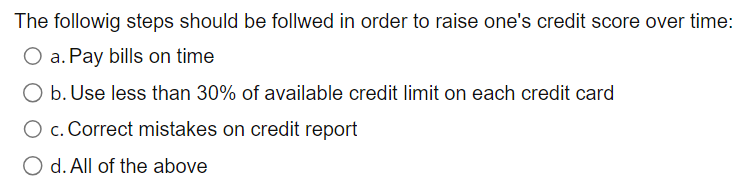

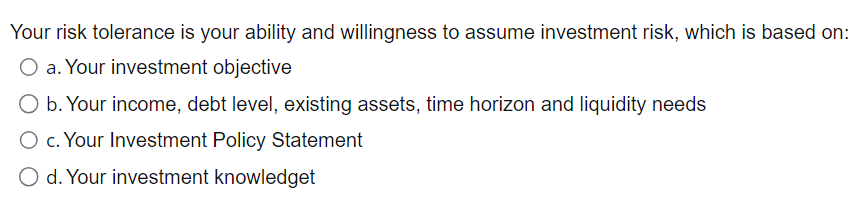


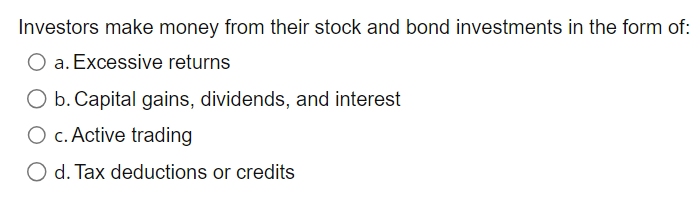
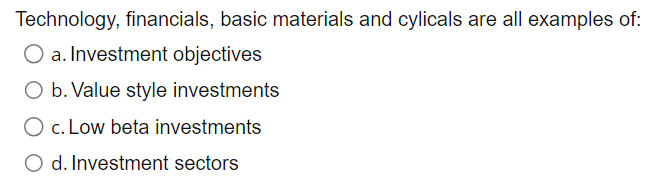
Your risk tolerance is your ability and willingness to assume investment risk, which is based on: a. Your investment objective b. Your income, debt level, existing assets, time horizon and liquidity needs c. Your Investment Policy Statement d. Your investment knowledget Risk is measured by the amount of volatility, meaning the difference between actual returns and average (expected) returns of a benchmark like the S\&P 500 index. This difference is referred to as: a. Risk percentage b. The expense ratio c. Standard deviation or beta d. Front-running Paying as much as you can afford against your most expensive debt and minimums against all other debts until that first debt is paid off, then paying off each debt in order until you are debt free is called? a. Debt consolidation b. The credit utilization ratio c. The "avalanche" method of debt repayment d. Effective budgeting "I want my money to grow some but not lose value" and "I want my money to grow as fast or aggressively as possible" are both examples of investor a. Investment time horizon b. Financial goals c. Risk tolerance d. Investment objectives The followig steps should be follwed in order to raise one's credit score over time: a. Pay bills on time b. Use less than 30% of available credit limit on each credit card c. Correct mistakes on credit report d. All of the above A mutual fund is an investment portfolio consisting of securities that an individual investor can invest in all at once without having to buy each individual stock or bond. One of the advantages of investing in mutual funds is: a. Guaranteed returns b. High interest c. Market-timing d. Diversification Technology, financials, basic materials and cylicals are all examples of: a. Investment objectives b. Value style investments c. Low beta investments d. Investment sectors Investors make money from their stock and bond investments in the form of: a. Excessive returns b. Capital gains, dividends, and interest c. Active trading d. Tax deductions or credits Your risk tolerance is your ability and willingness to assume investment risk, which is based on: a. Your investment objective b. Your income, debt level, existing assets, time horizon and liquidity needs c. Your Investment Policy Statement d. Your investment knowledget Risk is measured by the amount of volatility, meaning the difference between actual returns and average (expected) returns of a benchmark like the S\&P 500 index. This difference is referred to as: a. Risk percentage b. The expense ratio c. Standard deviation or beta d. Front-running Paying as much as you can afford against your most expensive debt and minimums against all other debts until that first debt is paid off, then paying off each debt in order until you are debt free is called? a. Debt consolidation b. The credit utilization ratio c. The "avalanche" method of debt repayment d. Effective budgeting "I want my money to grow some but not lose value" and "I want my money to grow as fast or aggressively as possible" are both examples of investor a. Investment time horizon b. Financial goals c. Risk tolerance d. Investment objectives The followig steps should be follwed in order to raise one's credit score over time: a. Pay bills on time b. Use less than 30% of available credit limit on each credit card c. Correct mistakes on credit report d. All of the above A mutual fund is an investment portfolio consisting of securities that an individual investor can invest in all at once without having to buy each individual stock or bond. One of the advantages of investing in mutual funds is: a. Guaranteed returns b. High interest c. Market-timing d. Diversification Technology, financials, basic materials and cylicals are all examples of: a. Investment objectives b. Value style investments c. Low beta investments d. Investment sectors Investors make money from their stock and bond investments in the form of: a. Excessive returns b. Capital gains, dividends, and interest c. Active trading d. Tax deductions or credits
Step by Step Solution
There are 3 Steps involved in it

Get step-by-step solutions from verified subject matter experts
 Study Help