







Question: Please answer this after reading the article: In the article on Benchmarking in the Nursing environment (Understanding Benchmarking), the author(s) identify three sources of the
Please answer this after reading the article:
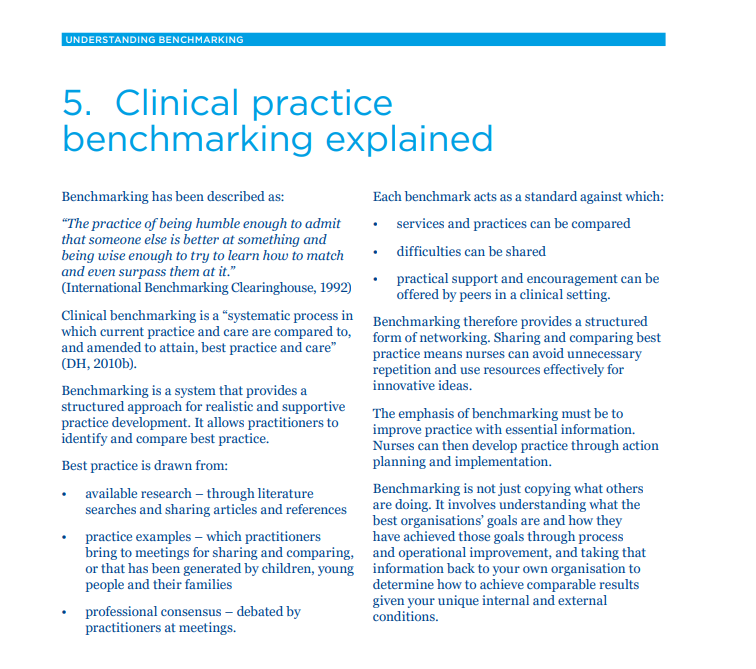
In the article on Benchmarking in the Nursing environment ("Understanding Benchmarking"), the author(s) identify three sources of the "Best Practice" concept as it pertains specifically to Benchmarking activities: available research, practice examples, and professional consensus. Please select one example of Benchmarking in the HIM environment and briefly discuss (2/3 sentences maximum) how the practice of benchmarking might contribute towards the creation of a more efficient workflow. You may select any operational aspect that would be found in the typical HIM environment.
AGAIN, please answer this after reading the article:
In the article on Benchmarking in the Nursing environment ("Understanding Benchmarking"), the author(s) identify three sources of the "Best Practice" concept as it pertains specifically to Benchmarking activities: available research, practice examples, and professional consensus. Please select one example of Benchmarking in the HIM environment and briefly discuss (2/3 sentences maximum) how the practice of benchmarking might contribute towards the creation of a more efficient workflow. You may select any operational aspect that would be found in the typical HIM environment.
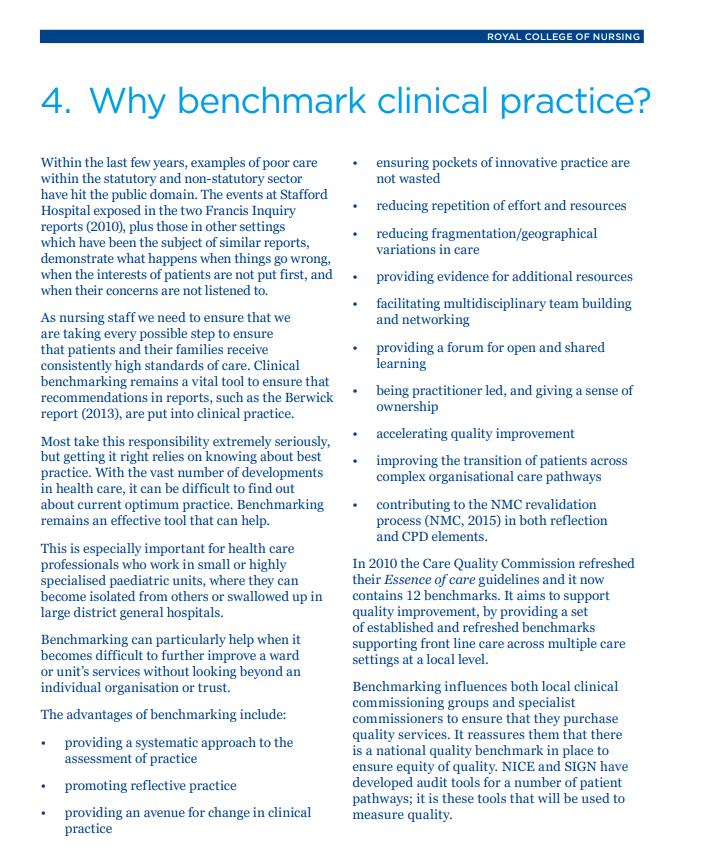
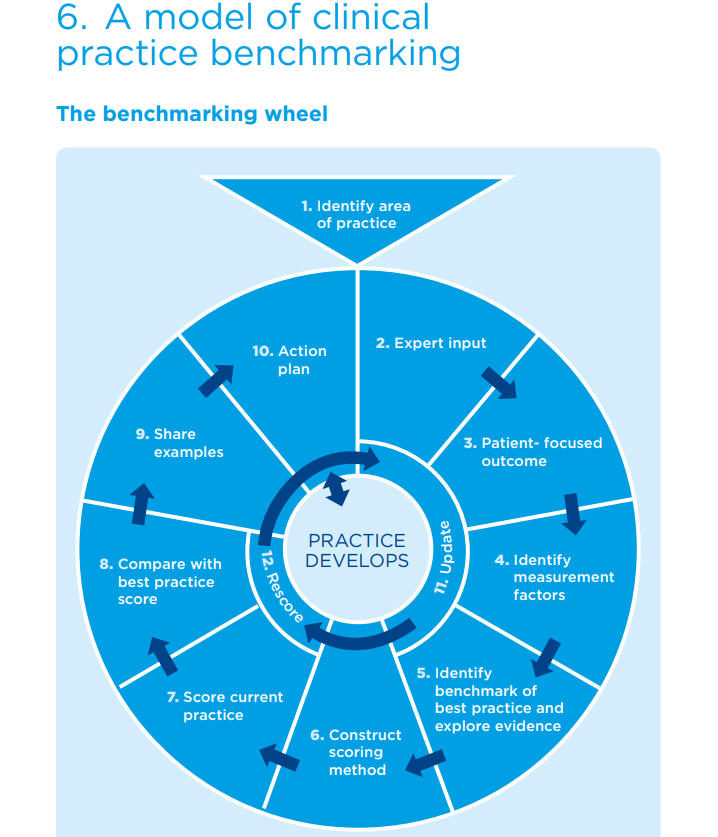
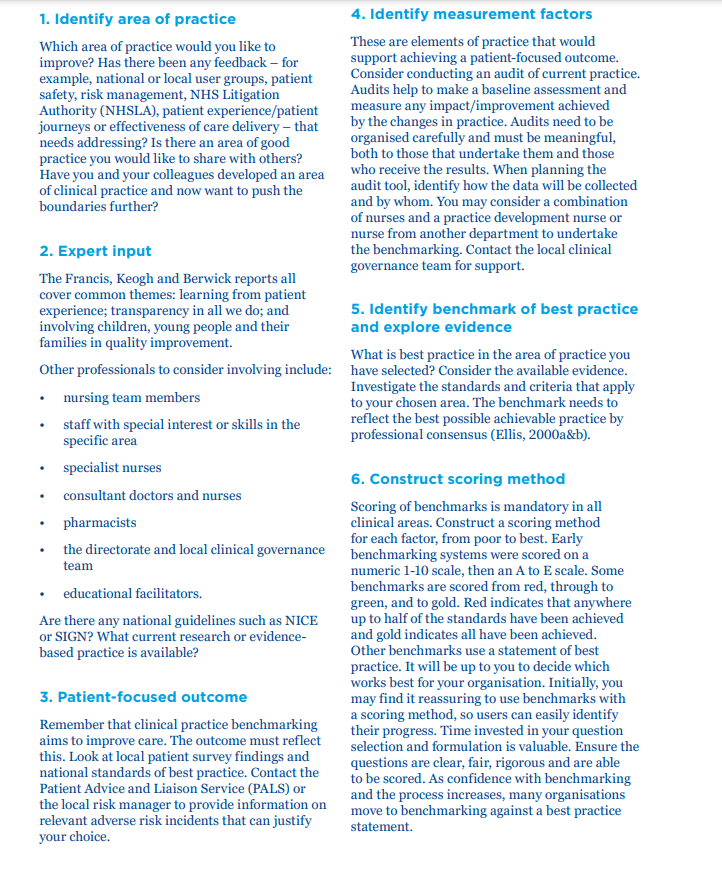
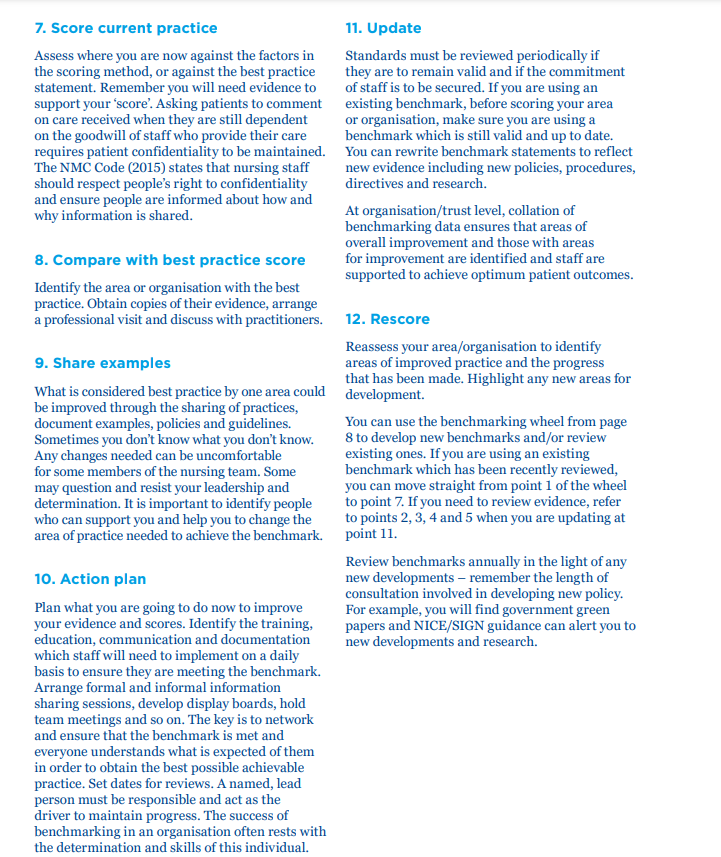
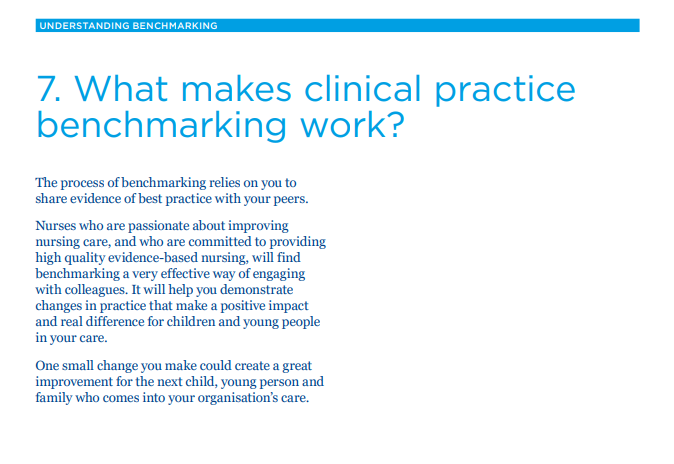
ROYAL COLLEGE OF NURSING 4. Why benchmark clinical practice? Within the last few years, examples of poor care ensuring pockets of innovative practice are within the statutory and non-statutory sector not wasted have hit the public domain. The events at Stafford Hospital exposed in the two Francis Inquiry reducing repetition of effort and resources reports (2010), plus those in other settings which have been the subject of similar reports, reducing fragmentation/geographical demonstrate what happens when things go wrong, variations in care when the interests of patients are not put first, and providing evidence for additional resources when their concerns are not listened to. facilitating multidisciplinary team building As nursing staff we need to ensure that we and networking are taking every possible step to ensure that patients and their families receive providing a forum for open and shared consistently high standards of care. Clinical learning benchmarking remains a vital tool to ensure that recommendations in reports, such as the Berwick being practitioner led, and giving a sense of report (2013), are put into clinical practice. ownership Most take this responsibility extremely seriously, accelerating quality improvement but getting it right relies on knowing about best improving the transition of patients across practice. With the vast number of developments complex organisational care pathways in health care, it can be difficult to find out about current optimum practice. Benchmarking contributing to the NMC revalidation remains an effective tool that can help. process (NMC, 2015) in both reflection and CPD elements. This is especially important for health care professionals who work in small or highly In 2010 the Care Quality Commission refreshed specialised paediatric units, where they can their Essence of care guidelines and it now become isolated from others or swallowed up in contains 12 benchmarks. It aims to support large district general hospitals. quality improvement, by providing a set of established and refreshed benchmarks Benchmarking can particularly help when it supporting front line care across multiple care becomes difficult to further improve a ward settings at a local level. or unit's services without looking beyond an individual organisation or trust. Benchmarking influences both local clinical commissioning groups and specialist The advantages of benchmarking include: commissioners to ensure that they purchase providing a systematic approach to the quality services. It reassures them that there assessment of practice is a national quality benchmark in place to ensure equity of quality. NICE and SIGN have promoting reflective practice developed audit tools for a number of patient pathways; it is these tools that will be used to providing an avenue for change in clinical measure quality. practice UNDERSTANDING BENCHMARKING 5. Clinical practice benchmarking explained Benchmarking has been described as: Each benchmark acts as a standard against which: "The practice of being humble enough to admit services and practices can be compared that someone else is better at something and being wise enough to try to learn how to match difficulties can be shared and even surpass them at it." (International Benchmarking Clearinghouse, 1992) practical support and encouragement can be offered by peers in a clinical setting. Clinical benchmarking is a systematic process in Benchmarking therefore provides a structured which current practice and care are compared to, form of networking. Sharing and comparing best and amended to attain, best practice and care" practice means nurses can avoid unnecessary (DH, 2010b). repetition and use resources effectively for Benchmarking is a system that provides a innovative ideas. structured approach for realistic and supportive practice development. It allows practitioners to The emphasis of benchmarking must be to identify and compare best practice. improve practice with essential information. Nurses can then develop practice through action Best practice is drawn from: planning and implementation. available research - through literature Benchmarking is not just copying what others searches and sharing articles and references are doing. It involves understanding what the best organisations' goals are and how they practice examples - which practitioners have achieved those goals through process bring to meetings for sharing and comparing, and operational improvement, and taking that or that has been generated by children, young information back to your own organisation to people and their families determine how to achieve comparable results given your unique internal and external professional consensus - debated by conditions. practitioners at meetings. 6. A model of clinical practice benchmarking The benchmarking wheel 1. Identify area of practice 2. Expert input 10. Action plan 9. Share examples 3. Patient-focused outcome PRACTICE DEVELOPS 8. Compare with best practice score 17. Update 4. Identify measurement factors Rescore 7. Score current practice 5. Identify benchmark of best practice and explore evidence 6. Construct scoring method 1. Identify area of practice 4. Identify measurement factors Which area of practice would you like to These are elements of practice that would improve? Has there been any feedback - for support achieving a patient-focused outcome. example, national or local user groups, patient Consider conducting an audit of current practice. safety, risk management, NHS Litigation Audits help to make a baseline assessment and Authority (NHSLA), patient experience/patient measure any impact/improvement achieved journeys or effectiveness of care delivery - that by the changes in practice. Audits need to be needs addressing? Is there an area of good organised carefully and must be meaningful, practice you would like to share with others? both to those that undertake them and those Have you and your colleagues developed an area who receive the results. When planning the of clinical practice and now want to push the audit tool, identify how the data will be collected boundaries further? and by whom. You may consider a combination of nurses and a practice development nurse or nurse from another department to undertake 2. Expert input the benchmarking. Contact the local clinical governance team for support. The Francis, Keogh and Berwick reports all cover common themes: learning from patient experience; transparency in all we do; and 5. Identify benchmark of best practice involving children, young people and their and explore evidence families in quality improvement. What is best practice in the area of practice you Other professionals to consider involving include: have selected? Consider the available evidence. Investigate the standards and criteria that apply nursing team members to your chosen area. The benchmark needs to staff with special interest or skills in the reflect the best possible achievable practice by specific area professional consensus (Ellis, 2000a&b). specialist nurses 6. Construct scoring method consultant doctors and nurses Scoring of benchmarks is mandatory in all pharmacists clinical areas. Construct a scoring method the directorate and local clinical governance for each factor, from poor to best. Early benchmarking systems were scored on a team numeric 1-10 scale, then an A to Escale. Some educational facilitators. benchmarks are scored from red, through to green, and to gold. Red indicates that anywhere Are there any national guidelines such as NICE up to half of the standards have been achieved or SIGN? What current research or evidence- and gold indicates all have been achieved. based practice is available? Other benchmarks use a statement of best practice. It will be up to you to decide which works best for your organisation. Initially, you 3. Patient-focused outcome may find it reassuring to use benchmarks with a scoring method, so users can easily identify Remember that clinical practice benchmarking their progress. Time invested in your question aims to improve care. The outcome must reflect selection and formulation is valuable. Ensure the this. Look at local patient survey findings and questions are clear, fair, rigorous and are able national standards of best practice. Contact the to be scored. As confidence with benchmarking Patient Advice and Liaison Service (PALS) or and the process increases, many organisations the local risk manager to provide information on relevant adverse risk incidents that can justify move to benchmarking against a best practice statement your choice. . 7. Score current practice 11. Update Assess where you are now against the factors in Standards must be reviewed periodically if the scoring method, or against the best practice they are to remain valid and if the commitment statement. Remember you will need evidence to of staff is to be secured. If you are using an support your 'score? Asking patients to comment existing benchmark, before scoring your area on care received when they are still dependent or organisation, make sure you are using a on the goodwill of staff who provide their care benchmark which is still valid and up to date. requires patient confidentiality to be maintained. You can rewrite benchmark statements to reflect The NMC Code (2015) states that nursing staff new evidence including new policies, procedures, should respect people's right to confidentiality directives and research. and ensure people are informed about how and why information is shared. At organisation/trust level, collation of benchmarking data ensures that areas of overall improvement and those with areas 8. Compare with best practice score for improvement are identified and staff are supported to achieve optimum patient outcomes. Identify the area or organisation with the best practice. Obtain copies of their evidence, arrange a professional visit and discuss with practitioners. 12. Rescore Reassess your area/organisation to identify 9. Share examples areas of improved practice and the progress What is considered best practice by one area could development. that has been made. Highlight any new areas for be improved through the sharing of practices, document examples, policies and guidelines. You can use the benchmarking wheel from page Sometimes you don't know what you don't know. 8 to develop new benchmarks and/or review Any changes needed can be uncomfortable existing ones. If you are using an existing for some members of the nursing team. Some benchmark which has been recently reviewed, may question and resist your leadership and you can move straight from point 1 of the wheel determination. It is important to identify people to point 7. If you need to review evidence, refer who can support you and help you to change the to points 2, 3, 4 and 5 when you are updating at area of practice needed to achieve the benchmark. point 11. Review benchmarks annually in the light of any 10. Action plan new developments - remember the length of consultation involved in developing new policy. Plan what you are going to do now to improve For example, you will find government green your evidence and scores. Identify the training, papers and NICE/SIGN guidance can alert you to education, communication and documentation new developments and research. which staff will need to implement on a daily basis to ensure they are meeting the benchmark. Arrange formal and informal information sharing sessions, develop display boards, hold team meetings and so on. The key is to network and ensure that the benchmark is met and everyone understands what is expected of them in order to obtain the best possible achievable practice. Set dates for reviews. A named, lead person must be responsible and act as the driver to maintain progress. The success of benchmarking in an organisation often rests with the determination and skills of this individual. UNDERSTANDING BENCHMARKING 7. What makes clinical practice benchmarking work? The process of benchmarking relies on you to share evidence of best practice with your peers. Nurses who are passionate about improving nursing care, and who are committed to providing high quality evidence-based nursing, will find benchmarking a very effective way of engaging with colleagues. It will help you demonstrate changes in practice that make a positive impact and real difference for children and young people in your care. One small change you make could create a great improvement for the next child, young person and family who comes into your organisation's careStep by Step Solution
There are 3 Steps involved in it

Get step-by-step solutions from verified subject matter experts
 Study Help