







Question: Please answer this based on these 2 attempts: Which of the following statements about Erlang are TRUE? Check all that apply To mimic a stack,
Please answer this based on these 2 attempts:
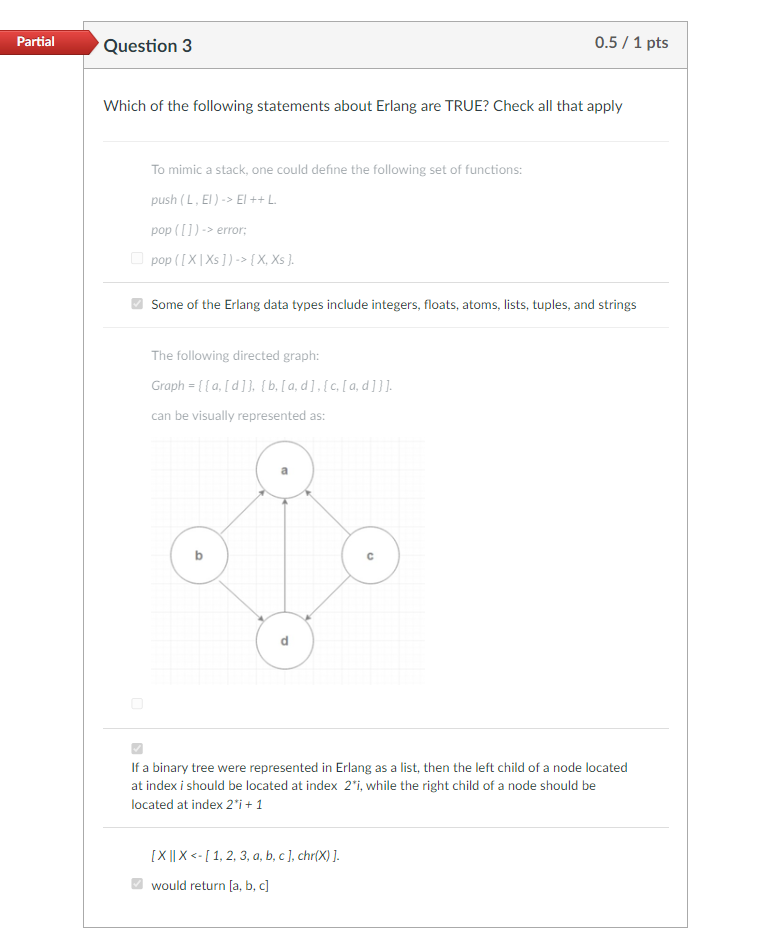
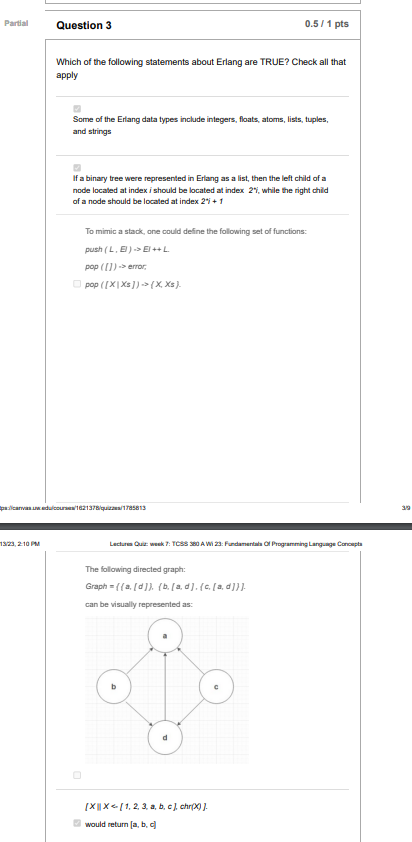
Which of the following statements about Erlang are TRUE? Check all that apply To mimic a stack, one could define the following set of functions: push(L,El)>El++L.pop([])->error;pop([XXs])>{X,Xs]. Some of the Erlang data types include integers, floats, atoms, lists, tuples, and strings The following directed graph: Graph={{a,[d]},{b,[a,d],{c,[a,d]}]. can be visually represented as: If a binary tree were represented in Erlang as a list, then the left child of a node located at index i should be located at index 2i, while the right child of a node should be located at index 2i+1 [XXerror,pop([XXs])=(X,Xs) The following directed graph: Graph ={(a,[d]],{b,[a,d],{c,[a,d]}]. can be visually represented as: [XX
Step by Step Solution
There are 3 Steps involved in it

Get step-by-step solutions from verified subject matter experts
 Study Help