







Question: please answer this correctly thank you NEED HELP? r Let's review first: The trial balance is a list of accounts and their ending balances. Each
please answer this correctly thank you
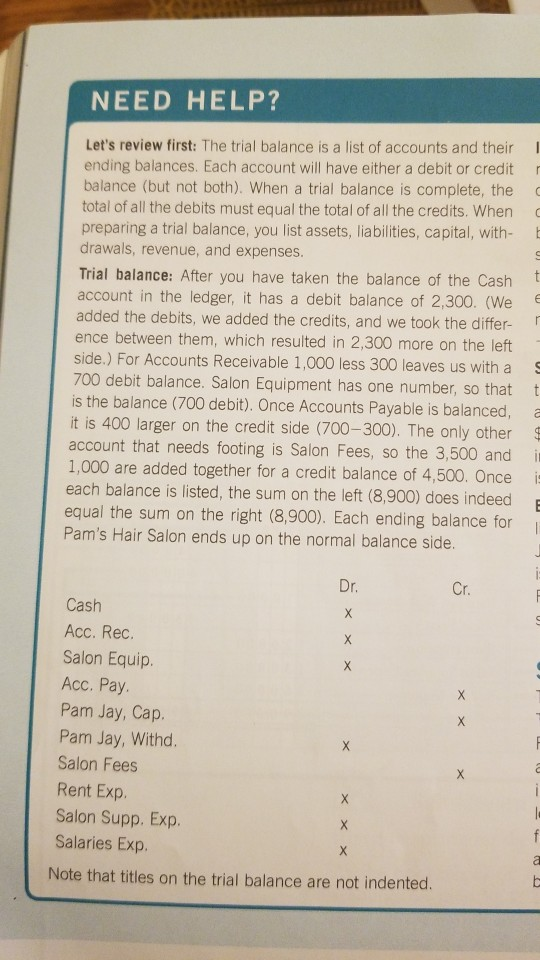
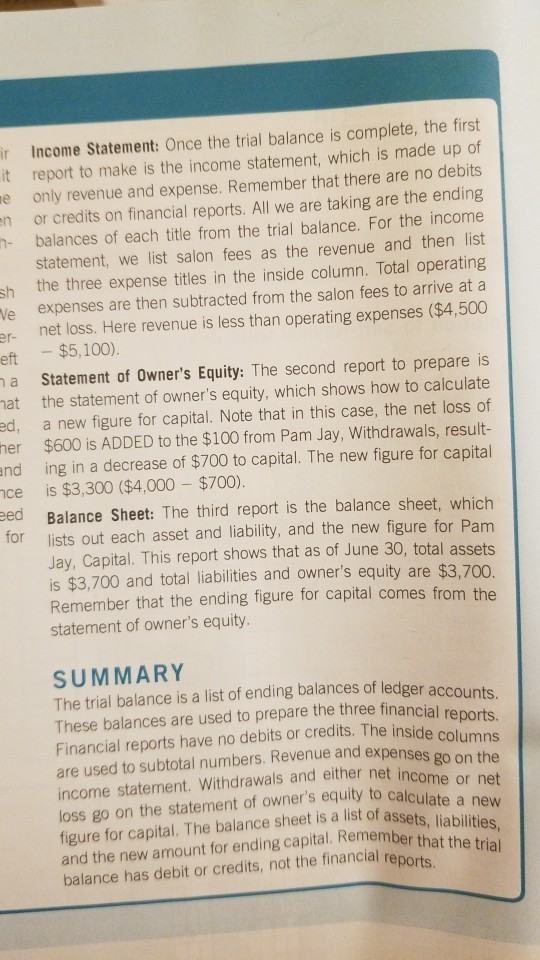
NEED HELP? r Let's review first: The trial balance is a list of accounts and their ending balances. Each account will have either a debit or credit balance (but not both). When a trial balance is complete, the total of all the debits must equal the total of all the credits. When preparing a trial balance, you list assets, liabilities, capital, with drawals, revenue, and expenses. Trial balance: After you have taken the balance of the Cash account in the ledger, it has a debit balance of 2,300. (We added the debits, we added the credits, and we took the differ- ence between them, which resulted in 2,300 more on the left side.) For Accounts Receivable 1,000 less 300 leaves us with a 700 debit balance. Salon Equipment has one number, so that is the balance (700 debit). Once Accounts Payable is balanced, it is 400 larger on the credit side (700-300). The only other account that needs footing is Salon Fees, so the 3,500 and 1,000 are added together for a credit balance of 4,500. Once each balance is listed, the sum on the left (8,900) does indeed equal the sum on the right (8,900). Each ending balance for Pam's Hair Salon ends up on the normal balance side. S t a $ in is - Cash Acc. Rec. Salon Equip Acc. Pay. Pam Jay, Cap. Pam Jay, Withd. Salon Fees Rent Exp. Salon Supp. Exp. Salaries Exp. Note that titles on the trial balance are not indented. ir it me en n sh Ve er eft ha hat ed, Income Statement: Once the trial balance is complete, the first report to make is the income statement, which is made up of only revenue and expense. Remember that there are no debits or credits on financial reports. All we are taking are the ending balances of each title from the trial balance. For the income statement, we list salon fees as the revenue and then list the three expense titles in the inside column. Total operating expenses are then subtracted from the salon fees to arrive at a net loss. Here revenue is less than operating expenses ($4,500 - $5,100). Statement of Owner's Equity: The second report to prepare is the statement of owner's equity, which shows how to calculate a new figure for capital. Note that in this case, the net loss of $600 is ADDED to the $100 from Pam Jay, Withdrawals, result- ing in a decrease of $700 to capital. The new figure for capital is $3,300 ($4,000 - $700). Balance Sheet: The third report is the balance sheet, which lists out each asset and liability, and the new figure for Pam Jay, Capital. This report shows that as of June 30, total assets is $3,700 and total liabilities and owner's equity are $3,700. Remember that the ending figure for capital comes from the statement of owner's equity. ther and nce eed for its or credits. The inside columns SUMMARY The trial balance is a list of ending balances of ledger accou balances are used to prepare the three financial reports Financial reports have no debits or credits. The inside are used to subtotal numbers. Revenue and expenses income statement. Withdrawals and either net ince drawals and either net income or net loss go on the statement of owner's equity to calc figure for capital. The balance sheet is a list of asset and the new amount for ending capital. Remember th balance has debit or credits, not the financial repo er's equity to calculate a new et is a list of assets, liabilities, pital. Remember that the trial
Step by Step Solution
There are 3 Steps involved in it

Get step-by-step solutions from verified subject matter experts
 Study Help