Question: please answer this I will rate good Please complete this work in your group. The group leader should upload the answer file. 1. What are
please answer this I will rate good
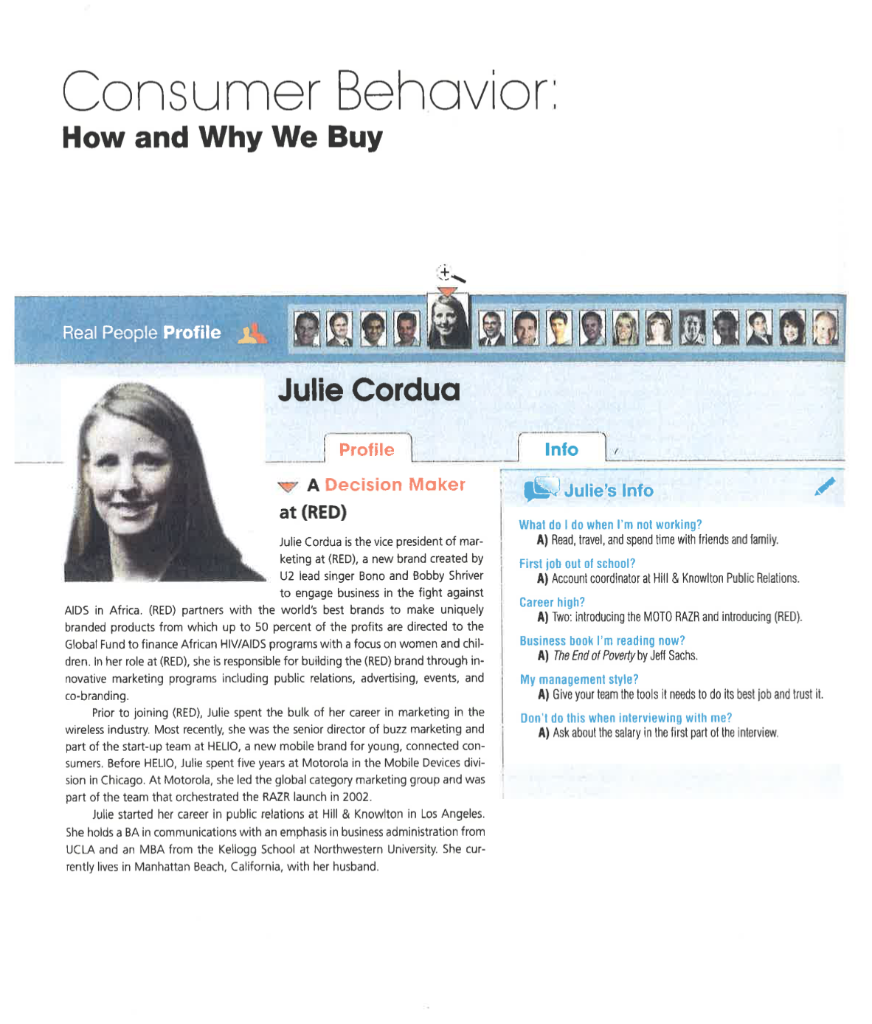
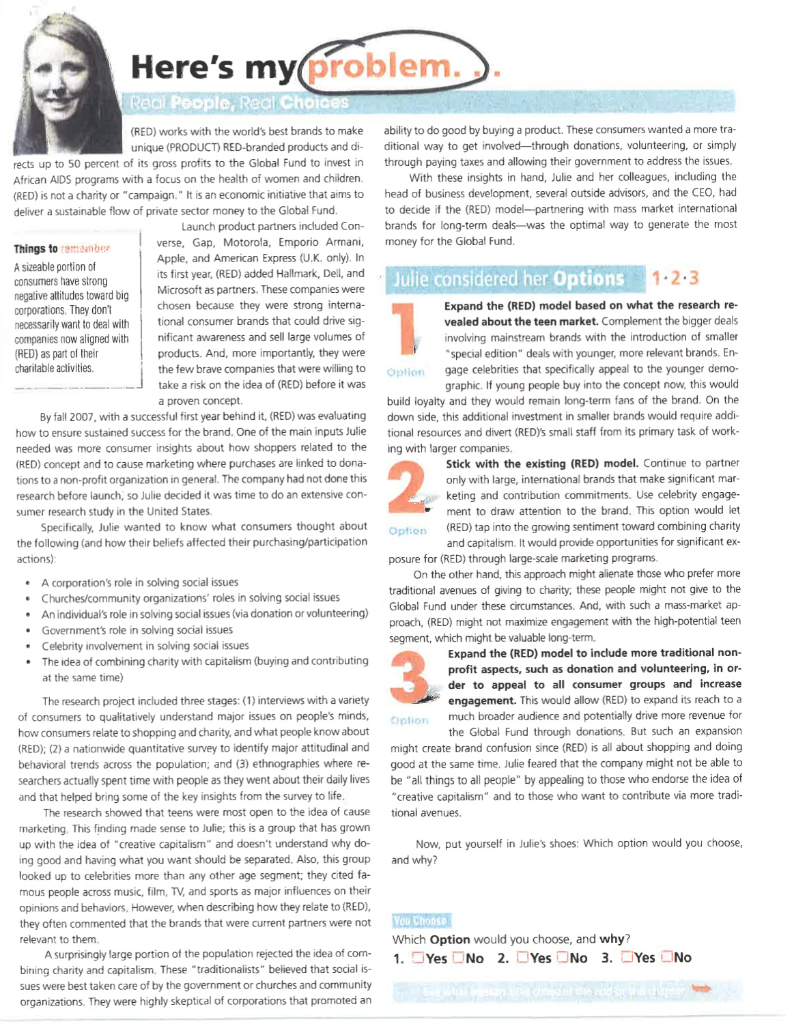
Please complete this work in your group. The group leader should upload the answer file. 1. What are three important things about Julia, from her Profile, that you think will shape her decision-process? Why those 3? 2. What are the three most interesting things in Julia's Info section, that you think will shape her decision-process? Why those 3? 3. Summarise, in one-two paragraphs, the problem Julia faces. Make sure you include the KEY issue, as you see it, and explain why that is the core problem. 4. Recommend one of the three suggested Options for Julia. Explain why this option is the best one for her to choose. Explain why the other two are not the best options. Suggest a fourth option she could consider. UAEU Consumer Behavior: How and Why We Buy Real People Profile eneo Anna Julie Cordua Profile Info Julie's Info A Decision Maker at (RED) Julie Cordua is the vice president of mar- keting at (RED), a new brand created by U2 lead singer Bono and Bobby Shriver to engage business in the fight against AIDS in Africa. (RED) partners with the world's best brands to make uniquely branded products from which up to 50 percent of the profits are directed to the Global Fund to finance African HIV/AIDS programs with a focus on women and chil- dren. In her role at (RED), she is responsible for building the (RED) brand through in- novative marketing programs including public relations, advertising, events, and co-branding Prior to joining (RED), Julie spent the bulk of her career in marketing in the wireless industry. Most recently, she was the senior director of buzz marketing and part of the start-up team at HELIO, a new mobile brand for young, connected con- sumers. Before HELIO, Julie spent five years at Motorola in the Mobile Devices divi- sion in Chicago. At Motorola, she led the global category marketing group and was part of the team that orchestrated the RAZR launch in 2002. Julie started her career in public relations at Hill & Knowlton in Los Angeles. She holds a BA in communications with an emphasis in business administration from UCLA and an MBA from the Kellogg School at Northwestern University. She cur- rently lives in Manhattan Beach, California, with her husband. What do I do when I'm not working? A) Read, travel, and spend time with friends and family. First job out of school? A) Account coordinator at Hill & Knowlton Public Relations. Career high? A) Two: introducing the MOTO RAZR and introducing (RED). Business book I'm reading now? A) The End of Poverty by Jeff Sachs. My management style? A) Give your team the tools it needs to do its best job and trust it. Don't do this when interviewing with me? A) Ask about the salary in the first part of the interview. Here's my problem. ability to do good by buying a product. These consumers wanted a more tra- ditional way to get involvedthrough donations, volunteering, or simply through paying taxes and allowing their government to address the issues. With these insights in hand, Julie and her colleagues, including the head of business development, several outside advisors, and the CEO, had to decide if the (RED) model-partnering with mass market international brands for long-term dealswas the optimal way to generate the most money for the Global Fund. tarna tional consumer graphic 2. Real People, Real Choices (RED) works with the world's best brands to make unique (PRODUCT) RED-branded products and di- rects up to 50 percent of its gross profits to the Global Fund to invest in African AIDS programs with a focus on the health of women and children. (RED) is not a charity or "campaign." It is an economic initiative that aims to deliver a sustainable flow of private sector money to the Global Fund. Launch product partners included Con- Things to remember verse, Gap, Motorola, Emporio Armani ople, and American Express (U.K. only). In A sizeable portion of its first year, (RED) added Hallmark, Dell, and , consumers have strong Microsoft as partners. These companies were negative attitudes toward big chosen because they were strong corporations. They don't necessarily want to deal with r brands that could drive sig- companies now aligned with nificant awareness and sell large volumes of (RED) as part of their products. And, more importantly, they were charitable activities the fou have companie the few brave companies that were willing to take a risk on the idea of (RED) before it was proven concept a proven concept By fall 2007, with a successful first year behind it, (RED) was evaluating how to ensure sustained success for the brand. One of the main inputs Julie needed was more consumer insights about how shoppers related to the (RED) concept and to cause marketing where purchases are linked to dona- tions to a non-profit organization in general. The company had not done this research before launch, so Julie decided it was time to do an extensive con- sumer research study in the United States Specifically, Julie wanted to know what consumers thought about the following (and how their beliefs affected their purchasing/participation actions) A corporation's role in solving social issues Churches/community organizations' roles in solving social issues An individual's role in solving social issues (via donation or volunteering) Government's role in solving social issues Celebrity involvement in solving social issues The idea of combining charity with capitalism (buying and contributing at the same time) The research project included three stages: (1) interviews with a variety of consumers to qualitatively understand major issues on people's minds, how consumers relate to shopping and charity, and what people know about (RED); (2) a nationwide quantitative survey to identify major attitudinal and behavioral trends across the population; and (3) ethnographies where re 3 searchers actually spent time with spent time with people as they went about their daily lives and that bring some of the key insights from the survey to life. The research showed that teens were most open to the idea of cause marketing. This finding made sense to Julie; this is a group that has grown up with the idea of "creative capitalism and doesn't understand why do ing good and having what you want should be separated. Also, this group looked up to celebrities more than any other age segment; they cited fa- mous people across music, film, TV, and sports as major influences on their opinions and behaviors. However, when describing how they relate to (RED), they often commented that the brands that were current partners were not relevant to them A surprisingly large portion of the population rejected the idea of com- bining charity and capitalism. These "traditionalists" believed that socialis- sues were best taken care of by the government or churches and community organizations. They were highly skeptical of corporations that promoted an Julie considered her Options 1.2.3 Expand the (RED) model based on what the research re- vealed about the teen market. Complement the bigger deals involving mainstream brands with the introduction of smaller "special edition" deals with younger, more relevant brands. En Option gage celebrities that specifically appeal to the younger demo- If young people buy into the concept now, this would build loyalty and they would remain long-term fans of the brand. On the down side, this additional investment in smaller brands would require addi- tional resources and divert (RED)'s small staff from its primary task of work- ing with larger companies. Stick with the existing (RED) model. Continue to partner only with large, international brands that make significant mar- keting and contribution commitments. Use celebrity engage ment to draw attention to the brand. This option would let toward Option (RED) tap into the growing sentiment toward combining charity and capitalism. It would provide opportunities for significant ex- posure for (RED) through large-scale marketing programs On the other hand, this approach might alienate those who prefer more traditional avenues of giving to charity, these people might not give to the Global Fund under these circumstances. And, with such a mass-market ap- proach, (RED) might not maximize engagement with the high-potential teen segment, which might be valuable long-term. Expand the (RED) model to include more traditional non- profit aspects, such as donation and volunteering, in or. der to appeal to all consumer groups and increase engagement. This would allow (RED) to expand its reach to a Option much broader audience and potentially drive more revenue for the Global Fund through donations. But such an expansion might create brand confusion since (RED) is all about shopping and doing good at the same time, Julie feared that the company might not be able to be "all things to all people" by appealing to those who endorse the idea of "Creative capitalism" and to those who want to contribute via more tradi- tional avenues. 3 that helped bring some of the key Now, put yourself in Julie's shoes: Which option would you choose, and why? You Chonso Which Option would you choose, and why? 1. Yes No 2. Yes No 3. Yes No









 Study Help