







Question: PLEASE ANSWER THIS IN FULL DETAIL, a full page summary analysis. identify this article back to communication, self awanress, leading, organzing, planning,controlling and teams n
PLEASE ANSWER THIS IN FULL DETAIL, a full page summary analysis. identify this article back to communication, self awanress, leading, organzing, planning,controlling and teams n collaboration ! then explain how this article helps construct your vision of buisness leadership. my artticle is shown below 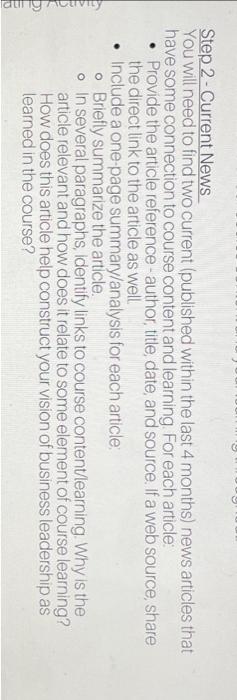
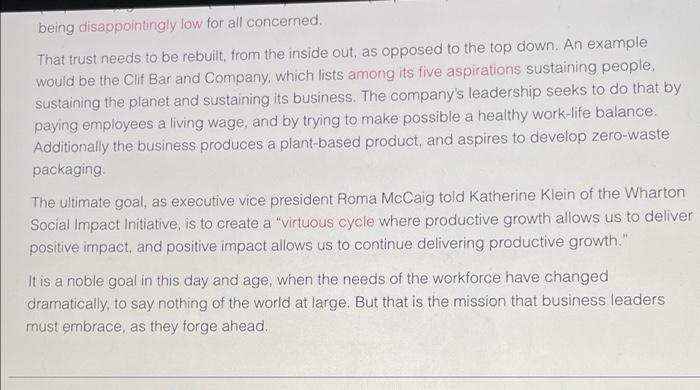
idenfity back to all the things listed communication, self awanress, etc in regards to the buisness world
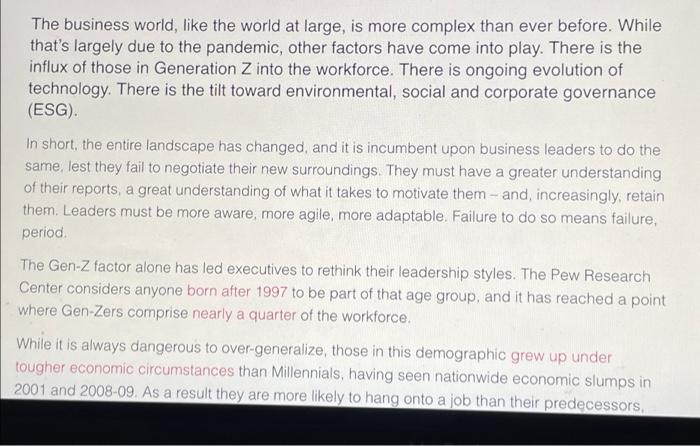
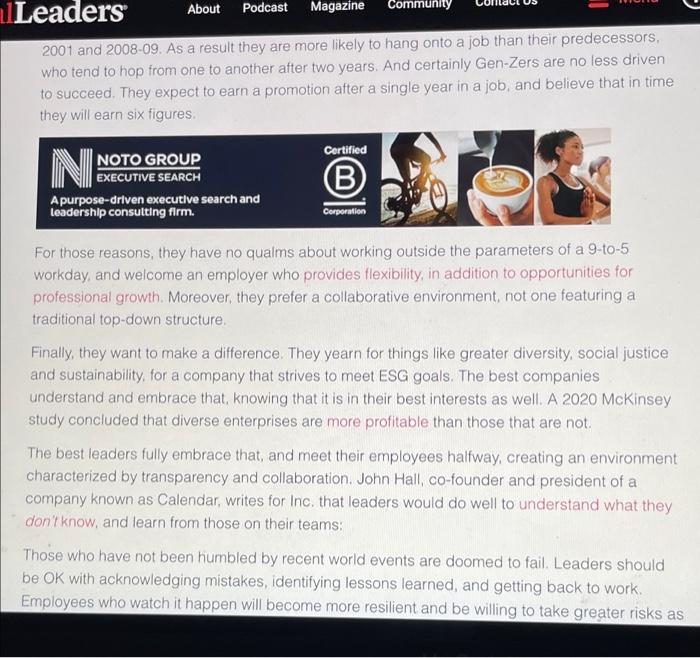
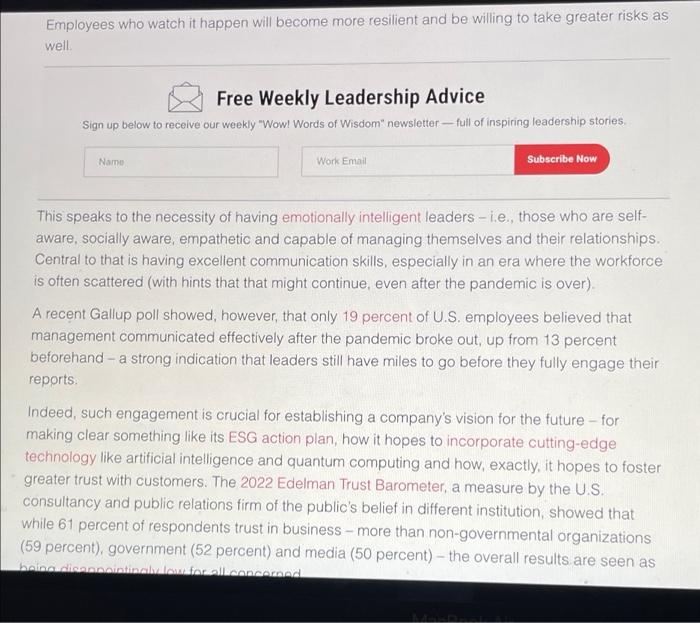
lating Activity Step 2 Current News You will need to find two current (published within the last 4 months) news articles that have some connection to course content and learning. For each article: Provide the article reference - author, title, date, and source. If a web source, share the direct link to the article as well. Include a one-page summary/analysis for each article: o Briefly summarize the article. o In several paragraphs, identify links to course content/learning. Why is the article relevant and how does it relate to some element of course learning? How does this article help construct your vision of business leadership as learned in the course? The business world, like the world at large, is more complex than ever before. While that's largely due to the pandemic, other factors have come into play. There is the influx of those in Generation Z into the workforce. There is ongoing evolution of technology. There is the tilt toward environmental, social and corporate governance (ESG). In short, the entire landscape has changed, and it is incumbent upon business leaders to do the same, lest they fail to negotiate their new surroundings. They must have a greater understanding of their reports, a great understanding of what it takes to motivate them - and, increasingly, retain them. Leaders must be more aware, more agile, more adaptable. Failure to do so means failure, period. The Gen-Z factor alone has led executives to rethink their leadership styles. The Pew Research Center considers anyone born after 1997 to be part of that age group, and it has reached a point where Gen-Zers comprise nearly a quarter of the workforce. While it is always dangerous to over-generalize, those in this demographic grew up under tougher economic circumstances than Millennials, having seen nationwide economic slumps in 2001 and 2008-09. As a result they are more likely to hang onto a job than their predecessors, Leaders About Podcast Magazine Community 2001 and 2008-09. As a result they are more likely to hang onto a job than their predecessors, who tend to hop from one to another after two years. And certainly Gen-Zers are no less driven to succeed. They expect to earn a promotion after a single year in a job, and believe that in time they will earn six figures. Certified N NOTO GROUP EXECUTIVE SEARCH B A purpose-driven executive search and leadership consulting firm. Corporation For those reasons, they have no qualms about working outside the parameters of a 9-to-5 workday, and welcome an employer who provides flexibility, in addition to opportunities for professional growth. Moreover, they prefer a collaborative environment, not one featuring a traditional top-down structure. Finally, they want to make a difference. They yearn for things like greater diversity, social justice and sustainability, for a company that strives to meet ESG goals. The best companies understand and embrace that, knowing that it is in their best interests as well. A 2020 McKinsey study concluded that diverse enterprises are more profitable than those that are not. The best leaders fully embrace that, and meet their employees halfway, creating an environment characterized by transparency and collaboration. John Hall, co-founder and president of a company known as Calendar, writes for Inc. that leaders would do well to understand what they don't know, and learn from those on their teams: Those who have not been humbled by recent world events are doomed to fail. Leaders should be OK with acknowledging mistakes, identifying lessons learned, and getting back to work. Employees who watch it happen will become more resilient and be willing to take greater risks as Employees who watch it happen will become more resilient and be willing to take greater risks as well. Free Weekly Leadership Advice Sign up below to receive our weekly "Wow! Words of Wisdom" newsletter-full of inspiring leadership stories. Name Work Email Subscribe Now This speaks to the necessity of having emotionally intelligent leaders - i.e., those who are self- aware, socially aware, empathetic and capable of managing themselves and their relationships. Central to that is having excellent communication skills, especially in an era where the workforce is often scattered (with hints that that might continue, even after the pandemic is over). A recent Gallup poll showed, however, that only 19 percent of U.S. employees believed that management communicated effectively after the pandemic broke out, up from 13 percent beforehand - a strong indication that leaders still have miles to go before they fully engage their reports. Indeed, such engagement is crucial for establishing a company's vision for the future - for making clear something like its ESG action plan, how it hopes to incorporate cutting-edge technology like artificial intelligence and quantum computing and how, exactly, it hopes to foster greater trust with customers. The 2022 Edelman Trust Barometer, a measure by the U.S. consultancy and public relations firm of the public's belief in different institution, showed that while 61 percent of respondents trust in business - more than non-governmental organizations (59 percent), government (52 percent) and media (50 percent) - the overall results are seen as being disappointingly low for all concerned being disappointingly low for all concerned. That trust needs to be rebuilt, from the inside out, as opposed to the top down. An example would be the Clif Bar and Company, which lists among its five aspirations sustaining people, sustaining the planet and sustaining its business. The company's leadership seeks to do that by paying employees a living wage, and by trying to make possible a healthy work-life balance. Additionally the business produces a plant-based product, and aspires to develop zero-waste packaging. The ultimate goal, as executive vice president Roma McCaig told Katherine Klein of the Wharton Social Impact Initiative, is to create a "virtuous cycle where productive growth allows us to deliver positive impact, and positive impact allows us to continue delivering productive growth." It is a noble goal in this day and age, when the needs of the workforce have changed dramatically, to say nothing of the world at large. But that is the mission that business leaders must embrace, as they forge ahead
Step by Step Solution
There are 3 Steps involved in it
1 Expert Approved Answer
Step: 1 Unlock

Question Has Been Solved by an Expert!
Get step-by-step solutions from verified subject matter experts
Step: 2 Unlock
Step: 3 Unlock
 Study Help