







Question: please answer this question . Arbitrary transfer prices can be a great concern to governments because of tax implications. The article, Glaxo Gets New IRS
please answer this question
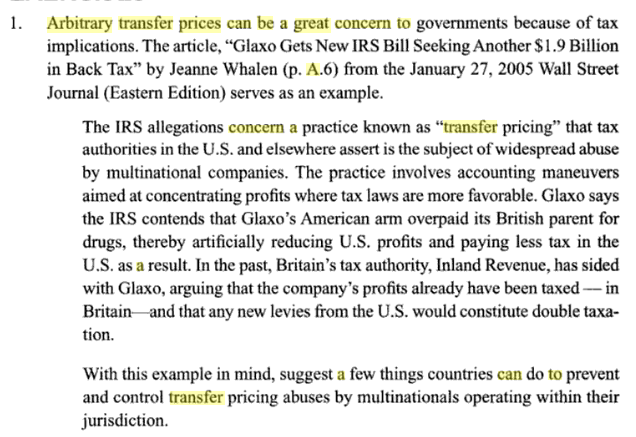
. Arbitrary transfer prices can be a great concern to governments because of tax implications. The article, "Glaxo Gets New IRS Bill Seeking Another $1.9 Billion in Back Tax" by Jeanne Whalen (p. A.6) from the January 27, 2005 Wall Street Journal (Eastern Edition) serves as an example The IRS allegations concern a practice known as "transfer pricing" that tax authorities in the U.S. and elsewhere assert is the subject of widespread abuse by multinational companies. The practice involves accounting maneuvers aimed at concentrating profits where tax laws are more favorable. Glaxo says the IRS contends that Glaxo's American arm overpaid its British parent for drugs, thereby artificially reducing U.S. profits and paying less tax in the U.S. as a result. In the past, Britain's tax authority, Inland Revenue, has sided with Glaxo, arguing that the company's profits already have been taxed in Britain and that any new levies from the U.S. would constitute double taxa- tion. With this example in mind, suggest a few things countries can do to prevent and control transfer pricing abuses by multinationals operating within their jurisdiction. . Arbitrary transfer prices can be a great concern to governments because of tax implications. The article, "Glaxo Gets New IRS Bill Seeking Another $1.9 Billion in Back Tax" by Jeanne Whalen (p. A.6) from the January 27, 2005 Wall Street Journal (Eastern Edition) serves as an example The IRS allegations concern a practice known as "transfer pricing" that tax authorities in the U.S. and elsewhere assert is the subject of widespread abuse by multinational companies. The practice involves accounting maneuvers aimed at concentrating profits where tax laws are more favorable. Glaxo says the IRS contends that Glaxo's American arm overpaid its British parent for drugs, thereby artificially reducing U.S. profits and paying less tax in the U.S. as a result. In the past, Britain's tax authority, Inland Revenue, has sided with Glaxo, arguing that the company's profits already have been taxed in Britain and that any new levies from the U.S. would constitute double taxa- tion. With this example in mind, suggest a few things countries can do to prevent and control transfer pricing abuses by multinationals operating within their jurisdiction
Step by Step Solution
There are 3 Steps involved in it

Get step-by-step solutions from verified subject matter experts
 Study Help