







Question: please answer this question. Consider the static model of the household discussed in Lecture 3. Suppose that instead of be- ing subject to a lump-sum
please answer this question.
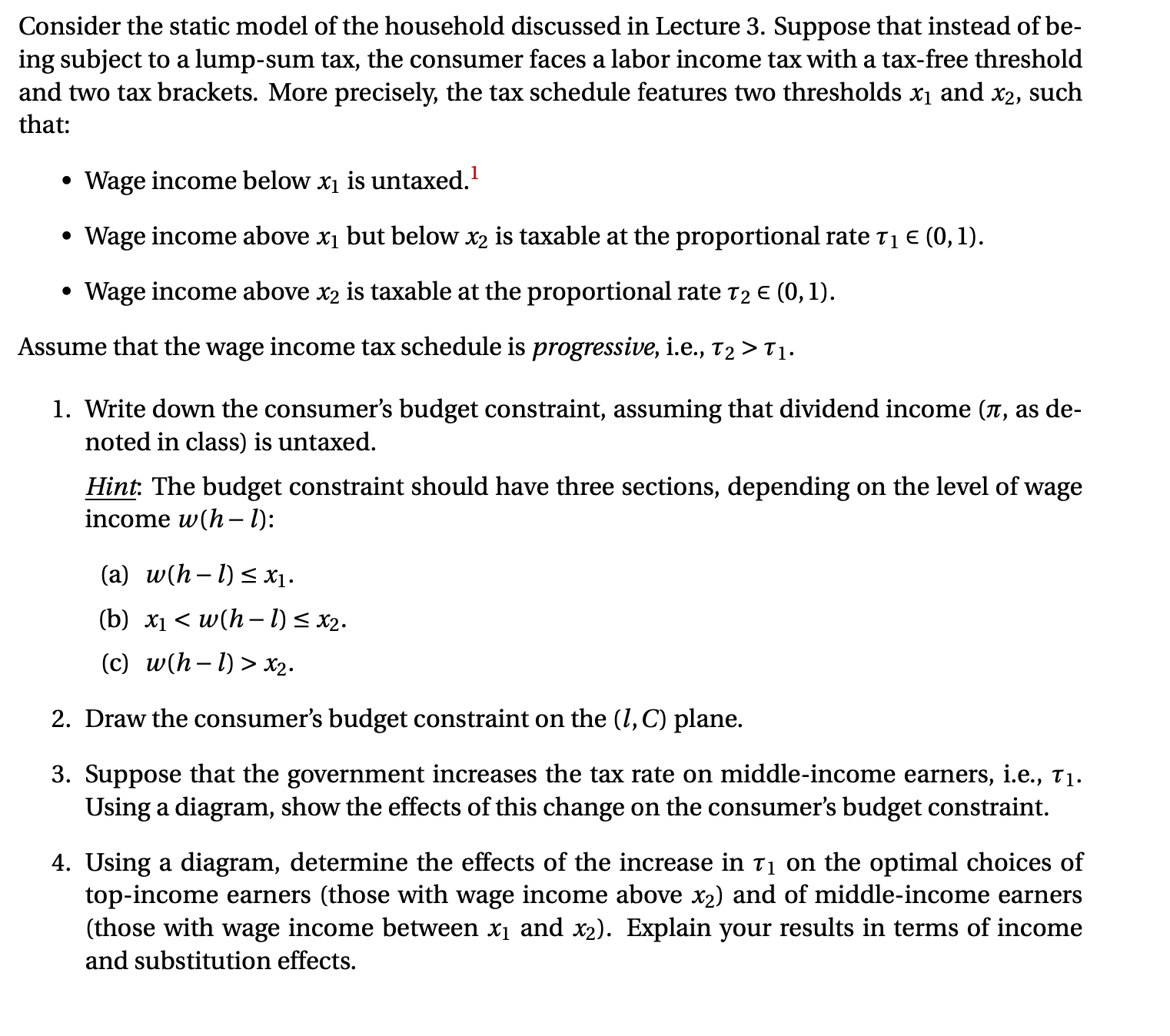
Consider the static model of the household discussed in Lecture 3. Suppose that instead of be- ing subject to a lump-sum tax, the consumer faces a labor income tax with a tax-free threshold and two tax brackets. More precisely, the tax schedule features two thresholds x1 and x2, such that: o Wage income below x1 is untaxed.1 - Wage income above x1 but below 152 is taxable at the proportional rate T1 E (0, 1). 0 Wage income above 152 is taxable at the proportional rate 1:2 E (0, 1). Assume that the wage income tax schedule is progressive, i.e., 12 > 1'1. 1. Write down the consumer's budget constraint, assuming that dividend income (It, as de- noted in class) is untaxed. Hint: The budget constraint should have three sections, depending on the level of wage income 1001 l): (a) w(h l) 5 x1. (b) x1 152. 2. Draw the consumer's budget constraint on the (l, C) plane. 3. Suppose that the government increases the tax rate on middle-income earners, i.e., 11. Using a diagram, show the effects of this change on the consumer's budget constraint. 4. Using a diagram, determine the effects of the increase in n on the optimal choices of top-income earners (those with wage income above x2) and of middle-income earners (those with wage income between x1 and x2). Explain your results in terms of income and substitution effects
Step by Step Solution
There are 3 Steps involved in it

Get step-by-step solutions from verified subject matter experts
 Study Help