



Question: please answer this question in a detailed form following the questions. Part Three: Organizational Structure and Culture Report Based on your analysis of the organization's
please answer this question in a detailed form following the questions.
Part Three: Organizational Structure and Culture Report
Based on your analysis of the organization's structure and culture, share recommendations for changing its structure and culture to be more conducive to innovation.
Describe the current organizational structure's impact on innovation.
How does your company's organizational structure support innovation?
How effective is the current structure in addressing changes in market demand?
Recommend changes to the current organizational structure.
How does the new structure support innovation?
How will your recommended changes make the enterprise more responsive to market demand?
Explain how organizational changes support a culture of innovation.
In what ways does the current
organization's structure and culture, share recommendations for changing its structure and culture to be more conducive to innovation.
Describe the current organizational structure's impact on innovation.
How does your company's organizational structure support innovation?
How effective is the current structure in addressing changes in market demand?
Recommend changes to the current organizational structure.
How does the new structure support innovation?
How will your recommended changes make the enterprise more responsive to market demand?
Explain how organizational changes support a culture of innovation.
In what ways does the current culture work against innovation?
How does the new structure support a culture of innovation?
MBA Organization Overview
Processes Structure, Culture
Your company manufactures and distributes automobiles across six continents. The structure is very complex and it is difficult to accurately count the levels of hierarchy. The company operates under a tall matrixed structure design.
Tall structures can be cumbersome, and decision makers are often those farthest from the customer. Communication can be slow and difficult, also slowing down decisionmaking speed. The specialized functions and organizations, often referred to as centers of excellence or centers of expertise COE allow for deep knowledge and expertise. Your company has many functional COEs where increased structure, governance, and control allow for resource and process efficiencies. Resources are centralized, reducing duplication of effort across the organization. These efficiencies can, however, result in rigid, inflexible processes. In addition, COEs can create functional silos or reduced crossfunctional coordination and lack of connectedness, where each function is striving toward its own unique objectives.
Your company follows a centralized and standardized approach where enterprisewide decisions are often made centrally and at the top of the hierarchy. This centralization makes it easier to implement common policies and practices, prevents parts of the organization from becoming too independent, and capitalizes on specialization.
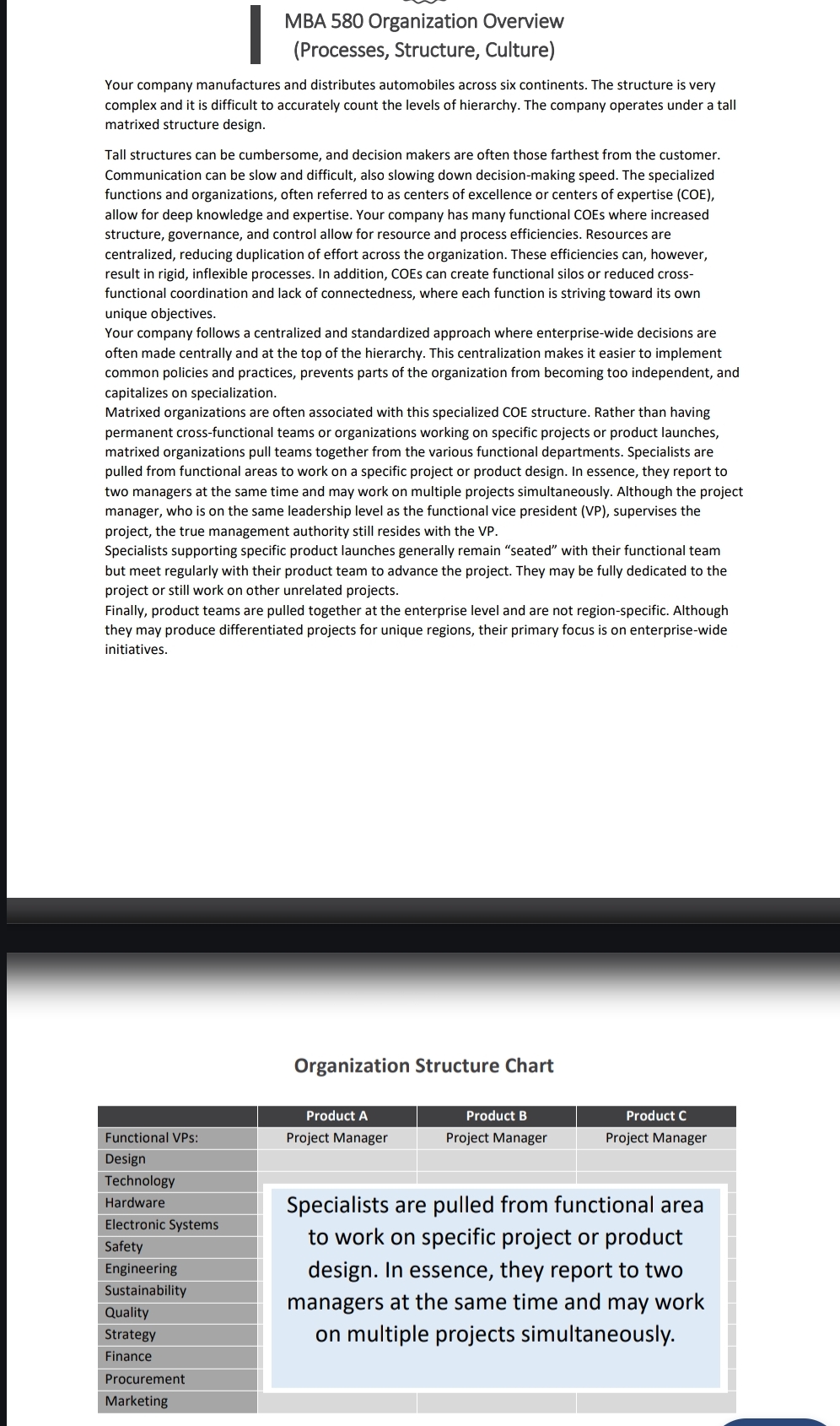
Matrixed organizations are often associated with this specialized COE structure. Rather than having permanent crossfunctional teams or organizations working on specific projects or product launches, matrixed organizations pull teams together from the various functional departments. Specialists are pulled from functional areas to work on a specific project or product design. In essence, they report to two managers at the same time and may work on multiple projects simultaneously. Although the project manager, who is on the same leadership level as the functional vice president VP supervises the project, the true management authority still resides with the VP
Specialists supporting specific product launches generally remain "seated" with their functional team but meet regularly with their product team to advance the project. They may be fully dedicated to the project or still work on other unrelated projects.
Finally, product teams are pulled together at the enterprise level and are not regionspecific. Although they may produce differentiated projects for unique regions, their primary focus is on enterprisewide initiatives.
Organization Structure Chart
tabletableProduct AProject ManagerProduct BProduct CFunctional VPs:Project Manager,Project ManagertableDesignTechnologytableHardwareElectronic Systems
tableSpecialists are pulled from functional areato work on specific project or productdesign In essence, they report to twomanagers at the same time and may workon multiple projects simultaneously.SafetyEngineeringSustainabilitytableQualityStratoovtableStrategyFinancetableFinanceProcurementProcurementMarketing
Step by Step Solution
There are 3 Steps involved in it
1 Expert Approved Answer
Step: 1 Unlock

Question Has Been Solved by an Expert!
Get step-by-step solutions from verified subject matter experts
Step: 2 Unlock
Step: 3 Unlock