



Question: please answer this question in in detail. I have also attached page # 98 so you can refer to different matrices. Thanks in advance! Explain
please answer this question in in detail. I have also attached page # 98 so you can refer to different matrices. Thanks in advance!
Explain how developing matrices for different business functions and creating relationships between them, helps with planning process. You may identify 2 different matrices listed in page 98 (Location-to-Function; Location-to-Unit; Unit-to-FunctionInformation System-to-Objective) and discuss how they can be used in the planning of new information systems. Try to provide examples on how a company can effectively use such tools to plan new systems, which will best fit its strategic needs.
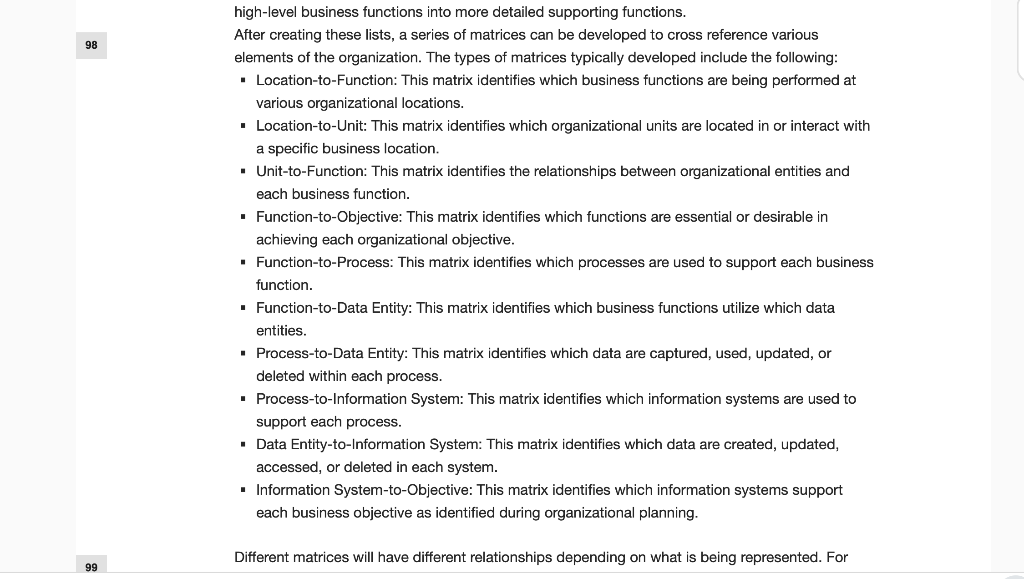
98 high-level business functions into more detailed supporting functions. After creating these lists, a series of matrices can be developed to cross reference various elements of the organization. The types of matrices typically developed include the following: Location-to-Function: This matrix identifies which business functions are being performed at various organizational locations. Location-to-Unit: This matrix identifies which organizational units are located in or interact with a specific business location. Unit-to-Function: This matrix identifies the relationships between organizational entities and each business function. Function-to-Objective: This matrix identifies which functions are essential or desirable in achieving each organizational objective. . Function-to-Process: This matrix identifies which processes are used to support each business function. Function-to-Data Entity: This matrix identifies which business functions utilize which data entities. Process-to-Data Entity: This matrix identifies which data are captured, used, updated, or deleted within each process. Process-to-Information System: This matrix identifies which information systems are used to support each process. Data Entity-to-Information System: This matrix identifies which data are created, updated, accessed, or deleted in each system. Information System-to-Objective: This matrix identifies which information systems support each business objective as identified during organizational planning. Different matrices will have different relationships depending on what is being represented. For 99
Step by Step Solution
There are 3 Steps involved in it
1 Expert Approved Answer
Step: 1 Unlock

Question Has Been Solved by an Expert!
Get step-by-step solutions from verified subject matter experts
Step: 2 Unlock
Step: 3 Unlock