Please answer this question quickly
It is the subject of organizational behavior
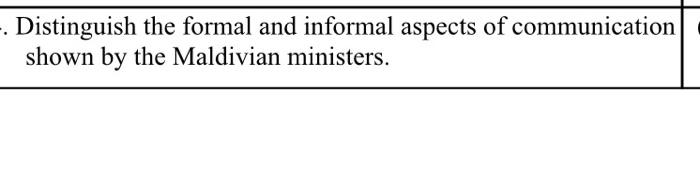
Answer ALL questions. An Underwater Meeting On Saturday October 17, 2009, democratically elected President Mohammad Nasheed of the Maldives invited his 13 officials to a cabinet meeting: the world's first underwater governmental meeting. The meeting "room" was in a lagoon off Girifushi, in the North Male atoll, and the ministers dove 20 feet (6 meters) to meet around a horseshoe-shaped table on the sea floor. The Maldives, located southwest of Sri Lanka, is an Indian Ocean archipelago, whose 1,192 islands stretch for 850 kilometers (530 miles). The Maldivian islands are on average only 2 meters (7 feet) above sea level, and they comprise the lowest-lying nation on the planet. the The meeting agenda highlighted how global warming was threatening the disappearance of the Maldives within a century. In 2007, data about this threat were confirmed by United Nation (UN) Intergovernmental Panel on Climate Change, warning that a rise in sea levels of 18 to 59 centimeters (7 to 23 inches) by 2100 would be enough to make the Maldives virtually uninhabitable. The decision made at the meeting was to sign off on an agreement for carbon emission cuts: We must unite in a global effort to halt further temperature rises." The meeting took place prior to the United Nations climate change conference in December, in anticipation of the renegotiation of the Kyoto Protocol. In which the Kyoto Protocol represented an international agreement linked to the United Nations Framework Convention on Climate Change, which commits its Parties by setting internationally binding emission reduction targets. The Kyoto Protocol recognized the developed countries as being principally responsible for the current high levels of GHG emissions in the atmosphere as a result of their more than 150 years of industrial activity. The Protocol placed a heavier burden on developed nations under the principle of "common but differentiated responsibilities." The Kyoto Protocol was adopted in Kyoto, Japan, on 11 December 1997 and entered into force on 16 February 2005. The detailed rules for the implementation of the Protocol were adopted at COP 7 in Marrakesh, Morocco, in 2001, and are referred to as the "Marrakesh Accords." Its first commitment period in being consonant with the accords started in 2008. In Maldives, the safety of the ministers was well considered; they held a dress rehearsal the day before; coral on the reef was checked for harmful creatures; participants communicated via hand signals to indicate they were okay. Instead of dressing in business suits, though, the 14 government ministers donned scuba diving gear and also wore name tags. Just as in every meeting, discussion took place, but here it was through writing on a special white board. The meeting was broadcast live on television. Inhabitants on Kuda Huvadhoo island built a sealed box, put their television in it, and, following their governments' lead, dove to the depths to view the underwater meeting-underwater. Back on dry land, the cabinet ministers were to sign their wetsuits for auctioning on the www.protectthemaldives.com website in a bid to raise money for protecting coral reefs. President Nasheed used the meeting venue as a publicity exercise to push for action so that his people can continue to live in the Maldives well into the future. . Distinguish the formal and informal aspects of communication shown by the Maldivian ministers