







Question: Please answer this questions ? . (e) What is the approximate probability that the robot will wind up in each of the twelve rooms after
Please answer this questions ?
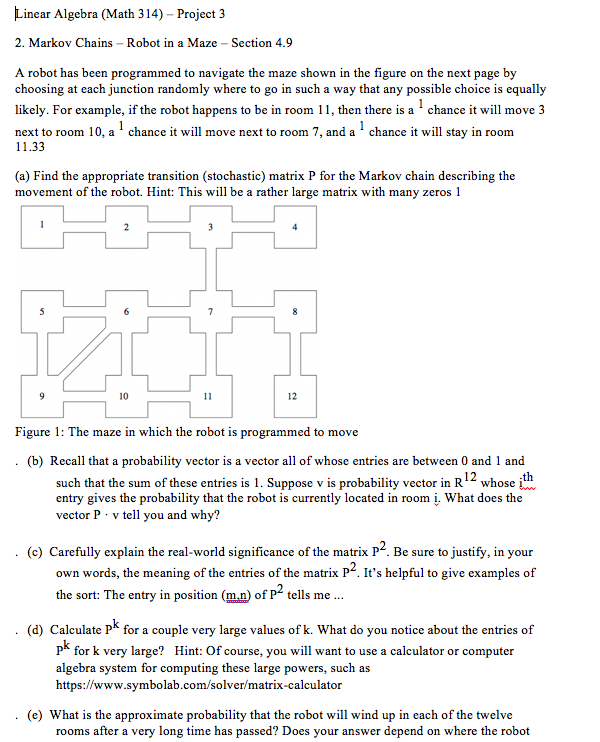
. (e) What is the approximate probability that the robot will wind up in each of the twelve rooms after a very long time has passed? Does your answer depend on where the robot begins its journey? Your answer should be a vector in R12. Hint: To answer this question, it might help to rst thing of the real-world interpretation of the entries of Pk, where k is large, along the lines of part (c) above. Then use the answer to part (d) together with this interpretation to answer the questions. . [t] Find a steady state vector for the robot's movement. 1What is the connection between this vector and your answer to the previous pai't'iI Hint: Recall that a steady state vector for the system is a probability vector that satises the equation m = v. You should obtain a 1-di_mensional subspace as the solution to the linear system P x = g, but only one vector in this subspace will be a probability vector. For bonus points: write a computer program that simulates the way the robot moves and counts how many times it has visited each room. For example, you could modify the Mathematica demon- m found at httpdemonsh'ations.wolfrarn.comJFiniteStateDiscreteTimeMarkovChains to suit the description for this problem. Such programs or demonstrations will be accepted until December 6 and are to be tumed in separately, via email. Linear Algebra (Math 314) - Project 3 2. Markov Chains - Robot in a Maze - Section 4.9 A robot has been programmed to navigate the maze shown in the figure on the next page by choosing at each junction randomly where to go in such a way that any possible choice is equally likely. For example, if the robot happens to be in room 11, then there is a ' chance it will move 3 next to room 10, a ' chance it will move next to room 7, and a ' chance it will stay in room 11.33 (a) Find the appropriate transition (stochastic) matrix P for the Markov chain describing the movement of the robot. Hint: This will be a rather large matrix with many zeros 1 8 12 Figure 1: The maze in which the robot is programmed to move . (b) Recall that a probability vector is a vector all of whose entries are between 0 and 1 and such that the sum of these entries is 1. Suppose v is probability vector in R - whose ith entry gives the probability that the robot is currently located in room i. What does the vector P . v tell you and why? (c) Carefully explain the real-world significance of the matrix P. Be sure to justify, in your own words, the meaning of the entries of the matrix P . It's helpful to give examples of the sort: The entry in position (man) of P tells me ... (d) Calculate PR for a couple very large values of k. What do you notice about the entries of P. for k very large? Hint: Of course, you will want to use a calculator or computer algebra system for computing these large powers, such as https://www.symbolab.com/solver/matrix-calculator (e) What is the approximate probability that the robot will wind up in each of the twelve rooms after a very long time has passed? Does your answer depend on where the robot
Step by Step Solution
There are 3 Steps involved in it

Get step-by-step solutions from verified subject matter experts
 Study Help