Question: please answer this with the working step for each question . tq INDIVIDUAL EXERCISE 4 Human Resources, Job Design, and Work Measurement 1. In time

please answer this with the working step for each question . tq please answer this with the working step for each
please answer this with the working step for each
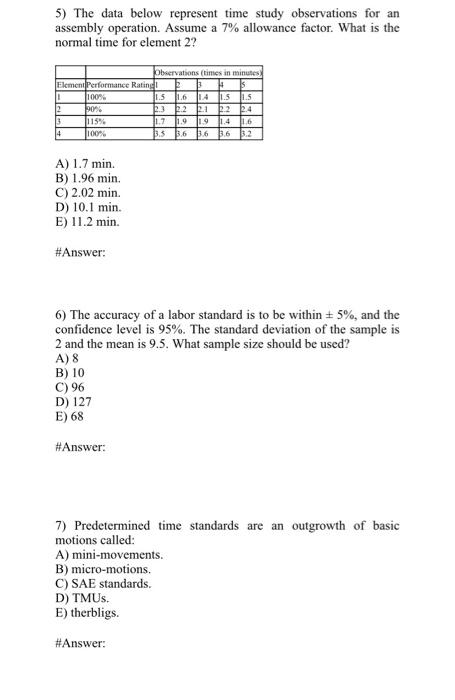
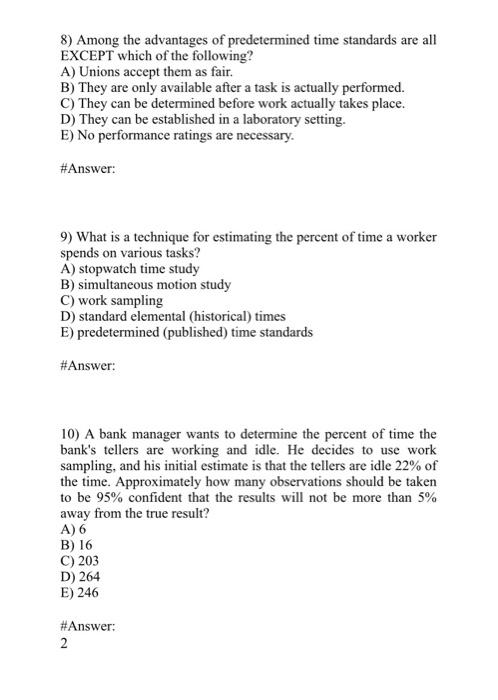
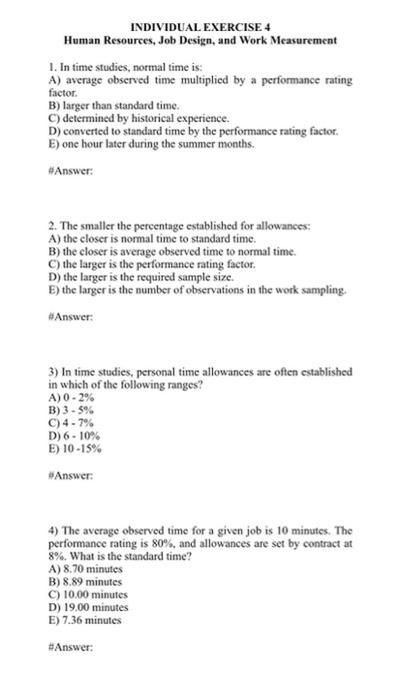
INDIVIDUAL EXERCISE 4 Human Resources, Job Design, and Work Measurement 1. In time studies, normal time is: A) average observed time multiplied by a performance rating factor B) larger than standard time. C) determined by historical experience. D) converted to standard time by the performance rating factor. E) one hour later during the summer months. #Answer: 2. The smaller the percentage established for allowances: A) the closer is normal time to standard time. B) the closer is average observed time to normal time C) the larger is the performance rating factor D) the larger is the required sample size. E) the larger is the number of observations in the work sampling. #Answer: 3) In time studies, personal time allowances are often established in which of the following ranges? A) 0 - 2 B) 3 - 5% C) 4-7% D) 6-10% E) 10-15% #Answer: 4) The average observed time for a given job is 10 minutes. The performance rating is 80%, and allowances are set by contract at 8%. What is the standard time? A) 8.70 minutes B) 8.89 minutes C) 10.00 minutes D) 19.00 minutes E) 7.36 minutes Answer: 5) The data below represent time study observations for an assembly operation. Assume a 7% allowance factor. What is the normal time for element 2? Observations (times in minutes Element Performance Rating 100% 1.5 1614 15 1.5 2 90% 3 115% 11.7 19 1.4 16 14 100% 3.5 3.6 3.6 6 3.2 A) 1.7 min. B) 1.96 min. C) 2.02 min. D) 10.1 min. E) 11.2 min. #Answer: 6) The accuracy of a labor standard is to be within + 5%, and the confidence level is 95%. The standard deviation of the sample is 2 and the mean is 9.5. What sample size should be used? A) 8 B) 10 C) 96 D) 127 E) 68 #Answer: 7) Predetermined time standards are an outgrowth of basic motions called: A) mini-movements. B) micro-motions. C) SAE standards. D) TMUS. E) therbligs. Answer: 8) Among the advantages of predetermined time standards are all EXCEPT which of the following? A) Unions accept them as fair. B) They are only available after a task is actually performed. C) They can be determined before work actually takes place. D) They can be established in a laboratory setting. E) No performance ratings are necessary. #Answer: 9) What is a technique for estimating the percent of time a worker spends on various tasks? A) stopwatch time study B) simultaneous motion study C) work sampling D) standard elemental (historical) times E) predetermined (published) time standards #Answer: 10) A bank manager wants to determine the percent of time the bank's tellers are working and idle. He decides to use work sampling, and his initial estimate is that the tellers are idle 22% of the time. Approximately how many observations should be taken to be 95% confident that the results will not be more than 5% away from the true result? A) 6 B) 16 C) 203 D) 264 E) 246 #Answer: 2

Step by Step Solution

There are 3 Steps involved in it

1 Expert Approved Answer
Step: 1 Unlock blur-text-image

Question Has Been Solved by an Expert!

Get step-by-step solutions from verified subject matter experts

Step: 2 Unlock
Step: 3 Unlock

Students Have Also Explored These Related General Management Questions!