







Question: please answer thoroughly Problem 1: Asymmetric Information Regarding Worker Quality (10 pts) PepsiCo is hiring engineers. It knows that there are high- and low-quality workers
please answer thoroughly
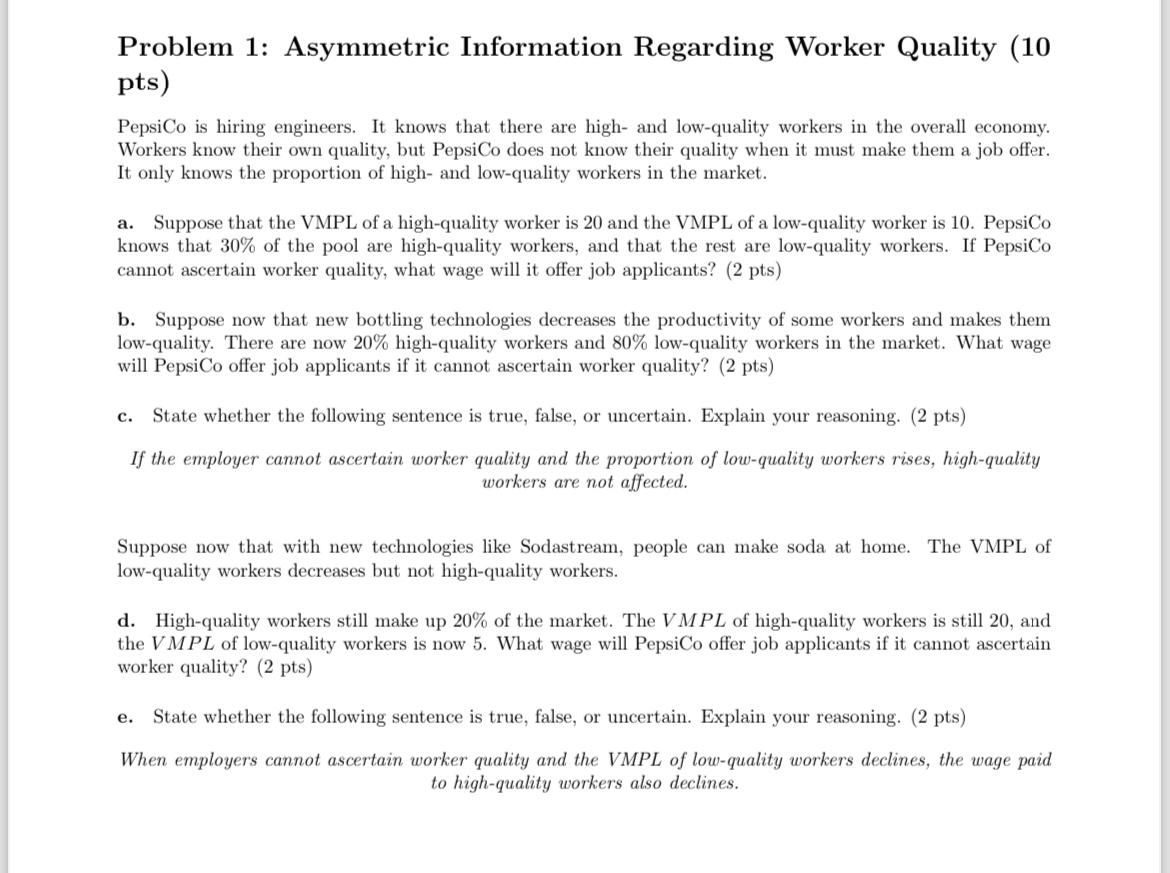
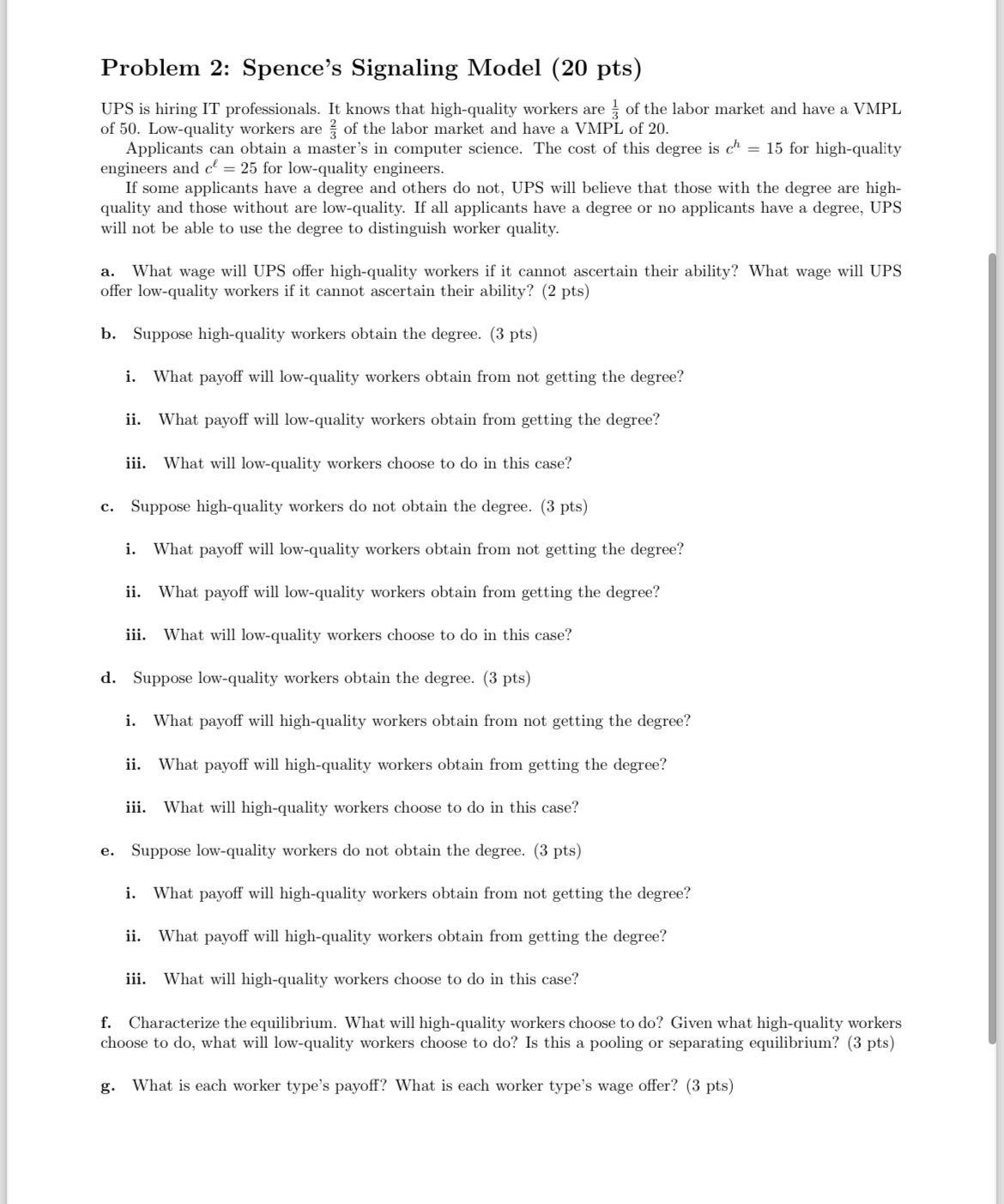
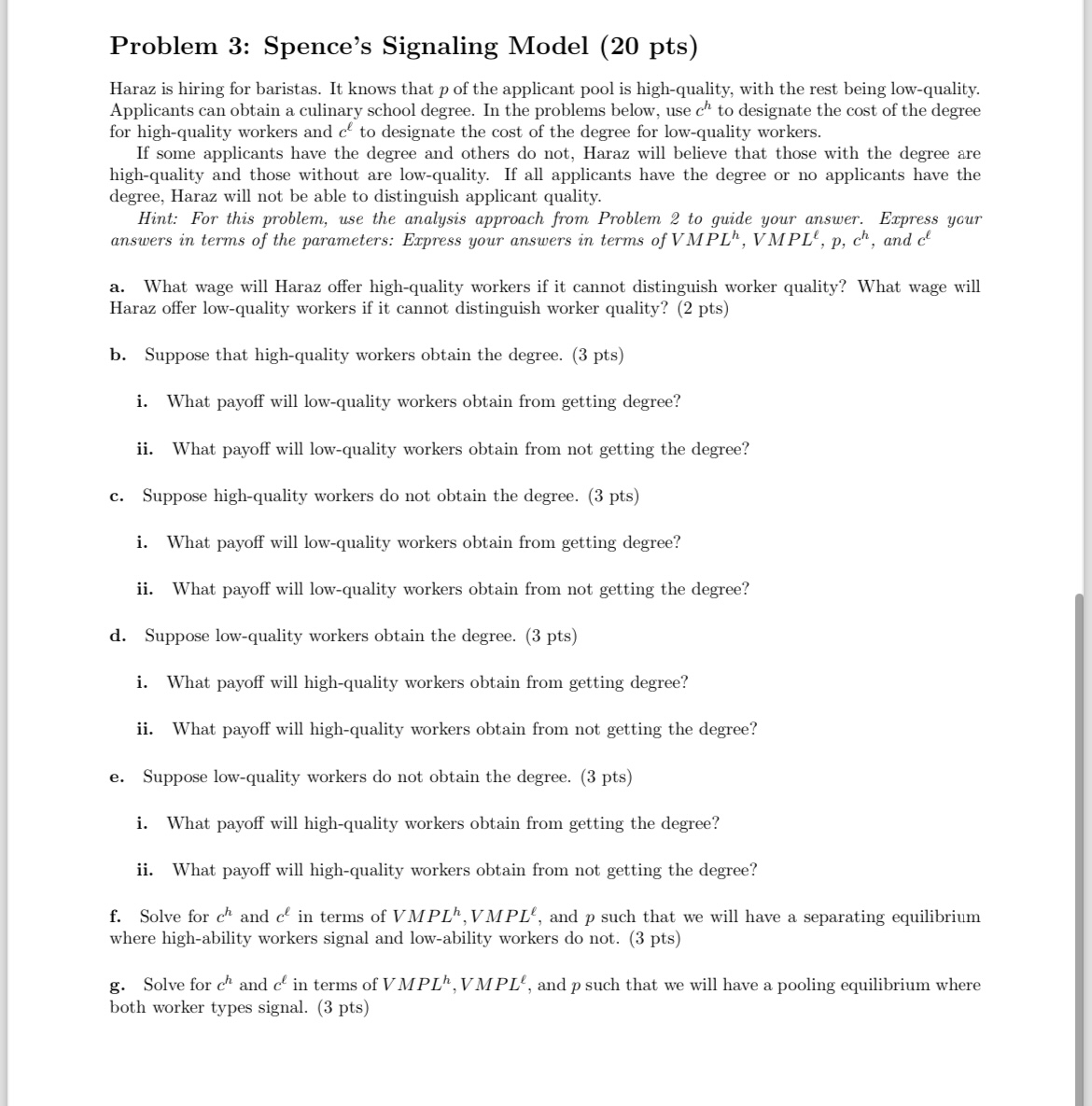
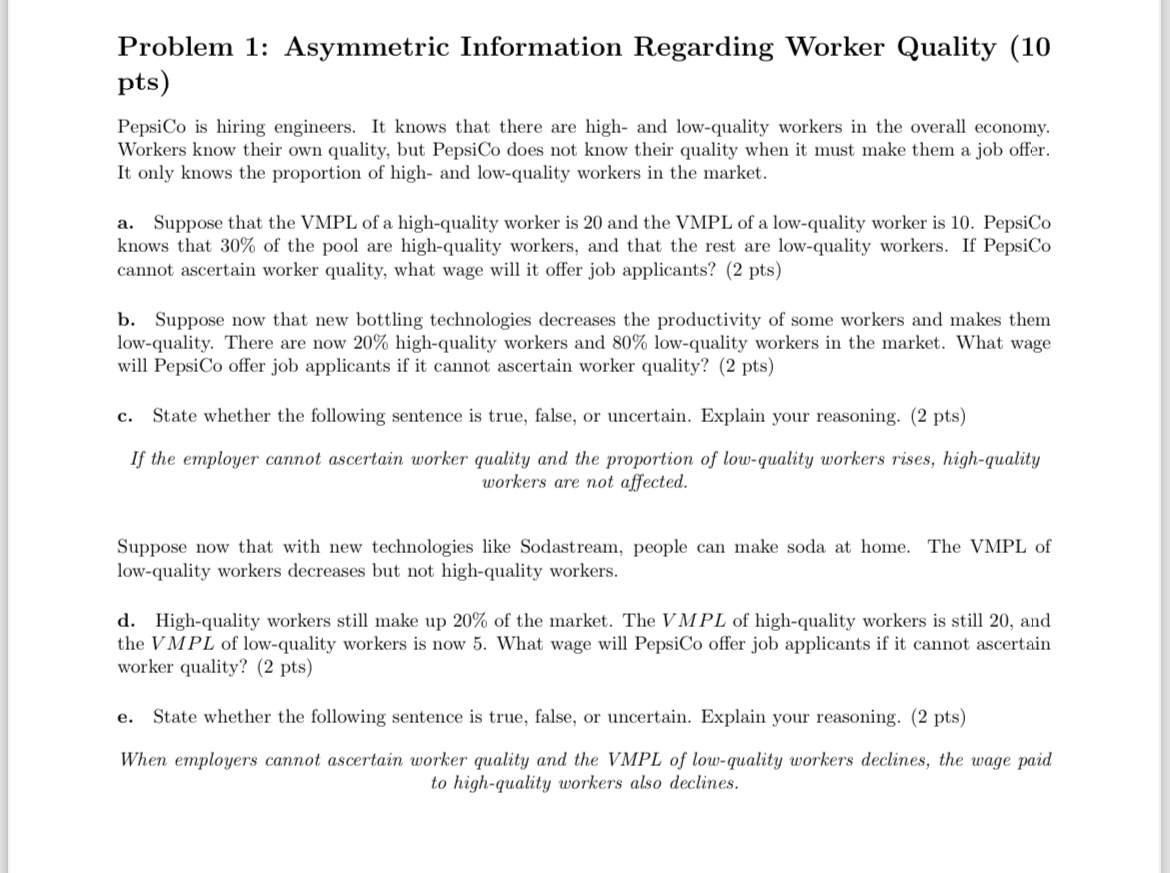
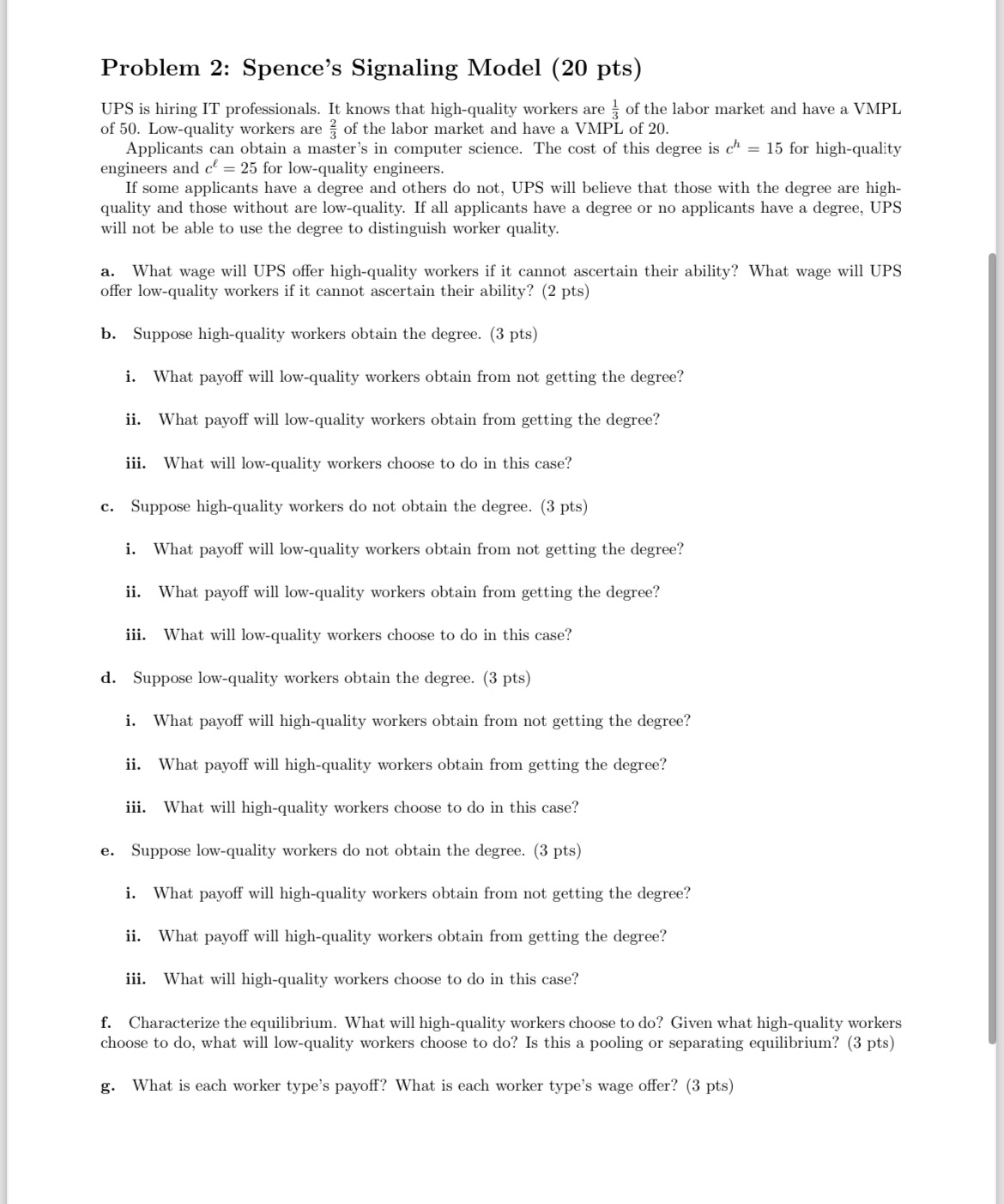
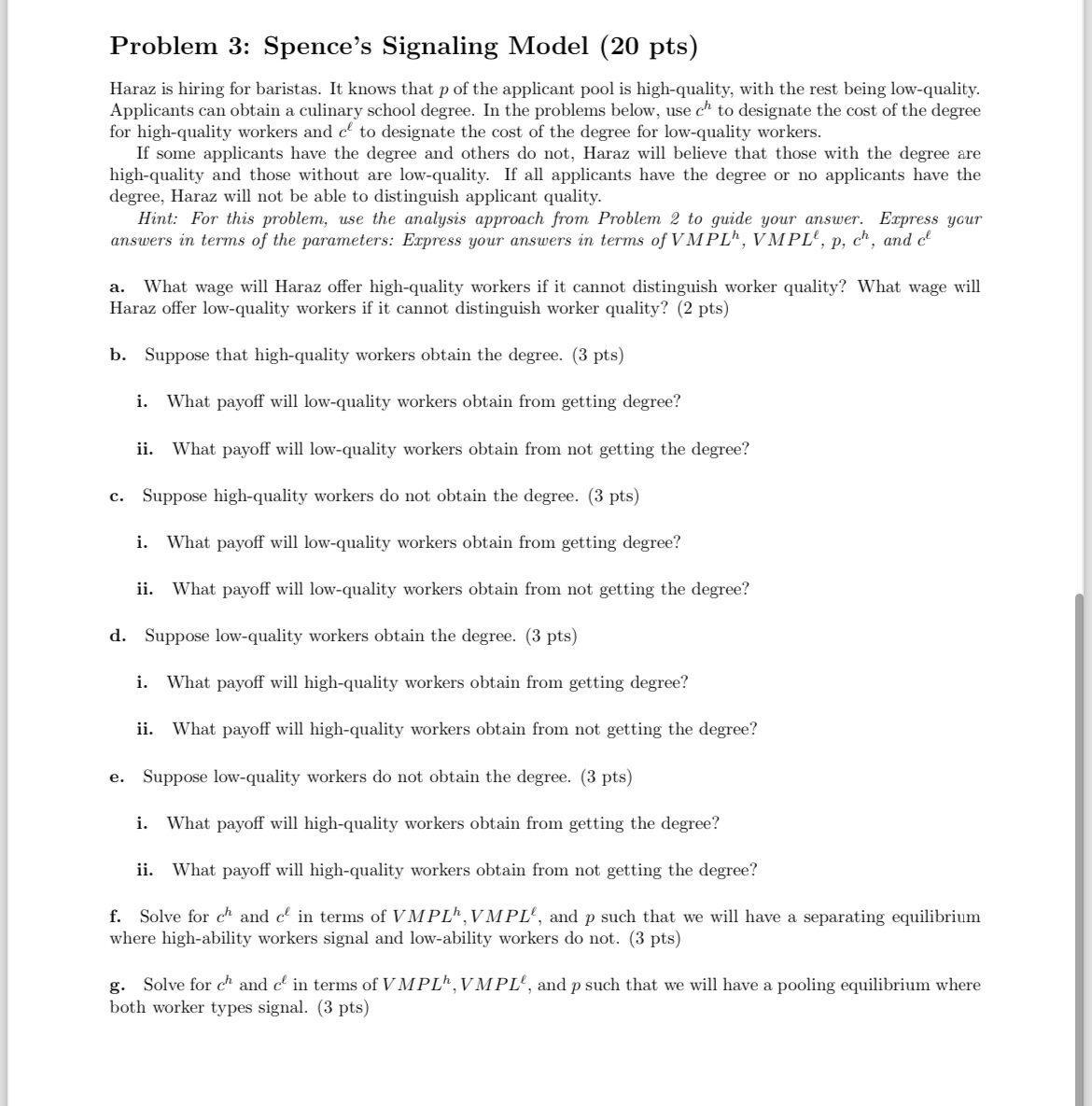
Problem 1: Asymmetric Information Regarding Worker Quality (10 pts) PepsiCo is hiring engineers. It knows that there are high- and low-quality workers in the overall economy. Workers know their own quality, but PepsiCo does not know their quality when it must make them a job offer. It only knows the proportion of high- and low-quality workers in the market. a. Suppose that the VMPL of a high-quality worker is 20 and the VMPL of a low-quality worker is 10. PepsiCo knows that 30% of the pool are high-quality workers, and that the rest are low-quality workers. If PepsiCo cannot ascertain worker quality, what wage will it offer job applicants? (2 pts) b. Suppose now that new bottling technologies decreases the productivity of some workers and makes them low-quality. There are now 20% high-quality workers and 80% low-quality workers in the market. What wage will PepsiCo offer job applicants if it cannot ascertain worker quality? (2 pts) c. State whether the following sentence is true, false, or uncertain. Explain your reasoning. (2 pts) If the employer cannot ascertain worker quality and the proportion of low-quality workers rises, high-quality workers are not affected. Suppose now that with new technologies like Sodastream, people can make soda at home. The VMPL of low-quality workers decreases but not high-quality workers. d. High-quality workers still make up 20% of the market. The VMPL of high-quality workers is still 20, and the VMPL of low-quality workers is now 5. What wage will PepsiCo offer job applicants if it cannot ascertain worker quality? (2 pts) e. State whether the following sentence is true, false, or uncertain. Explain your reasoning. (2 pts) When employers cannot ascertain worker quality and the VMPL of low-quality workers declines, the wage paid to high-quality workers also declines.Problem 2: Spence's Signaling Model (20 pts) UPS is hiring IT professionals. It knows that high-quality workers are % of the labor market and have a VMPL of 50. Low-quality workers are % of the labor market and have a VMPL of 20. Applicants can obtain a master's in computer science. The cost of this degree is " = 15 for high-quality engineers and / = 25 for low-quality engineers. If some applicants have a degree and others do not, UPS will believe that those with the degree are high- quality and those without are low-quality. If all applicants have a degree or no applicants have a degree, UPS will not be able to use the degree to distinguish worker quality. a. What wage will UPS offer high-quality workers if it cannot ascertain their ability? What wage will UPS offer low-quality workers if it cannot ascertain their ability? (2 pts) b. Suppose high-quality workers obtain the degree. (3 pts) i. What payoff will low-quality workers obtain from not getting the degree? ii. What payoff will low-quality workers obtain from getting the degree? iii. What will low-quality workers choose to do in this case? c. Suppose high-quality workers do not obtain the degree. (3 pts) i. What payoff will low-quality workers obtain from not getting the degree? ii. What payoff will low-quality workers obtain from getting the degree? iii. What will low-quality workers choose to do in this case? d. Suppose low-quality workers obtain the degree. (3 pts) i. What payoff will high-quality workers obtain from not getting the degree? ii. What payoff will high-quality workers obtain from getting the degree? iii. What will high-quality workers choose to do in this case? e. Suppose low-quality workers do not obtain the degree. (3 pts) i. What payoff will high-quality workers obtain from not getting the degree? ii. What payoff will high-quality workers obtain from getting the degree? iii. What will high-quality workers choose to do in this case? f. Characterize the equilibrium. What will high-quality workers choose to do? Given what high-quality workers choose to do, what will low-quality workers choose to do? Is this a pooling or separating equilibrium? (3 pts) g. What is each worker type's payoff? What is each worker type's wage offer? (3 pts) Problem 3: Spence's Signaling Model (20 pts) Haraz is hiring for baristas. It knows that p of the applicant pool is high-quality, with the rest being low-quality. Applicants can obtain a culinary school degree. In the problems below, use ch to designate the cost of the degree for high-quality workers and c' to designate the cost of the degree for low-quality workers. If some applicants have the degree and others do not, Haraz will believe that those with the degree are high-quality and those without are low-quality. If all applicants have the degree or no applicants have the degree, Haraz will not be able to distinguish applicant quality. Hint: For this problem, use the analysis approach from Problem 2 to guide your answer. Express your answers in terms of the parameters: Express your answers in terms of VMPL", VMPL', p, ch, and ce a. What wage will Haraz offer high-quality workers if it cannot distinguish worker quality? What wage will Haraz offer low-quality workers if it cannot distinguish worker quality? (2 pts) b. Suppose that high-quality workers obtain the degree. (3 pts) i. What payoff will low-quality workers obtain from getting degree? ii. What payoff will low-quality workers obtain from not getting the degree? c. Suppose high-quality workers do not obtain the degree. (3 pts) i. What payoff will low-quality workers obtain from getting degree? ii. What payoff will low-quality workers obtain from not getting the degree? d. Suppose low-quality workers obtain the degree. (3 pts) i. What payoff will high-quality workers obtain from getting degree? ii. What payoff will high-quality workers obtain from not getting the degree? e. Suppose low-quality workers do not obtain the degree. (3 pts) i. What payoff will high-quality workers obtain from getting the degree? ii. What payoff will high-quality workers obtain from not getting the degree? f. Solve for ch and c' in terms of VMPL", VMPL', and p such that we will have a separating equilibrium where high-ability workers signal and low-ability workers do not. (3 pts) g. Solve for ch and c' in terms of VMPL", VMPL', and p such that we will have a pooling equilibrium where both worker types signal. (3 pts)
Step by Step Solution
There are 3 Steps involved in it

Get step-by-step solutions from verified subject matter experts
 Study Help