







Question: please answer those question from the case study Describe what is meant by motivation. What types of non-financial reward might a company use to motivate
please answer those question from the case study
Describe what is meant by motivation. What types of non-financial reward might a company use to motivate employees?
Describe the effects of an unmotivated workforce on a company. How does Tesco benefit from ensuring that its workforce is motivated?
Why is Taylors theory not relevant to companies and employees in the 21st century?
Evaluate the four motivational theories in the study, demonstrating how each relates to Tesco
Show transcribed image text
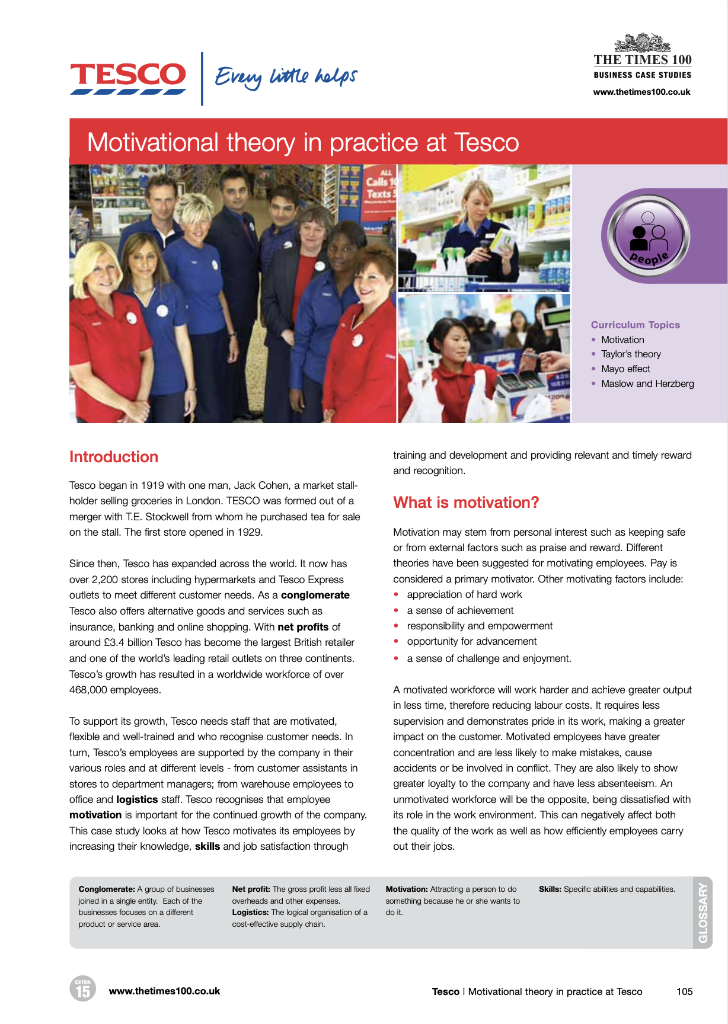
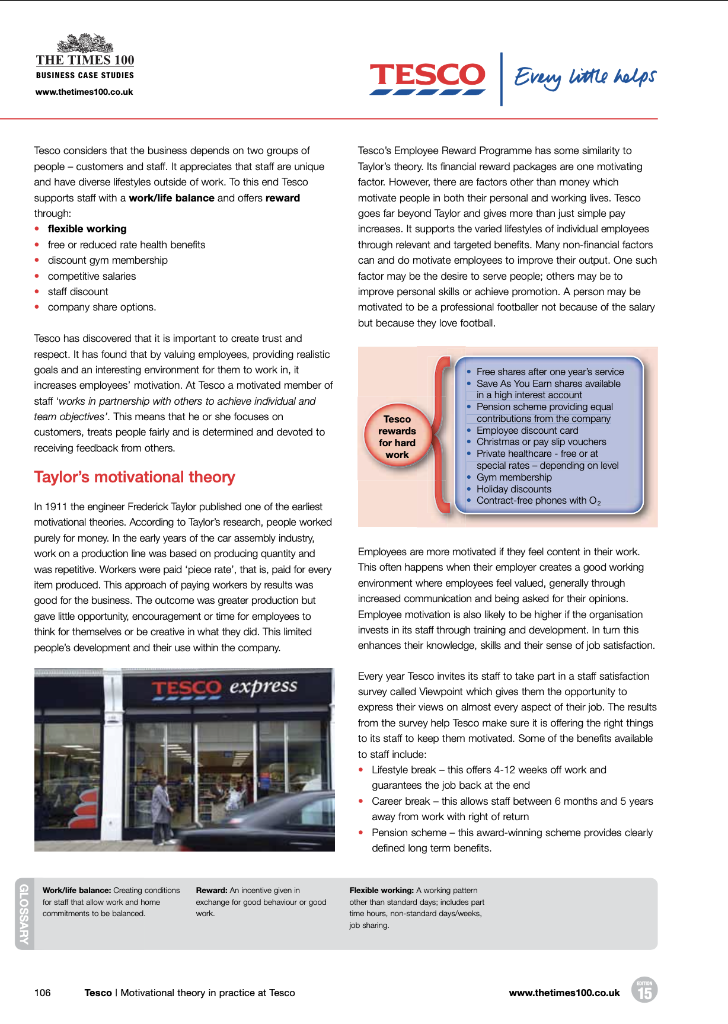
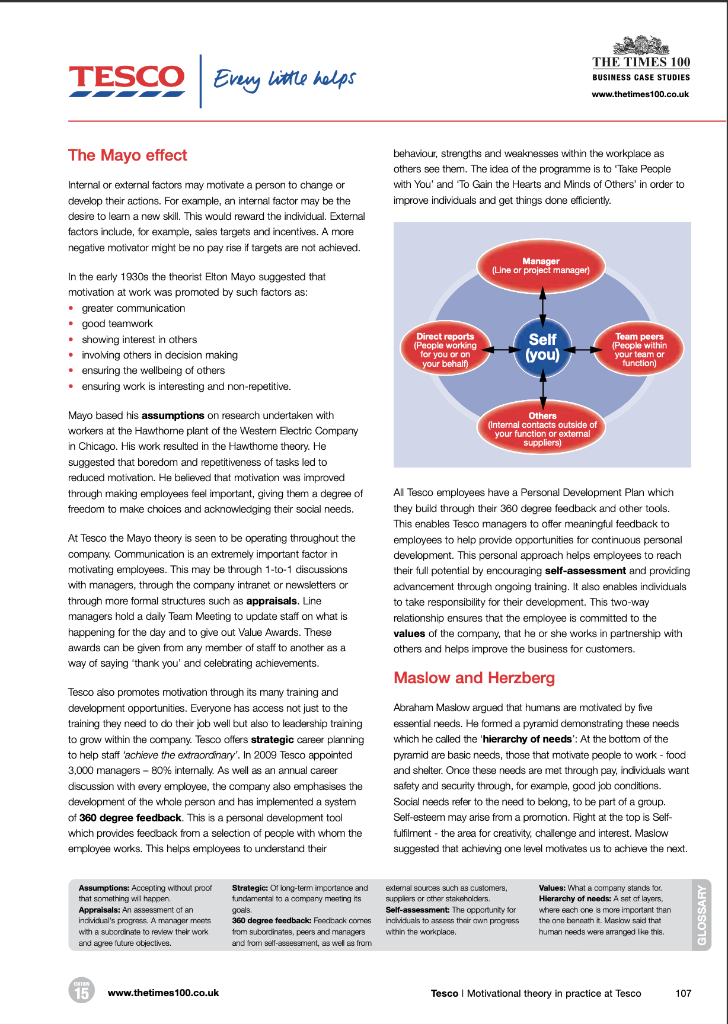
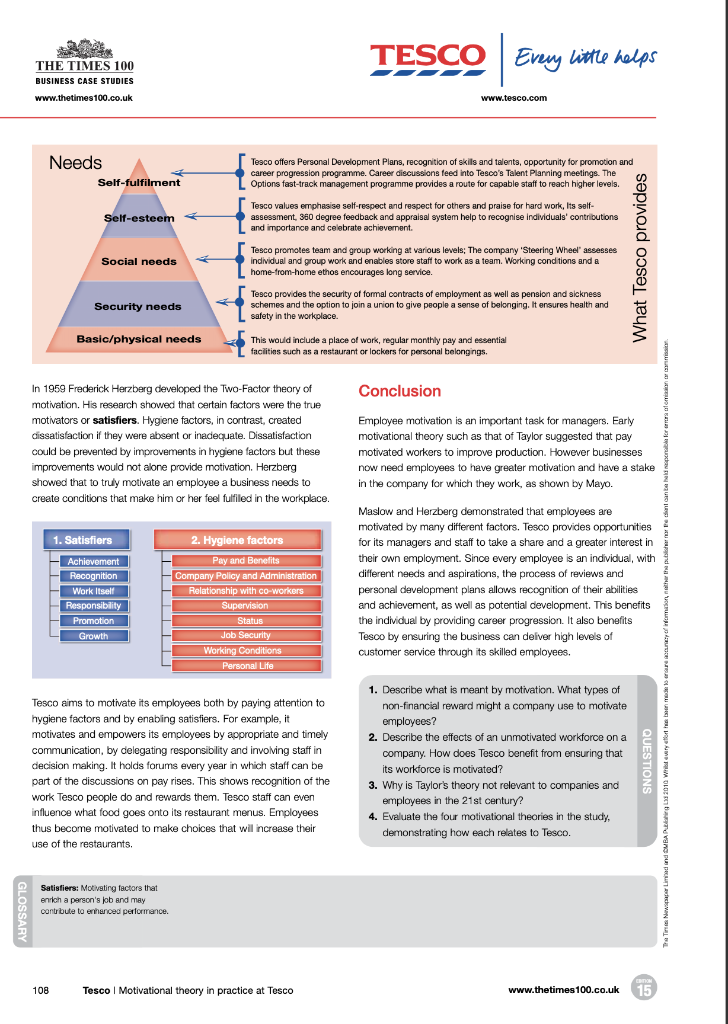
TESCO Every little helps THE TIMES 100 BUSINESS CASE STUDIES www.the times100.co.uk Motivational theory in practice at Tesco ALL Calls 10 Texts People Curriculum Topics . Motivation Taylor's theory Mayo effect Maslow and Herzberg Introduction training and development and providing relevant and timely reward and recognition. Tesco began in 1919 with one man, Jack Cohen, a market stall- holder selling groceries in London. TESCO was formed out of a merger with T.E. Stockwell from whom he purchased tea for sale on the stall. The first store opened in 1929. What is motivation? Since then, Tesco has expanded across the world. It now has over 2,200 stores including hypermarkets and Tesco Express Outlets to meet different customer needs. As a conglomerate Tesco also offers alternative goods and services such as insurance, banking and online shopping. With net profits of around 3.4 billion Tesco has become the largest British retailer and one of the world's leading retail outlets on three continents. Tesco's growth has resulted in a worldwide workforce of over 468,000 employees Motivation may stem from personal interest such as keeping safe or from external factors such as praise and reward. Different theories have been suggested for motivating employees. Pay is considered a primary motivator. Other motivating factors include: appreciation of hard work a sense of achievement responsibility and empowerment opportunity for advancement a sense of challenge and enjoyment. To support its growth, Tesco needs staff that are motivated, flexible and well-trained and who recognise customer needs. In turn, Tesco's employees are supported by the company in their various roles and at different levels - from customer assistants in stores to department managers; from warehouse employees to office and logistics staff. Tesco recognises that employee motivation is important for the continued growth of the company This case study looks at how Tesco motivates its employees by increasing their knowledge, skills and job satisfaction through A motivated workforce will work harder and achieve greater output in less time, therefore reducing labour costs. It requires less supervision and demonstrates pride in its work, making a greater impact on the customer. Motivated employees have greater concentration and are less likely to make mistakes, cause accidents or be involved in conflict. They are also likely to show greater loyalty to the company and have less absenteeism. An . unmotivated workforce will be the opposite, being dissatisfied with its role in the work environment. This can negatively affect both the quality of the work as well as how efficiently employees carry out their jobs. . Skills: Specificatiities and capabilities Conglomerate: A group of businesses joined in a single entity. Each of the businesses focuses on a different product or service area . Net profit: The gross profit less all fixed overheads and other expenses. Logistics: The logical organisation of a cost-effective supply chain. Motivation: Attracting a person to do something because he or she wants to do it. GLOSSARY 15 www.thetimes 100.co.uk Tesco | Motivational theory in practice at Tesco 105 THE TIMES 100 BUSINESS CASE STUDIES www.thetimes100.co.uk TESCO Evry little helps Tesco considers that the business depends on two groups of people - customers and staff. It appreciates that staff are unique and have diverse lifestyles outside of work. To this end Tesco supports staff with a work/life balance and offers reward poris through: flexible working free or reduced rate health benefits discount gym membership competitive salaries staff discount company share options. Tesco's Employee Reward Programme has some similarity to Taylor's theory. Its financial reward packages are one motivating factor. However, there are factors other than money which motivate people in both their personal and working lives. Tesco goes far beyond Taylor and gives more than just simple pay increases. It supports the varied lifestyles of individual employees through relevant and targeted benefits. Many non-financial factors can and do motivate employees to improve their output. One such factor may be the desire to serve people; others may be to improve personal skills or achieve promotion. A person may be motivated to be a professional footballer not because of the salary but because they love footbal. Tesco has discovered that it is important to create trust and respect. It has found that by valuing employees, providing realistic goals and an interesting environment for them to work in, it increases employees' motivation. At Tesco a motivated member of staff 'works in partnership with others to achieve individual and team objectives'. This means that he or she focuses on customers, treats people fairly and is determined and devoted to receiving feedback from others. . Tesco rewards for hard work . Free shares after one year's service Save As You Earn shares available in a high interest account Pension scheme providing equal contributions from the company Employee discount card Christmas or pay slip vouchers Private healthcare - froe or at special rates - depending on level Gym membership Holiday discounts Contract-free phones with Oz Taylor's motivational theory In 1911 the engineer Frederick Taylor published one of the earliest motivational theories. According to Taylor's research, people worked purely for money. In the early years of the car assembly industry, work on a production line was based on producing quantity and was repetitive. Workers were paid "piece rate', that is, paid for every item produced. This approach of paying workers by results was good for the business. The outcome was greater production but gave ittle opportunity, encouragement or time for employees to think for themselves or be creative in what they did. This limited people's development and their use within the company. . Employees are more motivated if they feel content in their work. This often happens when their employer creates a good working environment where employees feel valued, generally through increased communication and being asked for their opinions. Employee motivation is also likely to be higher if the organisation invests in its staff through training and development. In turn this enhances their knowledge, skills and their sense of job satisfaction. TESCO express Every year Tesco invites its staff to take part in a staff satisfaction survey called Viewpoint which gives them the opportunity to express their views on almost every aspect of their job. The results from the survey help Tesco make sure it is offering the right things to its staff to keep them motivated. Some of the benefits available to staff include: : Lifestyle break - this offers 4-12 weeks off work and guarantees the job back at the end Career break - this allows staff between 6 months and 5 years - 6 5 away from work with right of return Pension scheme - this award-winning scheme provides clearly defined long term benefits. Work/life balance: Creating conditions for stall that alow work and home commitments to be balanced. Reward: An incentive given in exchange for good behaviour or good work Flexible working: A working pattern other than standard days, includes part time hours, non standard days/wooks, job sharing. 106 Tesco | Motivational theory in practice at Tesco www.thetimes 100.co.uk 15 TESCO Every little helps THE TIMES 100 BUSINESS CASE STUDIES www.thetimes100.co.uk The Mayo effect behaviour, strengths and weaknesses within the workplace as others see them. The idea of the programme is to "Take People with You' and 'To Gain the Hearts and Minds of Others' in order to improve individuals and get things done efficiently. Internal or external factors may motivate a person to change or develop their actions. For example, an internal factor may be the desire to learn a new skill. This would reward the individual. External factors include, for example, sales targets and incentives. A more negative motivator might be no pay rise if targets are not achieved. Manager (Line or project manager) In the early 1930s the theorist Elton Mayo suggested that motivation at work was promoted by such factors as: greater communication good teamwork showing interest in others involving others in decision making ensuring the wellbeing of others ensuring work is interesting and non-repetitive. Direct reports (People working for you or on your behalf) Self (you) Team peers (People within your team o function) Others (Internal contacts outside of your function or external suppliers) Mayo based his assumptions on research undertaken with workers at the Hawthome plant of the Western Electric Company Chicago. His work resulted in the Hawthome theory. He suggested that boredom and repetitiveness of tasks led to reduced motivation. He believed that motivation was improved through making employees feel important, giving them a degree of freedom to make choices and acknowledging their social needs. At Tesco the Mayo theory is seen to be operating throughout the company. Communication is an extremely important factor in motivating employees. This may be through 1-to-1 discussions with managers, through the company intranet or newsletters or through more formal structures such as appraisals. Line managers hold a daily Team Meeting to update staff on what is happening for the day and to give out Value Awards. These awards can be given from any member of staff to another as a way of saying thank you' and celebrating achievements. Al Tesco employees have a Personal Development Plan which they build through their 360 degree feedback and other tools. This enables Tesco managers to offer meaningful feedback to employees to help provide opportunities for continuous personal development. This personal approach helps employees to reach their full potential by encouraging self-assessment and providing advancement through ongoing training. It also enables individuals to take responsibility for their development. This two-way relationship ensures that the employee is committed to the values of the company, that he or she works in partnership with others and helps improve the business for customers. Maslow and Herzberg Tesco also promotes motivation through its many training and development opportunities. Everyone has access not just to the training they need to do their job well but also to leadership training to grow within the company. Tesco offers strategic career planning to help staff achieve the extraordinary'. In 2009 Tesco appointed 3,000 managers - 80% internally. As well as an annual career discussion with every employee, the company also emphasises the development of the whole person and has implemented a system of 360 degree feedback. This is a personal development tool which provides feedback from a selection of people with whom the employee works. This helps employees to understand their Abraham Maslow argued that humans are motivated by five essential needs. He formed a pyramid demonstrating these needs which he called the 'hierarchy of needs': At the bottom of the pyramid are basic needs, those that motivate people to work - food and shelter. Once these needs are met through pay, individuals want safety and security through, for example, good job conditions. Social needs refer to the need to belong, to be part of a group, Self-esteem may arise from a promotion. Right at the top is Self- fulfilment - the area for creativity, challenge and interest. Maslow suggested that achieving one level motivates us to achieve the next Assumptions: Accepting without proof that something will happen Appraisals: An assessment of an incirica's progress. A manager meets with a subordinate to review the work and agree future objectives Strategic: Of long-term importance and fundamentalto a company meeting its goals 360 degree feedback: Foodback comes from subordinates, peers and managers and from sel-seosament, as well as from external sources such as customers, suppliers or other stakeholders. Self-assessment: The opportunty for individuals to assess their own progress within the workplace. Values: What a company stands for Hierarchy of needs: A set of nors where each one is more important than the one baneath t. Maslow said that human needs were arranged Ike this 15 www.thetimes 100.co.uk Tesco | Motivational theory in practice at Tesco 107 TESCO Evry little helps THE TIMES 100 BUSINESS CASE STUDIES www.thetimes100.co.uk www.tesco.com Needs Self-fulfilment Self-esteem - Tesco offers Personal Development Plans, recognition of skills and talents, opportunity for promotion and career progression programme. Career discussions feed into Tesco's Talent Planning meetings. The Options fast-track management programme provides a route for capable staff to reach higher levels. Tesco values emphasise self-respect and respect for others and praise for hard work, Its self- assessment, 360 degree feedback and appraisal system help to recognise Individuals' contributions L and importance and celebrate achievement. Tesco promotes team and group working at various levels: The company 'Steering Wheel' assesses individual and group work and enables store staff to work as a team. Working conditions and a home-from-home ethos encourages long service. Tesco provides the security of formal contracts of employment as well as pension and sickness schemes and the option to join a union to give people a sense of belonging. It ensures health and safety in the workplace. Social needs What Tesco provides Security needs Basic/physical needs This would include a place of work, regular monthly pay and essential facilities such as a restaurant or lockers for personal belongings. Conclusion In 1959 Frederick Herzberg developed the Two-Factor theory of motivation. His research showed that certain factors were the true motivators or satisfiers. Hygiene factors, in contrast, created dissatisfaction if they were absent or inadequate. Dissatisfaction could be prevented by improvements in hygiene factors but these improvements would not alone provide motivation. Herzberg showed that to truly motivate an employee a business needs to create conditions that make him or her feel fulfilled in the workplace. Employee motivation is an important task for managers. Early motivational theory such as that of Taylor suggested that pay motivated workers to improve production. However businesses now need employees to have greater motivation and have a stake in the company for which they work, as shown by Mayo. 1. Satisfiers Achievement Recognition Work itself Responsibility Promotion 2. Hygiene factors Pay and Benefits Company Policy and Administration Relationship with co-workers Supervision Status Job Security Working Conditions Personal Life Maslow and Herzberg demonstrated that employees are motivated by many different factors. Tesco provides opportunities for its managers and staff to take a share and a greater interest in their own employment. Since every employee is an individual, with different needs and aspirations, the process of reviews and personal development plans allows recognition of their abilities and achievement, as well as potential development. This benefits the individual by providing career progression. It also benefits Tesco by ensuring the business can deliver high levels of customer service through its skilled employees. Growth Tesco aims to motivate its employees both by paying attention to hygiene factors and by enabing satisfiers. For example, it motivates and empowers its employees by appropriate and timely communication, by delegating responsibility and involving staff in decision making. It holds forums every year in which staff can be part of the discussions on pay rises. This shows recognition of the work Tesco people do and rewards them. Tesco staff can even influence what food goes onto its restaurant menus. Employees thus become motivated to make choices that will increase their use of the restaurants, 1. Describe what is meant by motivation. What types of non-financial reward might a company use to motivate employees? 2. Describe the effects of an unmotivated workforce on a company. How does Tesco benefit from ensuring that . its workforce is motivated? 3. Why is Taylor's theory not relevant to companies and employees in the 21st century? 4. Evaluate the four motivational theories in the study, , demonstrating how each relates to Tesco. QUESTIONS Satisfiers: Motivating factors that enrich a person's Job and may contribute to enhanced performance. 108 Tesco | Motivational theory in practice at Tesco www.thetimes 100.co.uk 15Step by Step Solution
There are 3 Steps involved in it
1 Expert Approved Answer
Step: 1 Unlock

Question Has Been Solved by an Expert!
Get step-by-step solutions from verified subject matter experts
Step: 2 Unlock
Step: 3 Unlock
 Study Help