







Question: please answer: true or false? numbers 17-23 18. 17. Using a defense in depth approach, designers try and imagine every possible scenario that can occur
please answer: true or false? 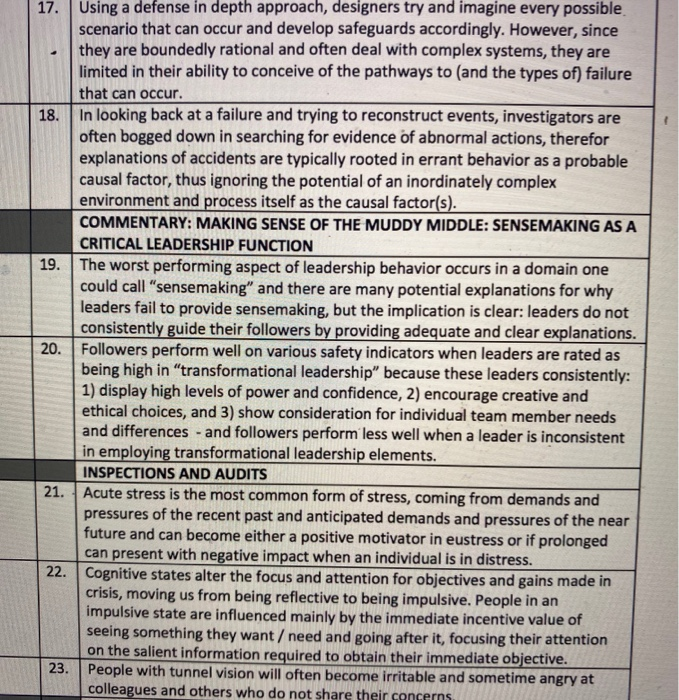
18. 17. Using a defense in depth approach, designers try and imagine every possible scenario that can occur and develop safeguards accordingly. However, since they are boundedly rational and often deal with complex systems, they are limited in their ability to conceive of the pathways to (and the types of) failure that can occur. In looking back at a failure and trying to reconstruct events, investigators are often bogged down in searching for evidence of abnormal actions, therefor explanations of accidents are typically rooted in errant behavior as a probable causal factor, thus ignoring the potential of an inordinately complex environment and process itself as the causal factor(s). COMMENTARY: MAKING SENSE OF THE MUDDY MIDDLE: SENSEMAKING AS A CRITICAL LEADERSHIP FUNCTION 19. The worst performing aspect of leadership behavior occurs in a domain one could call "sensemaking" and there are many potential explanations for why leaders fail to provide sensemaking, but the implication is clear: leaders do not consistently guide their followers by providing adequate and clear explanations. 20. Followers perform well on various safety indicators when leaders are rated as being high in "transformational leadership" because these leaders consistently: 1) display high levels of power and confidence, 2) encourage creative and ethical choices, and 3) show consideration for individual team member needs and differences - and followers perform less well when a leader is inconsistent in employing transformational leadership elements. INSPECTIONS AND AUDITS 21. Acute stress is the most common form of stress, coming from demands and pressures of the recent past and anticipated demands and pressures of the near future and can become either a positive motivator in eustress or if prolonged can present with negative impact when an individual is in distress. Cognitive states alter the focus and attention for objectives and gains made in crisis, moving us from being reflective to being impulsive. People in an impulsive state are influenced mainly by the immediate incentive value of seeing something they want / need and going after it, focusing their attention on the salient information required to obtain their immediate objective. 23. People with tunnel vision will often become irritable and sometime angry at colleagues and others who do not share their concerne 22 numbers 17-23
Step by Step Solution
There are 3 Steps involved in it
1 Expert Approved Answer
Step: 1 Unlock

Question Has Been Solved by an Expert!
Get step-by-step solutions from verified subject matter experts
Step: 2 Unlock
Step: 3 Unlock
 Study Help