







Question: PLEASE ANSWER U5. S5 IS HERE ONLY AS A REFERENCE U5. Return to the situation in Exercise S5, where Tudor's low per-unit production cost is
PLEASE ANSWER U5. S5 IS HERE ONLY AS A REFERENCE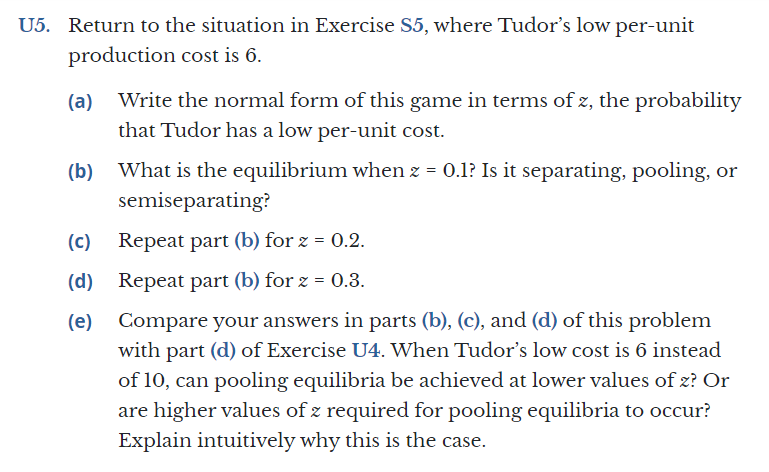
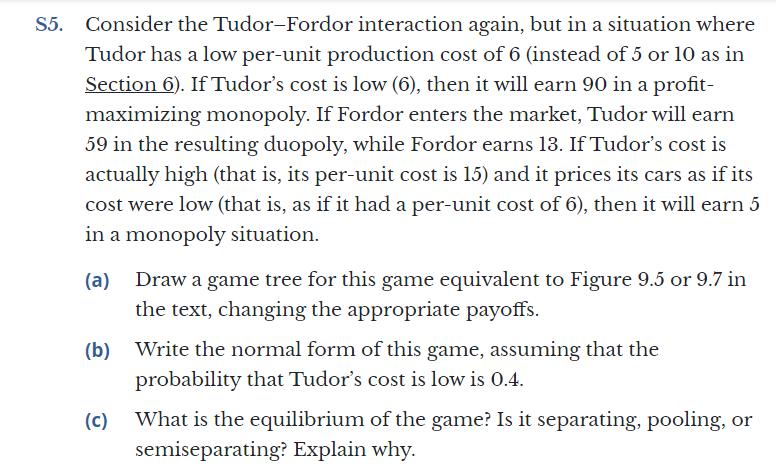
U5. Return to the situation in Exercise S5, where Tudor's low per-unit production cost is 6. (a) Write the normal form of this game in terms of z, the probability that Tudor has a low per-unit cost. (b) What is the equilibrium when z = 0.1? Is it separating, pooling, or semiseparating? (c) Repeat part (b) for z = 0.2. (d) Repeat part (b) for z = 0.3. (e) Compare your answers in parts (b), (c), and (d) of this problem with part (d) of Exercise U4. When Tudor's low cost is 6 instead of 10, can pooling equilibria be achieved at lower values of z? Or are higher values of z required for pooling equilibria to occur? Explain intuitively why this is the case. S5. Consider the Tudor-Fordor interaction again, but in a situation where Tudor has a low per-unit production cost of 6 (instead of 5 or 10 as in Section 6). If Tudor's cost is low (6), then it will earn 90 in a profit- maximizing monopoly. If Fordor enters the market, Tudor will earn 59 in the resulting duopoly, while Fordor earns 13. If Tudor's cost is actually high (that is, its per-unit cost is 15) and it prices its cars as if its cost were low (that is, as if it had a per-unit cost of 6), then it will earn 5 in a monopoly situation. (a) Draw a game tree for this game equivalent to Figure 9.5 or 9.7 in the text, changing the appropriate payoffs. (b) Write the normal form of this game, assuming that the probability that Tudor's cost is low is 0.4. (c) What is the equilibrium of the game? Is it separating, pooling, or semiseparating? Explain why. U5. Return to the situation in Exercise S5, where Tudor's low per-unit production cost is 6. (a) Write the normal form of this game in terms of z, the probability that Tudor has a low per-unit cost. (b) What is the equilibrium when z = 0.1? Is it separating, pooling, or semiseparating? (c) Repeat part (b) for z = 0.2. (d) Repeat part (b) for z = 0.3. (e) Compare your answers in parts (b), (c), and (d) of this problem with part (d) of Exercise U4. When Tudor's low cost is 6 instead of 10, can pooling equilibria be achieved at lower values of z? Or are higher values of z required for pooling equilibria to occur? Explain intuitively why this is the case. S5. Consider the Tudor-Fordor interaction again, but in a situation where Tudor has a low per-unit production cost of 6 (instead of 5 or 10 as in Section 6). If Tudor's cost is low (6), then it will earn 90 in a profit- maximizing monopoly. If Fordor enters the market, Tudor will earn 59 in the resulting duopoly, while Fordor earns 13. If Tudor's cost is actually high (that is, its per-unit cost is 15) and it prices its cars as if its cost were low (that is, as if it had a per-unit cost of 6), then it will earn 5 in a monopoly situation. (a) Draw a game tree for this game equivalent to Figure 9.5 or 9.7 in the text, changing the appropriate payoffs. (b) Write the normal form of this game, assuming that the probability that Tudor's cost is low is 0.4. (c) What is the equilibrium of the game? Is it separating, pooling, or semiseparating? Explain why
Step by Step Solution
There are 3 Steps involved in it

Get step-by-step solutions from verified subject matter experts
 Study Help