







Question: please answer! Use iterative substitution to solve the recurrence T(n) = 2T(n 1) + 3n. Assume that T(1) = 1. Suppose you wish to develop
 please answer!
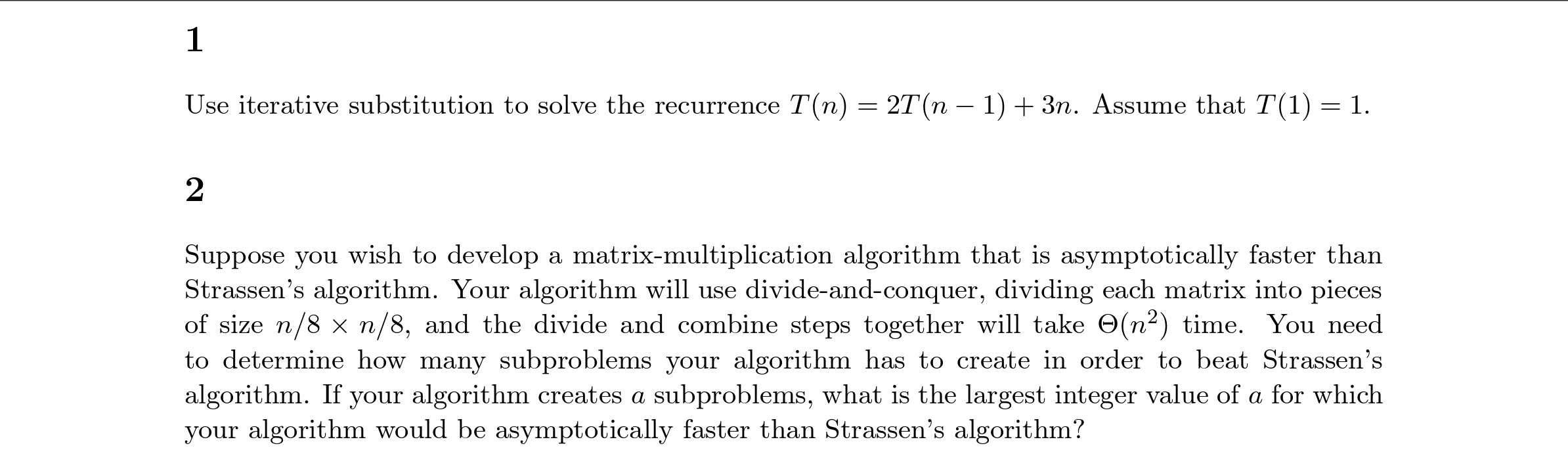
Use iterative substitution to solve the recurrence T(n) = 2T(n 1) + 3n. Assume that T(1) = 1.
Suppose you wish to develop a matrix-multiplication algorithm that is asymptotically faster than Strassens algorithm. Your algorithm will use divide-and-conquer, dividing each matrix into pieces of size n/8 n/8, and the divide and combine steps together will take (n2) time. You need to determine how many subproblems your algorithm has to create in order to beat Strassens algorithm. If your algorithm creates a subproblems, what is the largest integer value of a for which your algorithm would be asymptotically faster than Strassens algorithm?
Use iterative substitution to solve the recurrence T(n) = 2T(n 1) + 3n. Assume that T(1) = 1. Suppose you wish to develop a matrix-multiplication algorithm that is asymptotically faster than Strassens algorithm. Your algorithm will use divide-and-conquer, dividing each matrix into pieces of size n/8 x n/8, and the divide and combine steps together will take O(na) time. You need to determine how many subproblems your algorithm has to create in order to beat Strassen's algorithm. If your algorithm creates a subproblems, what is the largest integer value of a for which your algorithm would be asymptotically faster than Strassens algorithm
Step by Step Solution
There are 3 Steps involved in it

Get step-by-step solutions from verified subject matter experts
 Study Help