







Question: Please answer using C++ Thanks! Question 1: Write two versions of a program that reads a positive integer n, and prints the first n even
Please answer using C++
Thanks!
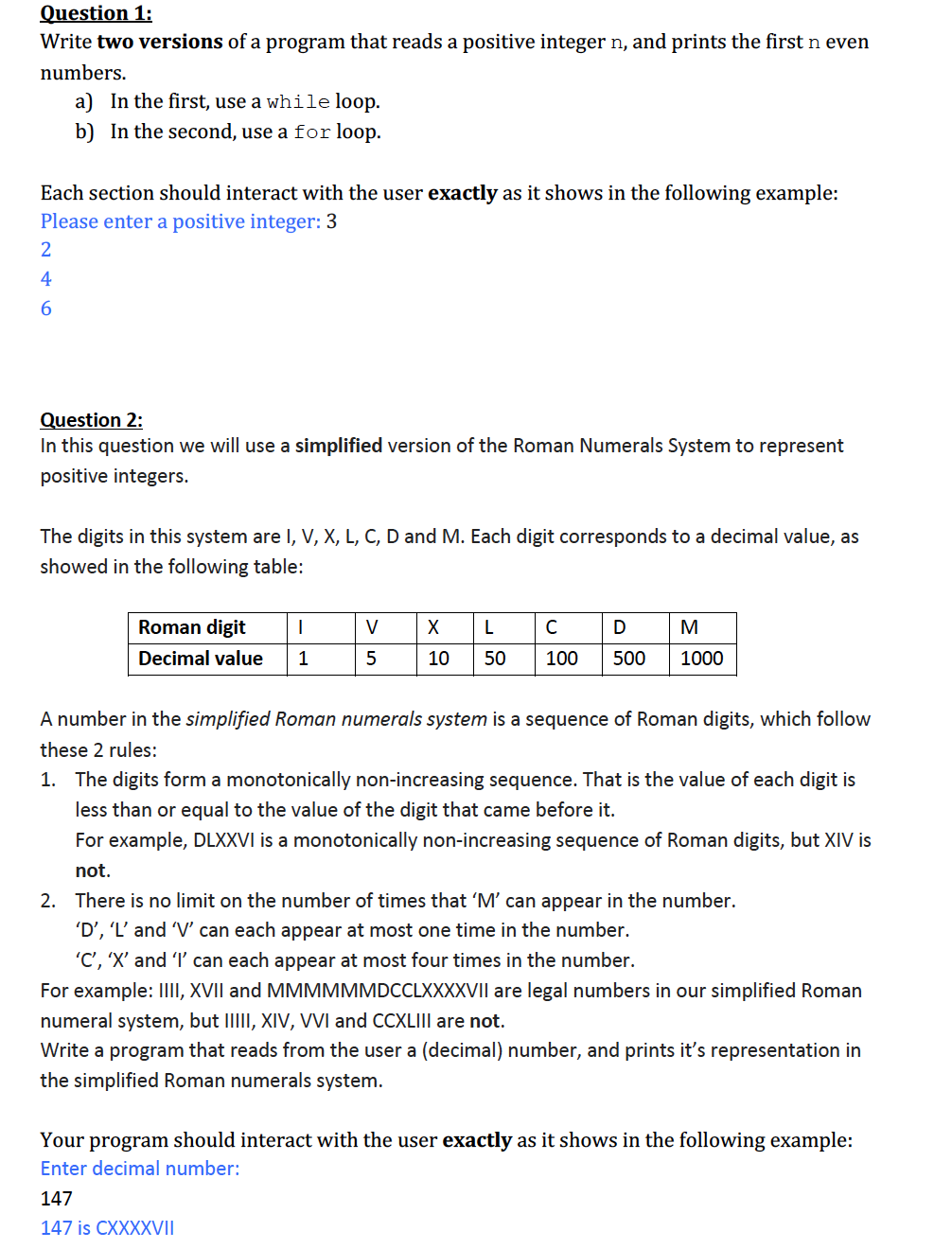
Question 1: Write two versions of a program that reads a positive integer n, and prints the first n even numbers. a) In the first, use a while loop. b) In the second, use a for loop. Each section should interact with the user exactly as it shows in the following example: Please enter a positive integer: 3 Question 2: In this question we will use a simplified version of the Roman Numerals System to represent positive integers. The digits in this system are I, V, X, L, C, D and M. Each digit corresponds to a decimal value, as showed in the following table: C D Roman digiti Decimal value 1 V 5 L 50 M. 1000 10 100 500 A number in the simplified Roman numerals system is a sequence of Roman digits, which follow these 2 rules: 1. The digits form a monotonically non-increasing sequence. That is the value of each digit is less than or equal to the value of the digit that came before it. For example, DLXXVI is a monotonically non-increasing sequence of Roman digits, but XIV is not. 2. There is no limit on the number of times that 'M' can appear in the number. 'D', 'L' and 'V' can each appear at most one time in the number. 'C', 'X' and 'l' can each appear at most four times in the number. For example: IIII, XVII and MMMMMMDCCLXXXXVII are legal numbers in our simplified Roman numeral system, but III, XIV, WI and CCXLIII are not. Write a program that reads from the user a (decimal) number, and prints it's representation in the simplified Roman numerals system. Your program should interact with the user exactly as it shows in the following example: Enter decimal number: 147 147 is CXXXXVII
Step by Step Solution
There are 3 Steps involved in it

Get step-by-step solutions from verified subject matter experts
 Study Help