







Question: please answer using excel forumal please do try to answer all empty + yellow boxes Question 2 (30 points) Prepare a DCF Analysis given the
please answer using excel forumal please do try to answer all empty + yellow boxes
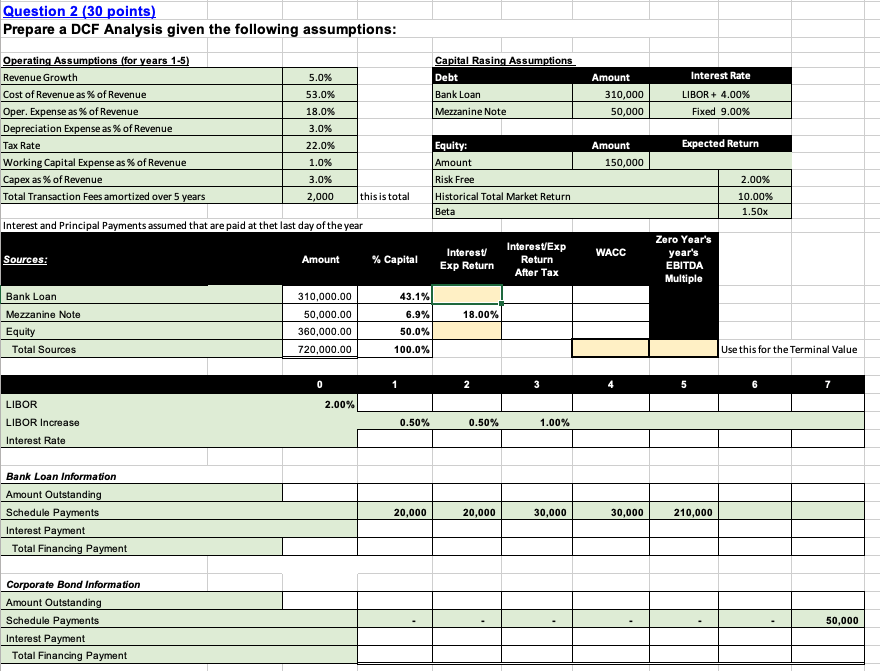
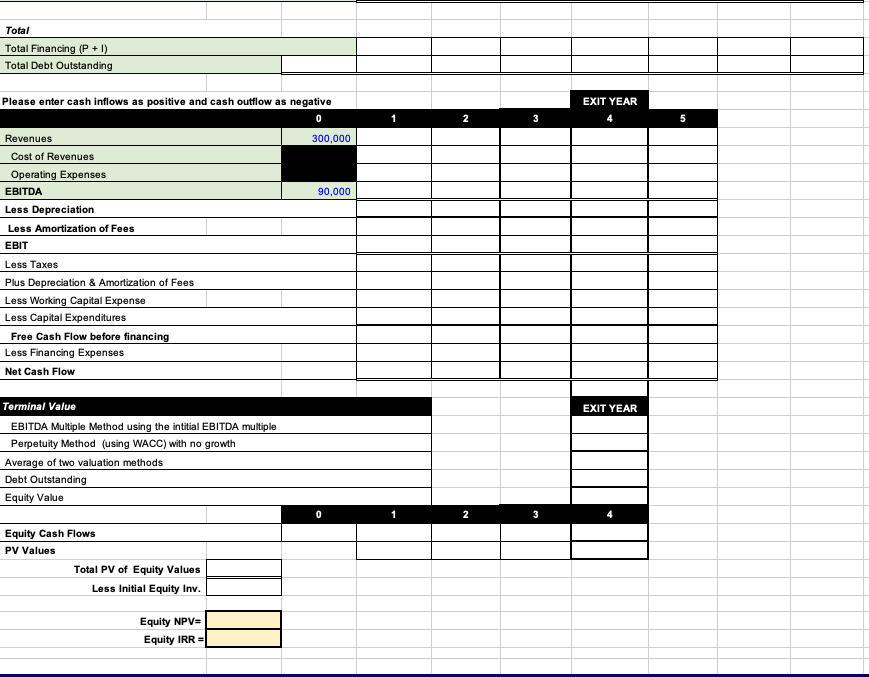
Question 2 (30 points) Prepare a DCF Analysis given the following assumptions: Capital Rasing Assumptions Debt Bank Loan Mezzanine Note Amount 310,000 50,000 Interest Rate LIBOR + 4.00% Fixed 9.00% Operating Assumptions (for years 1-5) Revenue Growth 5.0% Cost of Revenue as % of Revenue 53.0% Oper. Expense as % of Revenue 18.0% Depreciation Expense as % of Revenue 3.0% Tax Rate 22.0% Working Capital Expense as % of Revenue 1.0% Capex as % of Revenue 3.0% Total Transaction Fees amortized over 5 years 2,000 this is total Interest and Principal Payments assumed that are paid at thet last day of the year Expected Return Amount 150,000 Equity: Amount Risk Free Historical Total Market Return Beta 2.00% 10.00% 1.50x WACC Sources: Amount % Capital Interest Exp Return InterestExp Return After Tax Zero Year's year's EBITDA Multiple 43.1% 18.00% Bank Loan Mezzanine Note Equity Total Sources 310,000.00 50,000.00 360,000.00 720,000.00 6.9% 50.0% 100.0% Use this for the Terminal Value 0 2 3 5 6 7 LIBOR 2.00% 0.50% 0.50% 1.00% LIBOR Increase Interest Rate Bank Loan Information Amount Outstanding Schedule Payments Interest Payment Total Financing Payment 20,000 20,000 30,000 30,000 210,000 Corporate Bond Information Amount Outstanding Schedule Payments Interest Payment Total Financing Payment 50,000 Total Total Financing (P + 1) Total Debt Outstanding Please enter cash inflows as positive and cash outflow as negative EXIT YEAR 0 1 2 3 5 300,000 90,000 Revenues Cost of Revenues Operating Expenses EBITDA Less Depreciation Less Amortization of Fees EBIT Less Taxes Plus Depreciation & Amortization of Fees Less Working Capital Expense Less Capital Expenditures Free Cash Flow before financing Less Financing Expenses Net Cash Flow EXIT YEAR Terminal Value EBITDA Multiple Method using the intitial EBITDA multiple Perpetuity Method (using WACC) with no growth Average of two valuation methods Debt Outstanding Equity Value 0 2 3 Equity Cash Flows PV Values Total PV of Equity Values Less Initial Equity Inv. Equity NPV= Equity IRRI Question 2 (30 points) Prepare a DCF Analysis given the following assumptions: Capital Rasing Assumptions Debt Bank Loan Mezzanine Note Amount 310,000 50,000 Interest Rate LIBOR + 4.00% Fixed 9.00% Operating Assumptions (for years 1-5) Revenue Growth 5.0% Cost of Revenue as % of Revenue 53.0% Oper. Expense as % of Revenue 18.0% Depreciation Expense as % of Revenue 3.0% Tax Rate 22.0% Working Capital Expense as % of Revenue 1.0% Capex as % of Revenue 3.0% Total Transaction Fees amortized over 5 years 2,000 this is total Interest and Principal Payments assumed that are paid at thet last day of the year Expected Return Amount 150,000 Equity: Amount Risk Free Historical Total Market Return Beta 2.00% 10.00% 1.50x WACC Sources: Amount % Capital Interest Exp Return InterestExp Return After Tax Zero Year's year's EBITDA Multiple 43.1% 18.00% Bank Loan Mezzanine Note Equity Total Sources 310,000.00 50,000.00 360,000.00 720,000.00 6.9% 50.0% 100.0% Use this for the Terminal Value 0 2 3 5 6 7 LIBOR 2.00% 0.50% 0.50% 1.00% LIBOR Increase Interest Rate Bank Loan Information Amount Outstanding Schedule Payments Interest Payment Total Financing Payment 20,000 20,000 30,000 30,000 210,000 Corporate Bond Information Amount Outstanding Schedule Payments Interest Payment Total Financing Payment 50,000 Total Total Financing (P + 1) Total Debt Outstanding Please enter cash inflows as positive and cash outflow as negative EXIT YEAR 0 1 2 3 5 300,000 90,000 Revenues Cost of Revenues Operating Expenses EBITDA Less Depreciation Less Amortization of Fees EBIT Less Taxes Plus Depreciation & Amortization of Fees Less Working Capital Expense Less Capital Expenditures Free Cash Flow before financing Less Financing Expenses Net Cash Flow EXIT YEAR Terminal Value EBITDA Multiple Method using the intitial EBITDA multiple Perpetuity Method (using WACC) with no growth Average of two valuation methods Debt Outstanding Equity Value 0 2 3 Equity Cash Flows PV Values Total PV of Equity Values Less Initial Equity Inv. Equity NPV= Equity IRRI
Step by Step Solution
There are 3 Steps involved in it

Get step-by-step solutions from verified subject matter experts
 Study Help