







Question: Please answer! Will give thumbs up. The yield on a three-month T-bill is 2%, the yield on a 10-year T-bond is 2.82%. The market risk
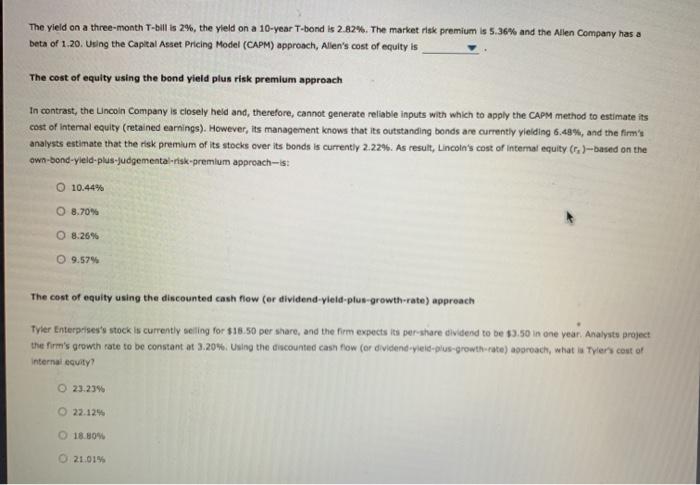
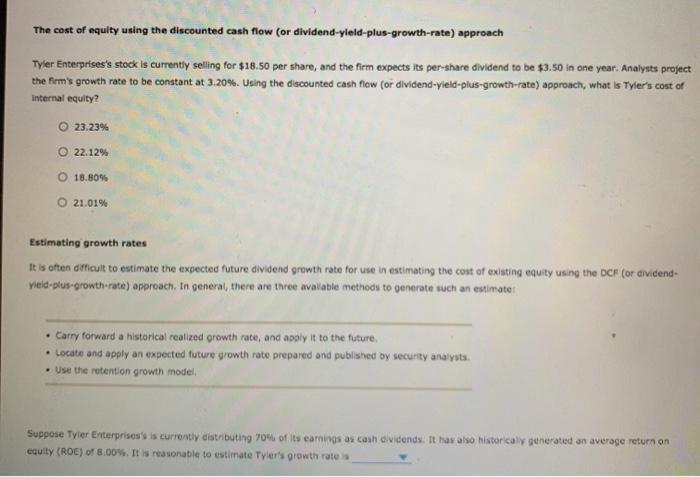
The yield on a three-month T-bill is 2%, the yield on a 10-year T-bond is 2.82%. The market risk premium is 5.36% and the Allen Company has a beta of 1.20. Using the Capital Asset Pricing Model (CAPM) approach, Allen's cost of equity is The cost of equity using the bond yield plus risk premium approach In contrast, the Lincoln Company is closely held and, therefore, cannot generate reliable inputs with which to apply the CAPM method to estimate its cost of internal equity (retained earnings). However, its management knows that its outstanding bonds are currently yielding 6.48%, and the firm's analysts estimate that the risk premium of its stocks over its bonds is currently 2.22%. As result, Lincoln's cost of internal equity (6.)-based on the own-bond-yield-plus-judgemental-risk-premium approach-is: O 10.44% O 8.70% 8.26% 9.57% The cost of equity using the discounted cash flow (er dividend.Vield-plus-growth-rate) approach Tyler Enterprises's stock is currently selling for $18.50 per share, and the firm expects it per share dividend to be $9.50 in one year analysts project the firm's growth rate to be constant at 3.20%. Using the discounted can flow (er dividendek-plus-growth.te) soroach, what is Tyler's cout of Internal equity? 23.23% 22.124 18.80 21.01% The cost of equity using the discounted cash flow (or dividend-yield-plus-growth-rate) approach Tyler Enterprises's stock is currently selling for $18.50 per share, and the firm expects its per-share dividend to be $3.50 in one year. Analysts project the firm's growth rate to be constant at 3.20%. Using the discounted cash flow (or dividend-yield-plus-growth-rate) approach, what is Tyler's cost of Internal equity? 23.23% 22.12% 18.80% 21.019 Estimating growth rates It is often difficult to estimate the expected future dividend growth rate for use in estimating the cost of existing equity using the DCF (or dividend Yield-plus-growth-rate) approach. In general, there are three available methods to generate such an estimate Carry forward a historical realized growth rate, and apply it to the future. Locate and apply an expected future growth rate prepared and published by security analysts. . Use the retention growth model Suppose Tyler Enterprises's is currently distributing 70% of its earnings as cash dividends. It has also historically generated an average return on equity (ROE) of 8.00%. It is reasonable to estimate Tyler's growth rates
Step by Step Solution
There are 3 Steps involved in it

Get step-by-step solutions from verified subject matter experts
 Study Help