







Question: please answer will rate thumbsup. 2. Using the four methods of ethical reasoning, discuss whether threats of harm from autonomous vehicles are an acceptable risk,
please answer will rate thumbsup. 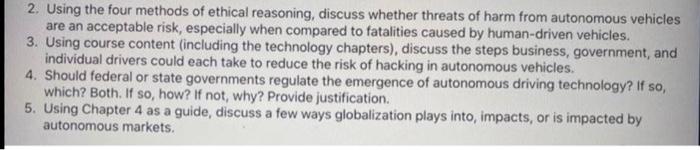
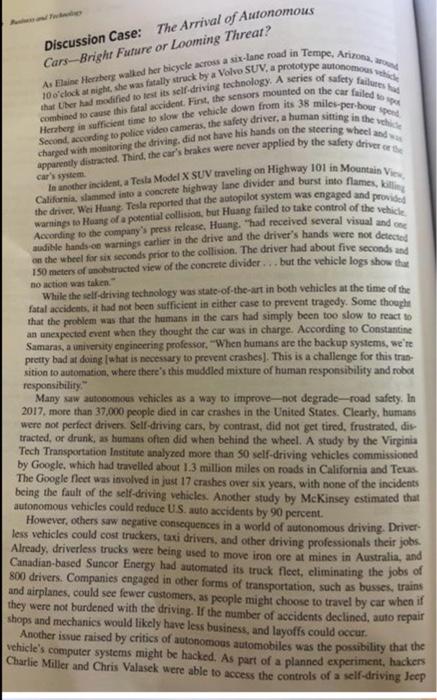
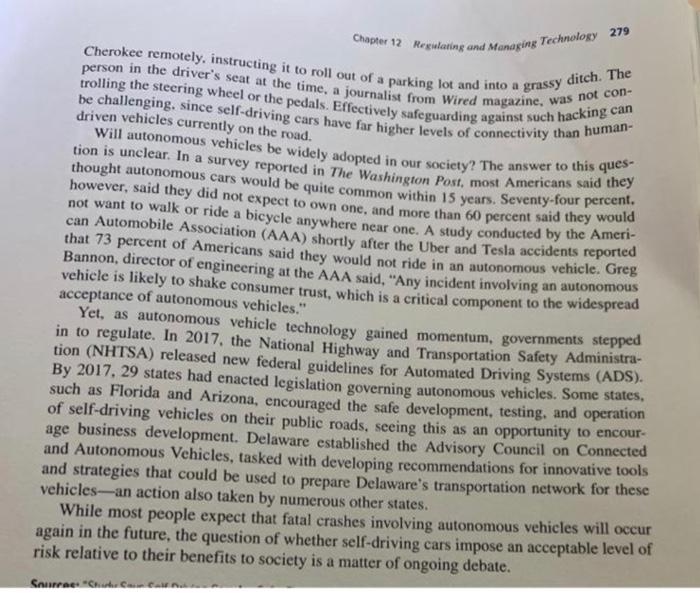
2. Using the four methods of ethical reasoning, discuss whether threats of harm from autonomous vehicles are an acceptable risk, especially when compared to fatalities caused by human-driven vehicles. 3. Using course content (including the technology chapters), discuss the steps business, government, and individual drivers could each take to reduce the risk of hacking in autonomous vehicles. 4. Should federal or state governments regulate the emergence of autonomous driving technology? If so, which? Both. If so, how? If not, why? Provide justification 5. Using Chapter 4 as a guide, discuss a few ways globalization plays into, impacts, or is impacted by autonomous markets. Discussion Case: The Arrival of Autonomous Cars-Bright Future or Looming Threar? As Elaine Herberg walked her bicycle across a six-Lane road in Tempe, Arizona combined to cause this fatal accident. First, the sensors mounted on the car faldt that he had modified to rest is self-driving technology. A series of safety auta 10 o'clock at night, she was fatally struck by a Volvo SUV, a prototype autonomous che Second according to police video cameras the safety driver, a human sitting in the vide Herbergi sufficient time to slow the vehicle down from its 38 miles-perbour sport charged with monitoring the driving did not have his hands on the steering wheel and apparently distracted, Third, the car's brakes were never applied by the safety driver car's In another incident, a Tesla Model X SUV traveling on Highway 101 in Mountain View California, slammed into a parete highway lane divider and burst into flames, the driver We Hunt Tesla reported that the topilot system was engaged and provides warnings to Hoane of a potential collision, but Huang failed to take control of the vehicle Accendine to the company's press release. Huang, Thad received several visual and on the wheel for six seconds prior to the collision. The driver had about five seconds and 150 meters of unobtracted view of the concrete divider... but the vehicle logs show the no action was taken While the self-driving technology was state-of-the-art in both vehicles at the time of the fatal accidents, it had not been sufficient in either case to prevent tragedy. Some thought that the problem was that the humans in the cars had simply been too slow to react to an unexpected event when they thought the car was in charge. According to Constantine Samaras, a university engineering professor. "When humans are the backup systems, we're pretty bad at doing (what is necessary to prevent crashes). This is a challenge for this trun sition to automation, where there's this muddled mixture of human responsibility and robok responsibility Many saw autonomous vehicles as a way to improve not degrade-road safety. In 2017. more than 37.000 people died in car crashes in the United States. Clearly, humans were not perfect drivers Self-driving cars, by contrast, did not get tired, frustrated, dis tracted, or drunk, as humans often did when behind the wheel. A study by the Virginia Tech Transportation Institute analyzed more than 50 self-driving vehicles commissioned by Google, which had travelled about 1.3 million miles on roads in California and Texas The Google fleet was involved in just 17 crashes over six years, with none of the incidents being the fault of the self-driving vehicles. Another study by McKinsey estimated that autonomous vehicles could reduce US auto accidents by 90 percent. However, others saw negative consequences in a world of autonomous driving. Driver less vehicles could cost trackers, taxi drivers, and other driving professionals their jobs Already, driverless trucks were being used to move iron ore at mines in Australia, and Canadian-based Suncor Energy had automated its truck fleet, eliminating the jobs of 800 drivers. Companies engaged in other forms of transportation, such as busses, trains and airplanes, could see fewer customers, as people might choose to travel by car when if they were not burdened with the driving. If the number of accidents declined, auto repair shops and mechanics would likely have less business, and layoffs could occur Another issue raised by critics of autonomous automobiles was the possibility that the vehicle's computer systems might be hacked. As part of a planned experiment, hackers Charlie Miller and Chris Valasek were able to access the controls of a self-driving Jeep Chapter 12 Regulating and Managing Technology 279 Cherokee remotely, instructing it to roll out of a parking lot and into a grassy ditch. The person in the driver's seat at the time, a journalist from Wired magazine, was not con- trolling the steering wheel or the pedals. Effectively safeguarding against such hacking can be challenging. since self-driving cars have far higher levels of connectivity than human- Will autonomous vehicles be widely adopted in our society? The answer to this ques- driven vehicles currently on the road. tion is unclear. In a survey reported in The Washington Post, most Americans said they thought autonomous cars would be quite common within 15 years. Seventy-four percent, however, said they did not expect to own one, and more than 60 percent said they would not want to walk or ride a bicycle anywhere near one. A study conducted by the Ameri can Automobile Association (AAA) shortly after the Uber and Tesla accidents reported that 73 percent of Americans said they would not ride in an autonomous vehicle. Greg Bannon, director of engineering at the AAA said, "Any incident involving an autonomous vehicle is likely to shake consumer trust, which is a critical component to the widespread acceptance of autonomous vehicles." Yet, as autonomous vehicle technology gained momentum, governments stepped in to regulate. In 2017, the National Highway and Transportation Safety Administra- tion (NHTSA) released new federal guidelines for Automated Driving Systems (ADS). By 2017, 29 states had enacted legislation governing autonomous vehicles. Some states, such as Florida and Arizona, encouraged the safe development, testing, and operation of self-driving vehicles on their public roads, seeing this as an opportunity to encour. age business development. Delaware established the Advisory Council on Connected and Autonomous Vehicles, tasked with developing recommendations for innovative tools and strategies that could be used to prepare Delaware's transportation network for these vehicles-an action also taken by numerous other states. While most people expect that fatal crashes involving autonomous vehicles will occur again in the future, the question of whether self-driving cars impose an acceptable level of risk relative to their benefits to society is a matter of ongoing debate. Suree. ChuCC Step by Step Solution
There are 3 Steps involved in it
1 Expert Approved Answer
Step: 1 Unlock

Question Has Been Solved by an Expert!
Get step-by-step solutions from verified subject matter experts
Step: 2 Unlock
Step: 3 Unlock
 Study Help