







Question: ***Please answer with cell references *** 1 Ruiz Company issued bonds on January 1 and has provided the relevant information. The Controller has asked you
***Please answer with cell references ***
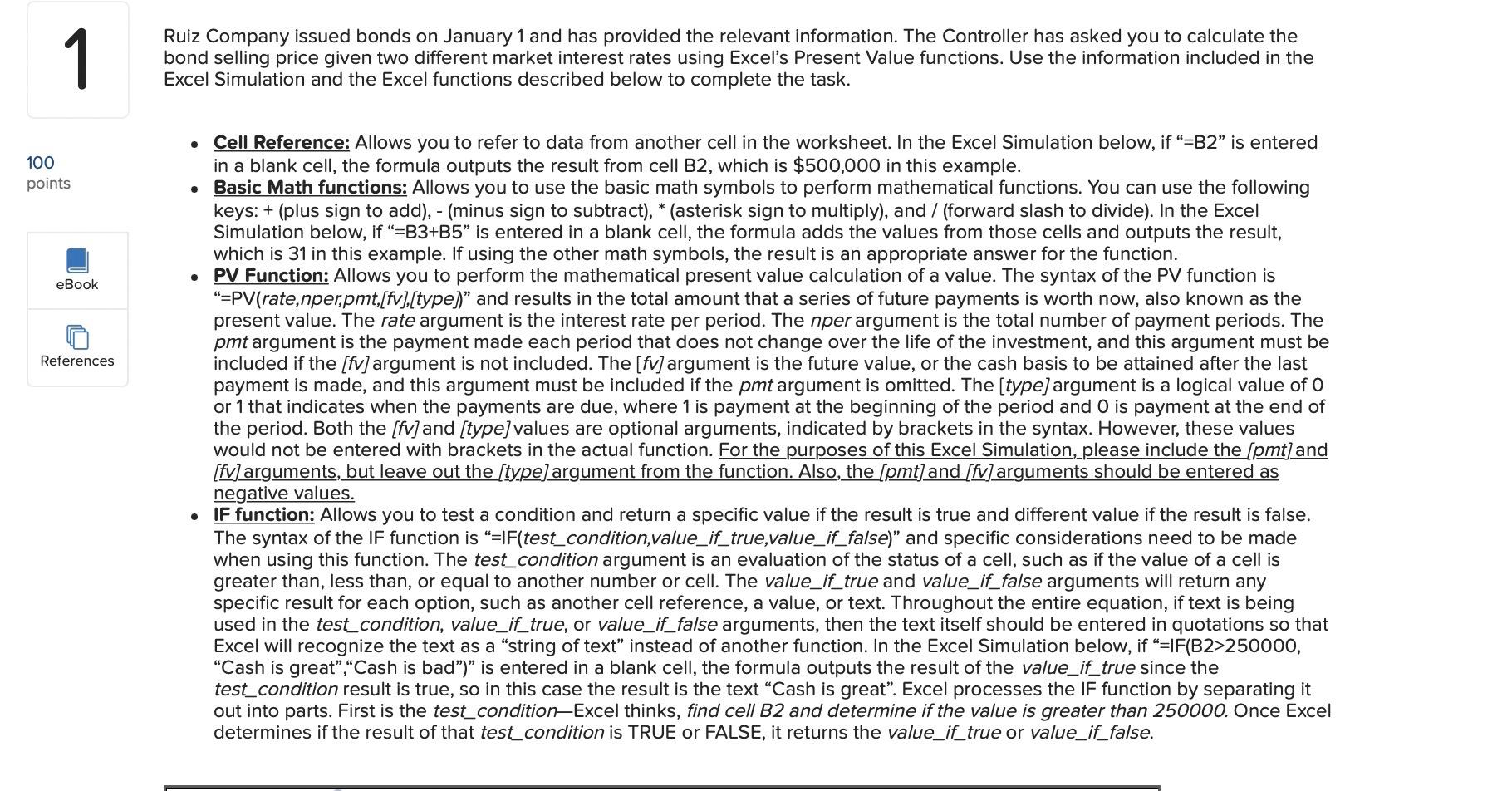
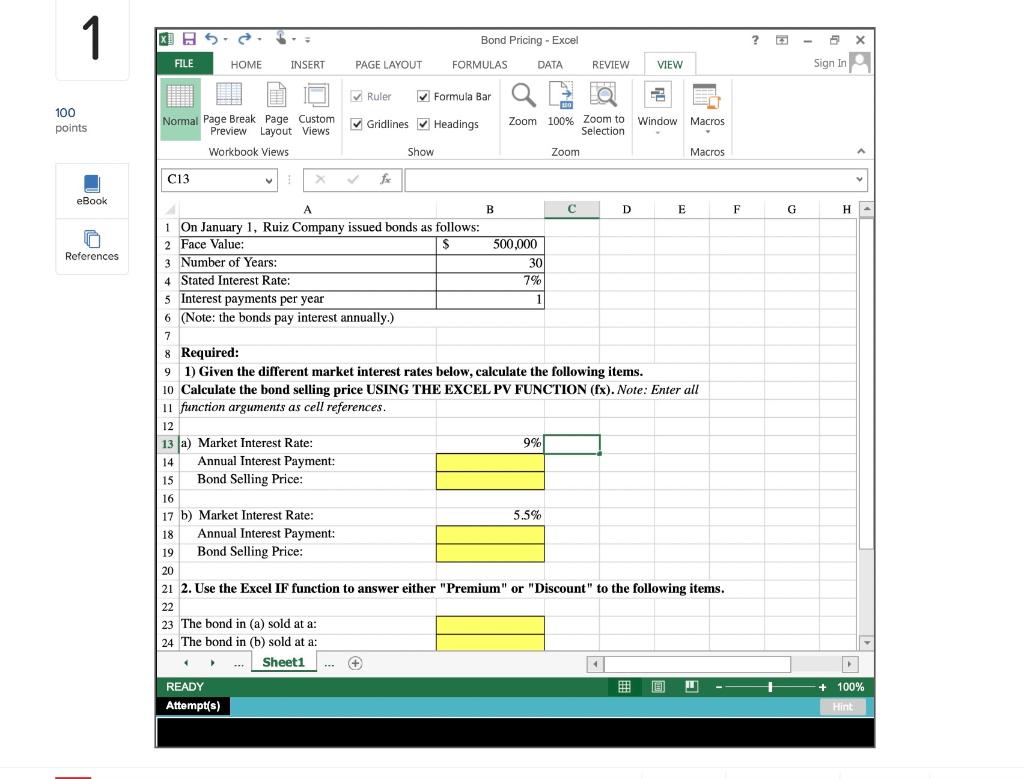
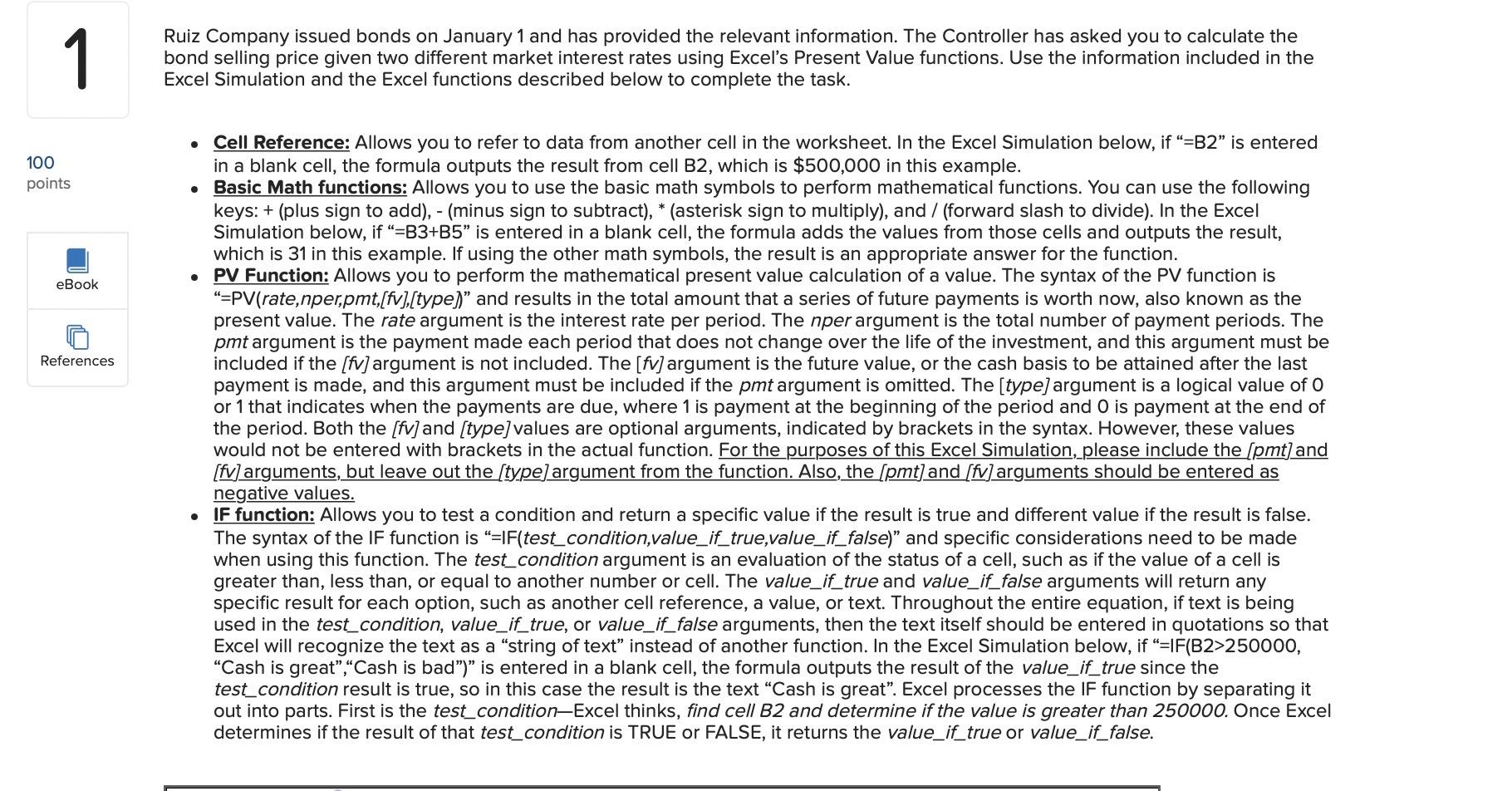
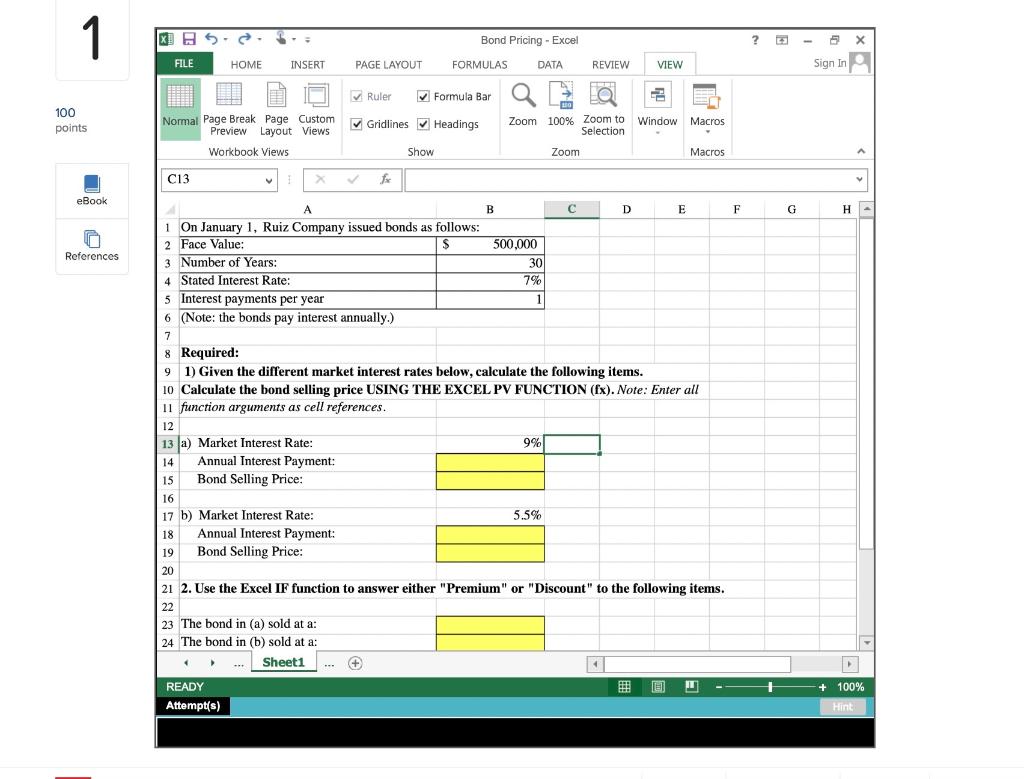
1 Ruiz Company issued bonds on January 1 and has provided the relevant information. The Controller has asked you to calculate the bond selling price given two different market interest rates using Excel's Present Value functions. Use the information included in the Excel Simulation and the Excel functions described below to complete the task. 100 points eBook References Cell Reference: Allows you to refer to data from another cell in the worksheet. In the Excel Simulation below, if =B2 is entered in a blank cell, the formula outputs the result from cell B2, which is $500,000 in this example. Basic Math functions: Allows you to use the basic math symbols to perform mathematical functions. You can use the following keys: + (plus sign to add), - (minus sign to subtract), * (asterisk sign to multiply), and / (forward slash to divide). In the Excel Simulation below, if =B3+B5" is entered in a blank cell, the formula adds the values from those cells and outputs the result, which is 31 in this example. If using the other math symbols, the result is an appropriate answer for the function. PV Function: Allows you to perform the mathematical present value calculation of a value. The syntax of the PV function is "=PV(rate,nper,pmt, (fv),[type)" and results in the total amount that a series of future payments is worth now, also known as the present value. The rate argument is the interest rate per period. The nper argument is the total number of payment periods. The pmt argument is the payment made each period that does not change over the life of the investment, and this argument must be included if the (fv) argument is not included. The (fv) argument is the future value, or the cash basis to be attained after the last payment is made, and this argument must be included if the pmt argument is omitted. The [type] argument is a logical value of O or 1 that indicates when the payments are due, where 1 is payment at the beginning of the period and O is payment at the end of the period. Both the (fv) and (type) values are optional arguments, indicated by brackets in the syntax. However, these values would not be entered with brackets in the actual function. For the purposes of this Excel Simulation, please include the pmtand [fv] arguments, but leave out the [type] argument from the function. Also, the [pmt] and [fv] arguments should be entered as negative values. IF function: Allows you to test a condition and return a specific value if the result is true and different value if the result is false. The syntax of the IF function is =IF(test_condition,value_if_true,value_if_false)" and specific considerations need to be made when using this function. The test_condition argument is an evaluation of the status of a cell, such as if the value of a cell is greater than, less than, or equal to another number or cell. The value_if_true and value_if_false arguments will return any specific result for each option, such as another cell reference, a value, or text. Throughout the entire equation, if text is being used in the test_condition, value_if_true, or value_if_false arguments, then the text itself should be entered in quotations so that Excel will recognize the text as a "string of text instead of another function. In the Excel Simulation below, if =IF(B2>250000, "Cash is great, Cash is bad) is entered in a blank cell, the formula outputs the result of the value_if_true since the test_condition result is true, so in this case the result is the text Cash is great. Excel processes the IF function by separating it out into parts. First is the test_condition-Excel thinks, find cell B2 and determine if the value is greater than 250000. Once Excel determines if the result of that test_condition is TRUE or FALSE, it returns the value_if_true or value_if_false. 1 XB5- - ? Bond Pricing - Excel FORMULAS DATA FILE HOME INSERT PAGE LAYOUT REVIEW VIEW Sign In Ruler Formula Bar QE 100 points Gridlines Headings Zoom 100% Zoom to Window Macros Selection Normal Page Break Page Custom Preview Layout Views Workbook Views Show Zoom Macros A C13 fax eBook B F G H. References A D E 1 On January 1, Ruiz Company issued bonds as follows: 2 Face Value: $ 500,000 3 Number of Years: 301 4 Stated Interest Rate: 7% 5 Interest payments per year 1 6 (Note: the bonds pay interest annually.) 7 8 Required: 9 1) Given the different market interest rates below, calculate the following items. 10 Calculate the bond selling price USING THE EXCEL PV FUNCTION (fx). Note: Enter all 11 function arguments as cell references. 12 13 a) Market Interest Rate: 9% 14 Annual Interest Payment: 15 Bond Selling Price: 16 17 b) Market Interest Rate: 5.5% 18 Annual Interest Payment: 19 Bond Selling Price: 20 21 2. Use the Excel IF function to answer either "Premium" or "Discount" to the following items. 22 23 The bond in (a) sold at a: 24 The bond in (b) sold at a: Sheet1 + . !! LEI READY Attempt(s) s + 100% Hint
Step by Step Solution
There are 3 Steps involved in it

Get step-by-step solutions from verified subject matter experts
 Study Help