







Question: please answer with short answers CHE 152 Exp #3A: Measuring the Rate of a Chemical Reaction Pre-laboratory Assignment Read the procedure, and complete the following
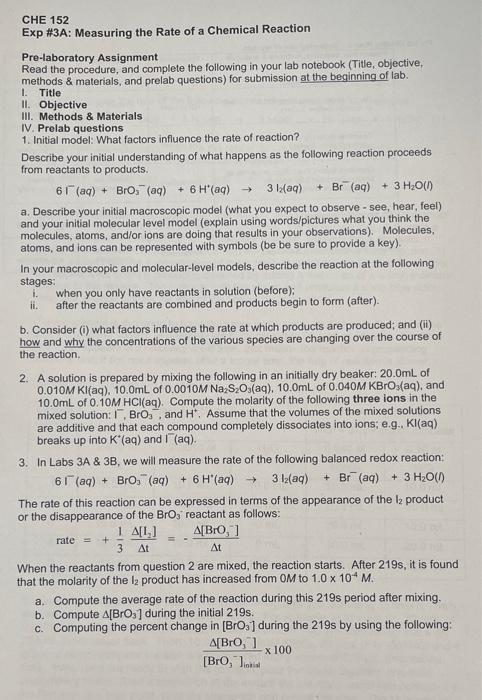
CHE 152 Exp \#3A: Measuring the Rate of a Chemical Reaction Pre-laboratory Assignment Read the procedure, and complete the following in your lab notebook (Title, objective, methods \& materials, and prelab questions) for submission at the beginning of lab. I. Title II. Objective III. Methods \& Materials IV. Prelab questions 1. Initial model: What factors influence the rate of reaction? Describe your initial understanding of what happens as the following reaction proceeds from reactants to products. 6F(aq)+BrO3(aq)+6H(aq)3H2(aq)+Br(aq)+3H2O(l) a. Describe your initial macroscopic model (what you expect to observe - see, hear, feel) and your initial molecular level model (explain using words/pictures what you think the molecules, atoms, and/or ions are doing that results in your observations). Molecules, atoms, and ions can be represented with symbols (be be sure to provide a key). In your macroscopic and molecular-level models, describe the reaction at the following stages: i. When you only have reactants in solution (before): ii. after the reactants are combined and products begin to form (after). b. Consider (i) what factors influence the rate at which products are produced; and (ii) how and why the concentrations of the various species are changing over the course of the reaction. 2. A solution is prepared by mixing the following in an initially dry beaker: 20.0mL of 0.010MKl(aq),10.0mL of 0.0010MNa2S2O3(aq),10.0mL of 0.040MKBrO(aq), and 10.0mL of 0.10MHCl(aq). Compute the molarity of the following three ions in the mixed solution: 1,BrO3, and H+. Assume that the volumes of the mixed solutions are additive and that each compound completely dissociates into ions; e.g.. KI(aq) breaks up into K+(aq) and I(aq). 3. In Labs 3A \& 3B, we will measure the rate of the following balanced redox reaction: 6I(aq)+BrO3(aq)+6H(aq)3I2(aq)+Br(aq)+3H2O(f) The rate of this reaction can be expressed in terms of the appearance of the I2 product or the disappearance of the BrO3 - reactant as follows: rate=+31t[I2]=t[BrO3] When the reactants from question 2 are mixed, the reaction starts. After 219s, it is found that the molarity of the I2 product has increased from 0M to 1.0104M. a. Compute the average rate of the reaction during this 219 s period after mixing. b. Compute [BrO3] during the initial 219s. c. Computing the percent change in [BrO3] during the 219 s by using the following: [BrO3]intial[BrO3]100
Step by Step Solution
There are 3 Steps involved in it

Get step-by-step solutions from verified subject matter experts
 Study Help