



Question: Please apply the context to a real-world situation in 300 words CHAPTER SUMMARY This chapter has focused on: 1) Understanding the importance of effective vision,
Please apply the context to a real-world situation in 300 words
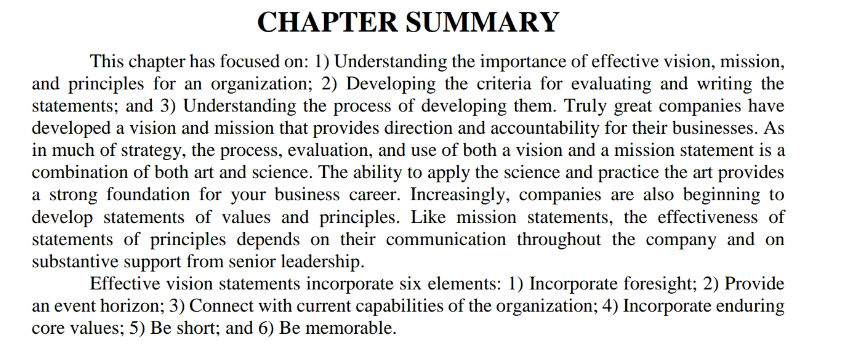
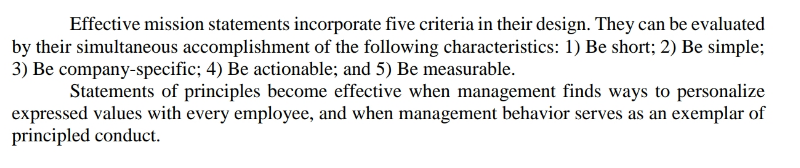
CHAPTER SUMMARY This chapter has focused on: 1) Understanding the importance of effective vision, mission, and principles for an organization; 2) Developing the criteria for evaluating and writing the statements, and 3) Understanding the process of developing them. Truly great companies have developed a vision and mission that provides direction and accountability for their businesses. As in much of strategy, the process, evaluation, and use of both a vision and a mission statement is a combination of both art and science. The ability to apply the science and practice the art provides a strong foundation for your business career. Increasingly, companies are also beginning to develop statements of values and principles. Like mission statements, the effectiveness of statements of principles depends on their communication throughout the company and on substantive support from senior leadership. Effective vision statements incorporate six elements: 1) Incorporate foresight; 2) Provide an event horizon; 3) Connect with current capabilities of the organization; 4) Incorporate enduring core values; 5) Be short; and 6) Be memorable. Effective mission statements incorporate five criteria in their design. They can be evaluated by their simultaneous accomplishment of the following characteristics: 1) Be short; 2) Be simple; 3) Be company-specific; 4) Be actionable; and 5) Be measurable. Statements of principles become effective when management finds ways to personalize expressed values with every employee, and when management behavior serves as an exemplar of principled conduct. CHAPTER SUMMARY This chapter has focused on: 1) Understanding the importance of effective vision, mission, and principles for an organization; 2) Developing the criteria for evaluating and writing the statements, and 3) Understanding the process of developing them. Truly great companies have developed a vision and mission that provides direction and accountability for their businesses. As in much of strategy, the process, evaluation, and use of both a vision and a mission statement is a combination of both art and science. The ability to apply the science and practice the art provides a strong foundation for your business career. Increasingly, companies are also beginning to develop statements of values and principles. Like mission statements, the effectiveness of statements of principles depends on their communication throughout the company and on substantive support from senior leadership. Effective vision statements incorporate six elements: 1) Incorporate foresight; 2) Provide an event horizon; 3) Connect with current capabilities of the organization; 4) Incorporate enduring core values; 5) Be short; and 6) Be memorable. Effective mission statements incorporate five criteria in their design. They can be evaluated by their simultaneous accomplishment of the following characteristics: 1) Be short; 2) Be simple; 3) Be company-specific; 4) Be actionable; and 5) Be measurable. Statements of principles become effective when management finds ways to personalize expressed values with every employee, and when management behavior serves as an exemplar of principled conductStep by Step Solution
There are 3 Steps involved in it
1 Expert Approved Answer
Step: 1 Unlock

Question Has Been Solved by an Expert!
Get step-by-step solutions from verified subject matter experts
Step: 2 Unlock
Step: 3 Unlock