







Question: Please as you can answer these questions with the steps. only multiple choice. Thank you A local farmer is interested in comparing the yields of
Please as you can answer these questions with the steps. only multiple choice.
Thank you
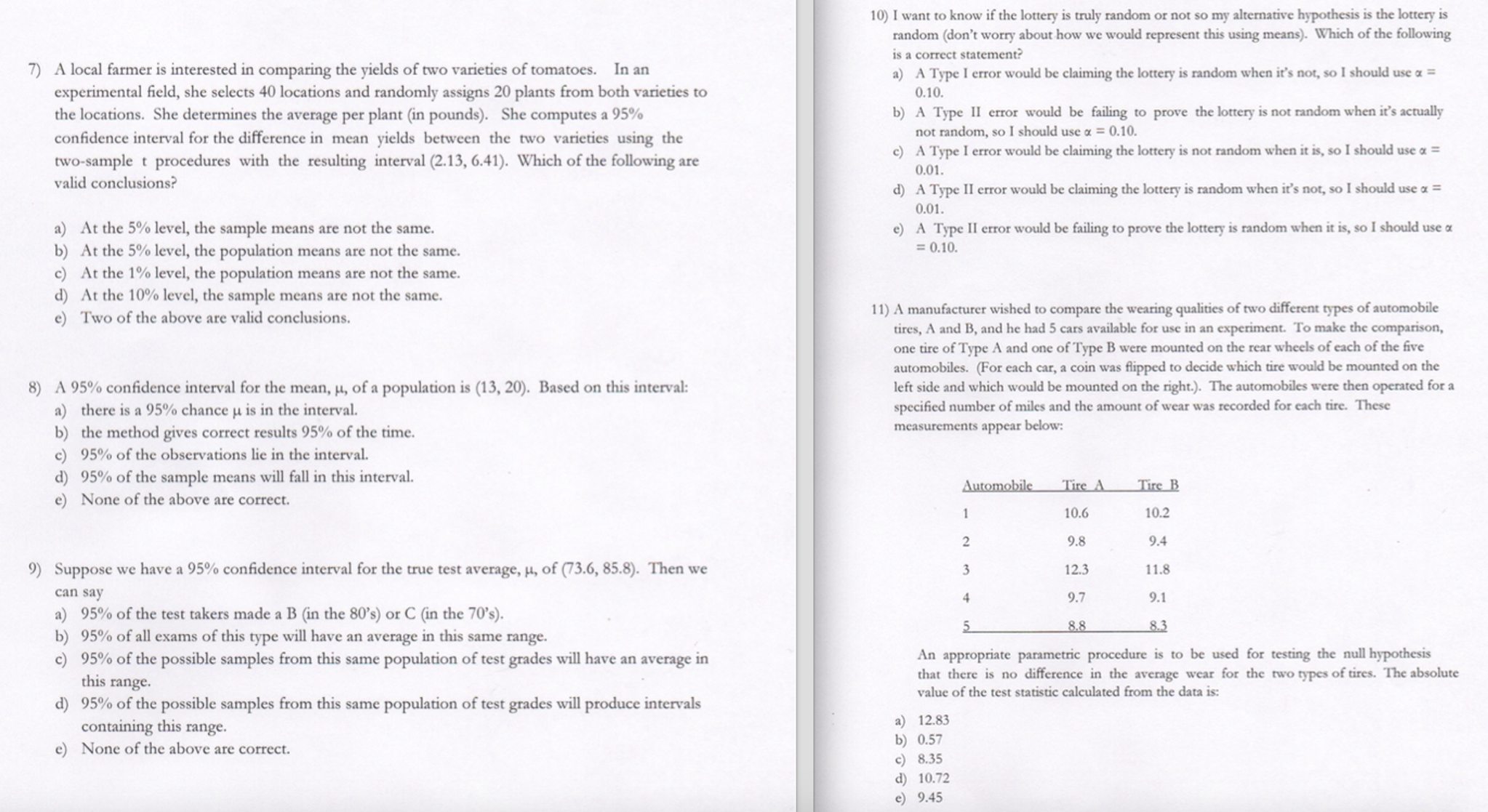
A local farmer is interested in comparing the yields of two varieties of tomatoes. In an experimental field, she selects 40 locations and randomly assigns 20 plants from both varieties to the locations. She determines the average per plant (in pounds). She computes a 95% confidence interval for the difference in mean yields between the two varieties using the two-sample t procedures with the resulting interval (2.13, 6.41). Which of the following are valid conclusions? At the 5% level, die sample means are not the same. At the 5% level, the population means are not the same. At the 1% level, the population means are not the same. At the 10% level, the sample means are not the same, Two of the above are valid conclusions. A 95% confidence interval for the mean, mu, of a population is (13, 20). Based on this interval: there is a 95% chance mu is in the interval. the method gives correct results 95% of the rime. 95% of the observations lie in the interval. 95% of the sample means will fall in this interval. None of the above are correct. Suppose we have a 95% confidence interval for the true test average, n, of (73.6, 85.8). Then we can say 95% of the test takers made a B (in the 80's) or C (in the 70's). 95% of all exams of this type will have an average in this same range. 95% of the possible samples from this same population of test grades will have an average in this range. 95% of the possible samples from this same population of test grades will produce intervals containing this range. None of the above are correct. I want to know if the lottery is truly random or not so my alternative hypothesis is the lottery is random (don't worry about how we would represent this using means). Which of the following is a correct statement? A Type I error would be claiming the lottery is random when it's not, so I should use a = 0.10. A Type 11 error would be failing to prove the lottery is not random when it's actually not random, so I should use a = 0.10. A Type I error would be claiming the lottery is not random when it is, so I should use a = 0.01. A Type II error would be claiming the lottery is random when it's not, so I should use a = 0.01 A Type II error would be failing to prove the lottery is random when it is, so I should use a = 0.10. A manufacturer wished to compare the wearing qualities of two different types of automobile tires, A and B, and he had 5 cars available for use in an experiment. To make the comparison, one tire of Type A and one of Type B were mounted on the rear wheels of each of the five automobiles. (For each car, a coin was flipped to decide which tire would be mounted on the left side and which would be mounted on the right.). The automobiles were then operated for a specified number of miles and the amount of wear was recorded for each tire. These measurements appear below: An appropriate parametric procedure is to be used for testing the null hypothesis that there is no difference in the average wear for the two types of tires. The absolute value of the test statistic calculated from the data is: 12.83 0.57 8.35 10.72 9.45
Step by Step Solution
There are 3 Steps involved in it

Get step-by-step solutions from verified subject matter experts
 Study Help