







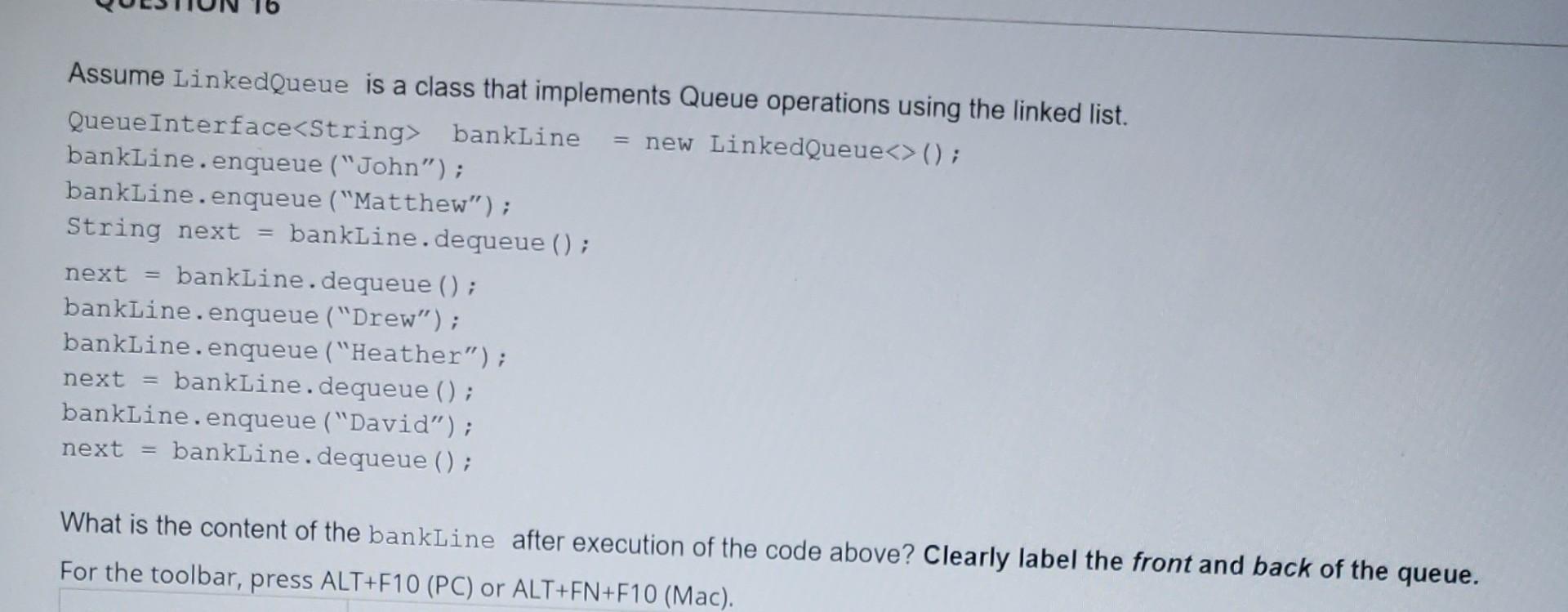
Question: Please asap Assume IinkedQueue is a class that implements Queue operations using the linked list. QueueInterface String bankLine = new LinkedQueue langle angle() ; bankLine.
Please asap
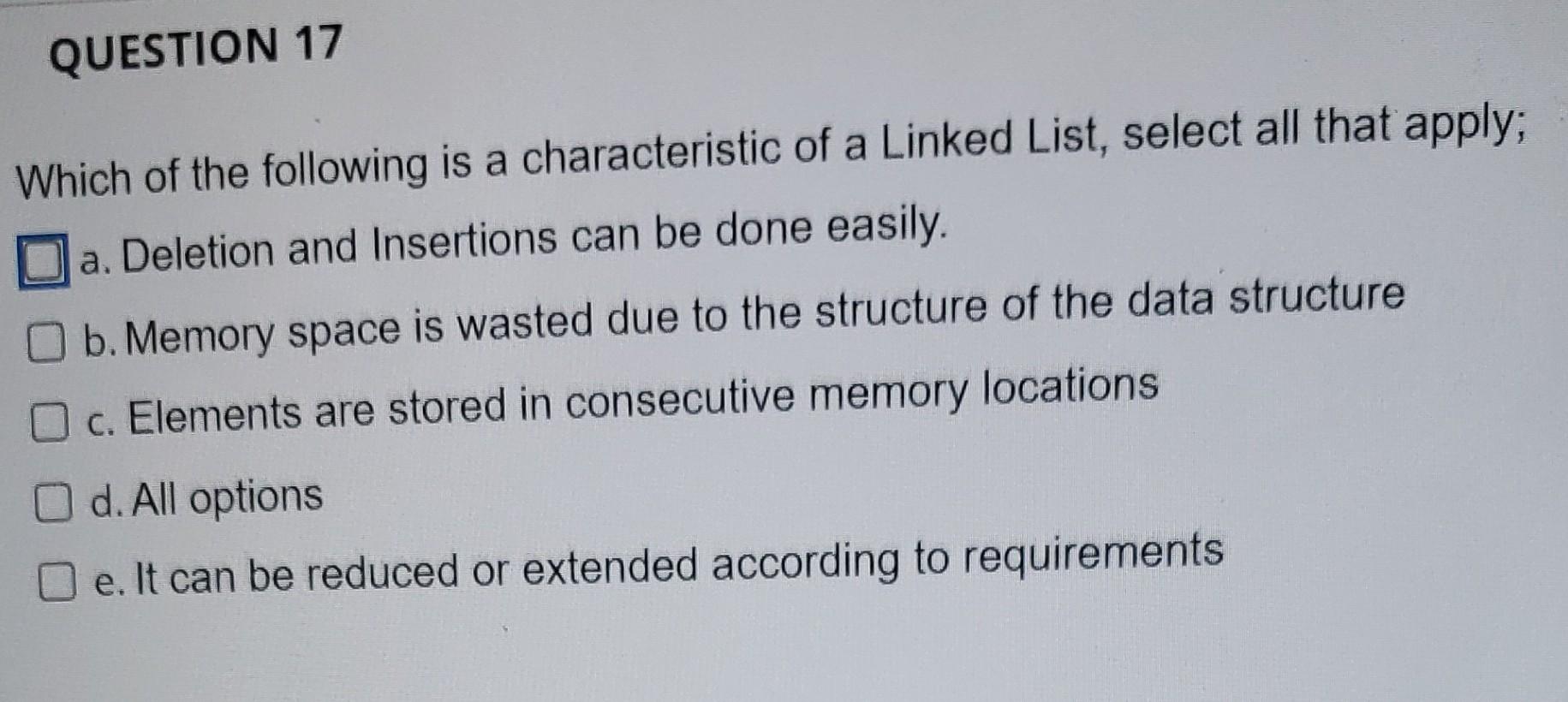
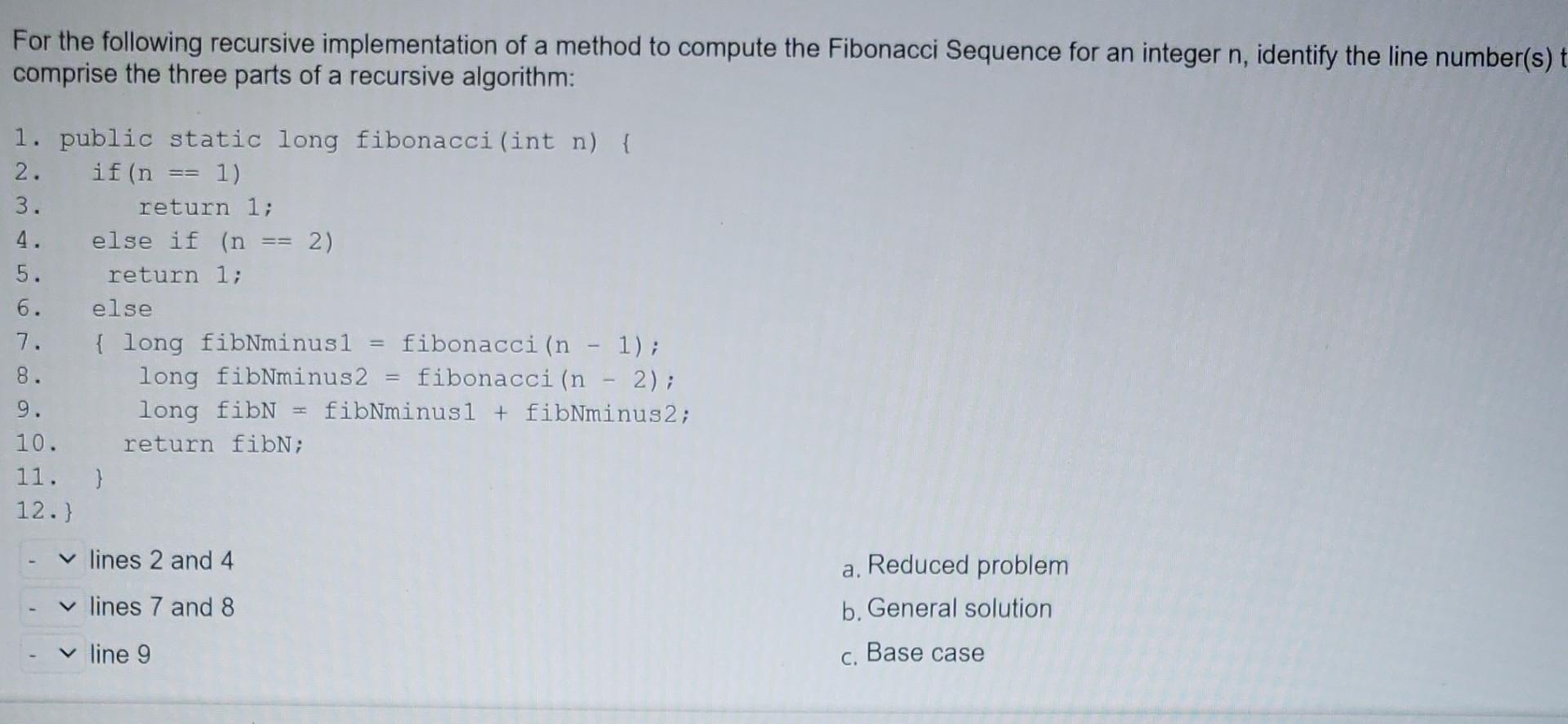
Assume IinkedQueue is a class that implements Queue operations using the linked list. QueueInterface String bankLine = new LinkedQueue \langle angle() ; bankLine. enqueue ("John") ; bankLine. enqueue ("Matthew"); String next = bankLine. dequeue (); next = bankLine. dequeue () ; bankLine. enqueue ("Drew"); bankLine. enqueue ("Heather") ; next = bankLine. dequeue () ; bankLine.enqueue ("David") ; next = bankLine. dequeue () ; What is the content of the bankLine after execution of the code above? Clearly label the front and back of the queue. For the toolbar, press ALT+F10(PC) or ALT+FN+F10 (Mac). Which of the following is a characteristic of a Linked List, select all that apply; a. Deletion and Insertions can be done easily. b. Memory space is wasted due to the structure of the data structure c. Elements are stored in consecutive memory locations d. All options e. It can be reduced or extended according to requirements For the following recursive implementation of a method to compute the Fibonacci Sequence for an integer n, identify the line number(s) comprise the three parts of a recursive algorithm: 1. public static long fibonacci(int n ) \{ 2. if (n==1) 3. return 1 ; 4. else if (n==2) 5. return 1; 6. else 7. { long fibNminus 1= fibonacci (n1); 8. long fibNminus 2= fibonacci (n2); 9. long fibN=fibNminus1+fibNminus2; 10. return fibN; 11. \} 12 \). lines 2 and 4 a. Reduced problem lines 7 and 8 b. General solution line 9 c. Base case
Step by Step Solution
There are 3 Steps involved in it

Get step-by-step solutions from verified subject matter experts
 Study Help