







Question: Please assist by using Regression R tool. Here's the data file - https://gattonweb.uky.edu/sheather/book/docs/datasets/pgatour2006.csv 5. An avid fan of the PGA tour with limited background in
Please assist by using Regression R tool.
Here's the data file - https://gattonweb.uky.edu/sheather/book/docs/datasets/pgatour2006.csv
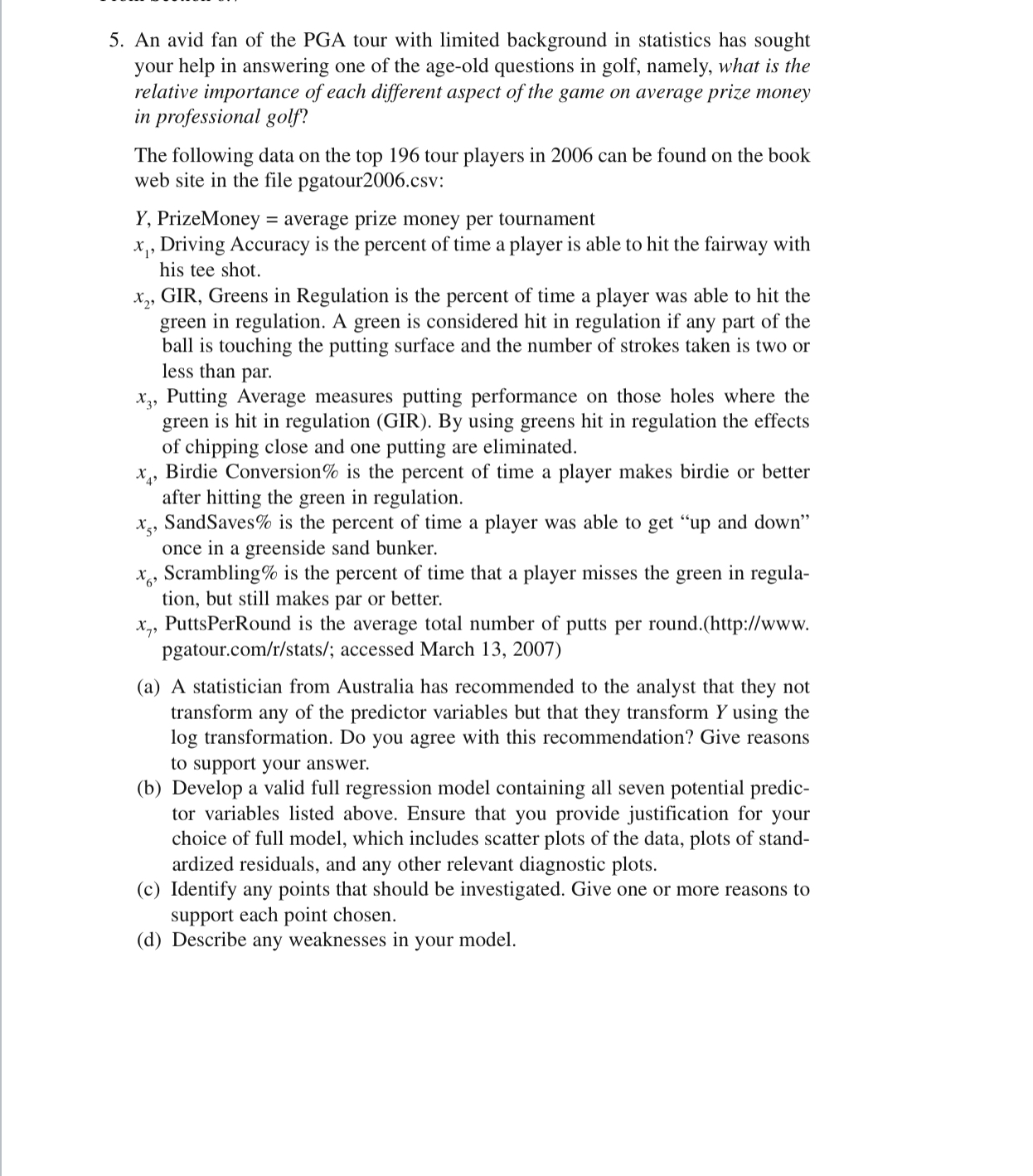
5. An avid fan of the PGA tour with limited background in statistics has sought your help in answering one of the ageold questions in golf, namely, what is the relative importance of each different aspect of the game on average prize money in professional gaff? The following data on the top 196 tour players in 2006 can be found on the book web site in the le pgatour2006.csv: Y, PrizeMoney = average prize money per tournament x1, Driving Accuracy is the percent of time a player is able to hit the fairway with his tee shot. x2, GIR, Greens in Regulation is the percent of time a player was able to hit the green in regulation. A green is considered hit in regulation if any part of the ball is touching the putting surface and the number of strokes taken is two or less than par. x3, Putting Average measures putting performance on those holes where the green is hit in regulation (GIR). By using greens hit in regulation the effects of chipping close and one putting are eliminated. x4, Birdie Conversion% is the percent of time a player makes birdie or better after hitting the green in regulation. x5, SandSaves% is the percent of time a player was able to get \"up and down\" once in a greenside sand bunker. x6, Scrambling% is the percent of time that a player misses the green in regula- tion, but still makes par or better. At? PuttsPerRound is the average total number of putts per round.(http:!/www. pgatour.com/rlstats/; accessed March 13, 2007) (a) A statistician from Australia has recommended to the analyst that they not transform any of the predictor variables but that they transform Y using the log transformation. Do you agree with this recommendation? Give reasons to support your answer. (b) Develop a valid full regression model containing all seven potential predic- tor variables listed above. Ensure that you provide justification for your choice of full model, which includes scatter plots of the data, plots of stand- ardized residuals, and any other relevant diagnostic plots. (c) Identify any points that should be investigated. Give one or more reasons to support each point chosen. ((1) Describe any weaknesses in your model
Step by Step Solution
There are 3 Steps involved in it

Get step-by-step solutions from verified subject matter experts
 Study Help