







Question: please assist on answering this [30 Marks] CASE STUDY Promoting Health and Wellness At Mzansi Packaging In 2018, the findings of the National Employee Wellness
please assist on answering this
![please assist on answering this [30 Marks] CASE STUDY Promoting Health and](https://dsd5zvtm8ll6.cloudfront.net/si.experts.images/questions/2024/10/6721dfd8b30fb_2406721dfd8230df.jpg)
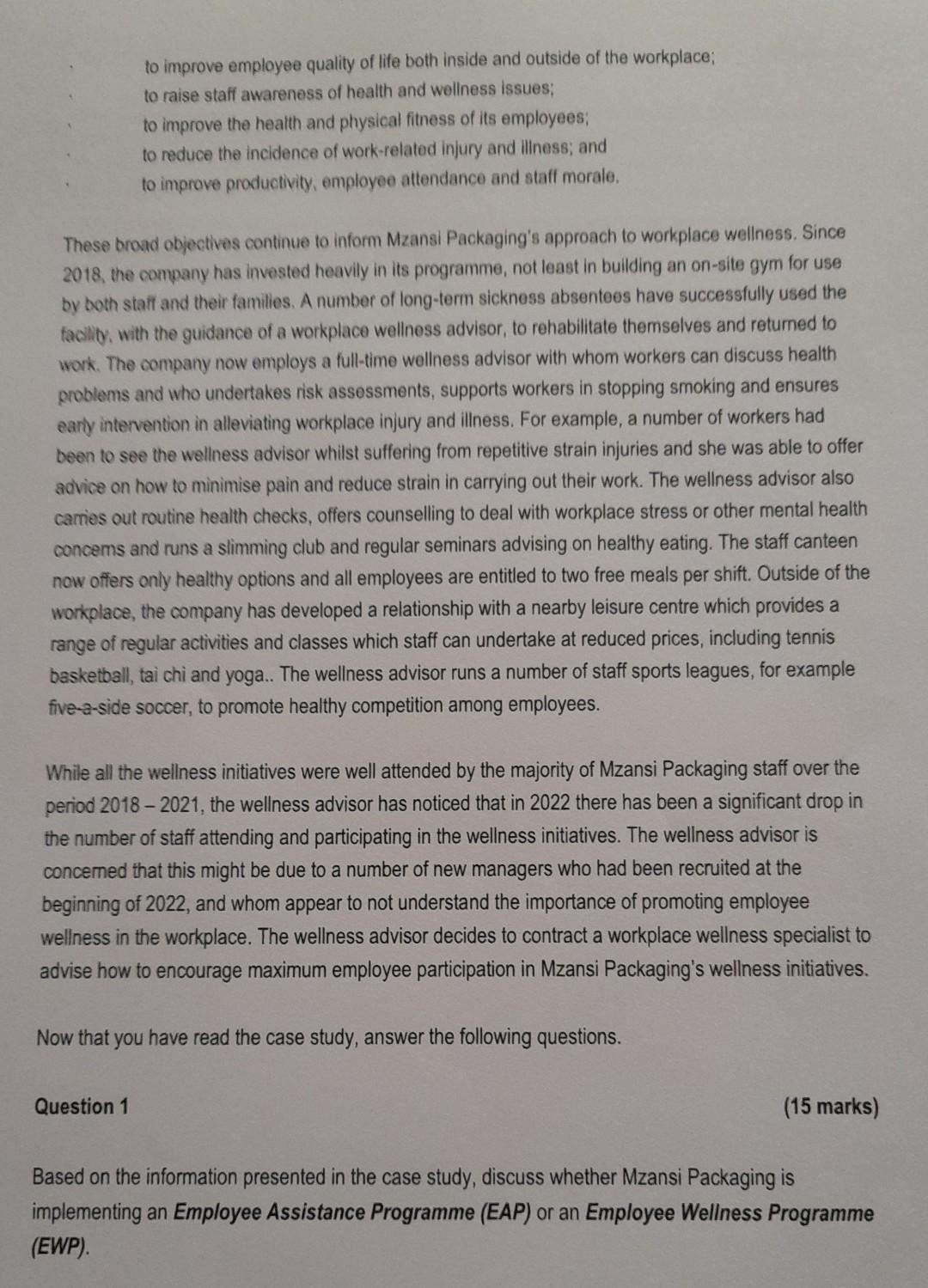
[30 Marks] CASE STUDY Promoting Health and Wellness At Mzansi Packaging In 2018, the findings of the National Employee Wellness Review into workplace health and wellness was published, advocating a shift in attitudes to ensure that employers and employees recognise both the importance of preventing ill-health and the key role the workplace can play in promoting health and wellness. The report reiterated the evidence that work is largely good for health and sought to promote among employers a greater understanding of the business case for investment in health and wellness initiatives and the message that good health is good business. Importantly, the review advocated greater consideration of management attitudes, working relationships, wider HR policies and practices and jobs themselves, in thinking about workplace health and well-being. The review made interesting reading for the senior management team at Mzansi Packaging who had introduced a number of the initiatives that were advocated in the previous year. Mzansi Packaging is a consumer packaging manufacturer based in Gauteng which employs approximately 450 staff in a manufacturing plant producing rigid plaster containers for the food manufacturing industry. The majority of its workforce is employed on its 24-hour, 7-days-a-week production line, working 8hour shifts in four shift teams. In the first half of 2018, Mzansi Packaging had undertaken a health audit, to assess both the reported and actual health of its workforce and its link to workplace productivity. Senior management felt that the health audit might provide some solutions to a range of employment problems it was experiencing at the time, including unacceptable levels of employee sickness absence and turnover which were impacting on productivity, product quality and the company finances. Whilst the work that much of the workforce does is largely repetitive and routine, training employees to work a particular piece of machinery can be time-consuming and costly. Subsequently, absence and turnover have sizeable financial implications. Moreover, the hiring of inexperienced temps at short notice to work on the production line often has a negative impact on both productivity and quality. Mzansi Packaging draws many of its semi-skilled and unskilled workers from areas with high levels of unemployment and poor health. The health audit found that most of the workforce displayed low levels of physical health, even among younger workers. Forty-five percent were smokers and over 60% reported drinking to excess at least once a week. The audit also found low levels of physical activity (aside from their work) and poor dietary choices. Alongside its health audit, Mzansi Packaging conducted its first-ever employee attitude survey. Of most concern, the survey found that only 48% of employees were satisfied with their jobs, 28% were actively looking to leave the company and 56% would consider alternative employment. Following analysis of the audit and staff survey findings, Mzansi Packaging decided to fund a series of staff seminars, presented by health care experts, on health issues ranging from smoking to heart disease. Surprised by the level of staff interest in the seminars, senior management, decided to introduce a wider range of workplace initiatives with the following objectives: to improve employee quality of life both inside and outside of the workplace; to raise staff awareness of health and wellness issues; to improve the health and physical fitness of its employees: to reduce the incidence of work-related injury and illness; and to improve productivity, employee attendance and staff morale. These broad objectives continue to inform Mzansi Packaging's approach to workplace wellness. Since 2018, the company has invested heavily in its programme, not least in building an on-site gym for use by both staff and their families. A number of long-term sickness absentees have successfully used the facillb, with the guidance of a workplace wellness advisor, to rehabilitate themselves and retumed to work. The company now employs a full-time wellness advisor with whom workers can discuss health problems and who undertakes risk assessments, supports workers in stopping smoking and ensures early intervention in alleviating workplace injury and illness. For example, a number of workers had been to see the wellness advisor whilst suffering from repetitive strain injuries and she was able to offer advice on how to minimise pain and reduce strain in carrying out their work. The wellness advisor also camies out routine health checks, offers counselling to deal with workplace stress or other mental health concems and runs a slimming club and regular seminars advising on healthy eating. The staff canteen now offers only healthy options and all employees are entitled to two free meals per shift. Outside of the workplace, the company has developed a relationship with a nearby leisure centre which provides a range of regular activities and classes which staff can undertake at reduced prices, including tennis basketball, tai chi and yoga.. The wellness advisor runs a number of staff sports leagues, for example five-a-side soccer, to promote healthy competition among employees. While all the wellness initiatives were well attended by the majority of Mzansi Packaging staff over the period 2018 - 2021, the wellness advisor has noticed that in 2022 there has been a significant drop in the number of staff attending and participating in the wellness initiatives. The wellness advisor is concemed that this might be due to a number of new managers who had been recruited at the beginning of 2022 , and whom appear to not understand the importance of promoting employee wellness in the workplace. The wellness advisor decides to contract a workplace wellness specialist to advise how to encourage maximum employee participation in Mzansi Packaging's wellness initiatives. Now that you have read the case study, answer the following questions. Question 1 (15 marks) Based on the information presented in the case study, discuss whether Mzansi Packaging is implementing an Employee Assistance Programme (EAP) or an Employee Wellness Programme (EWP)
Step by Step Solution
There are 3 Steps involved in it

Get step-by-step solutions from verified subject matter experts
 Study Help