Question: please assust with this case study A 1 5 s Questions 1. Who is ultimately responsible for formulating a firm's strategyits managers, employees, or both?
please assust with this case study
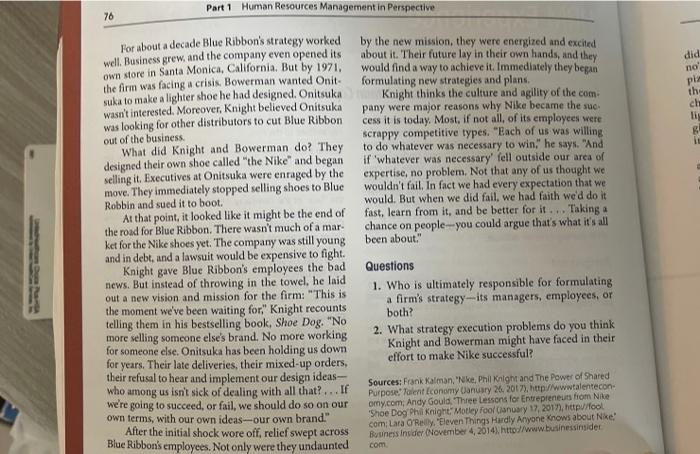
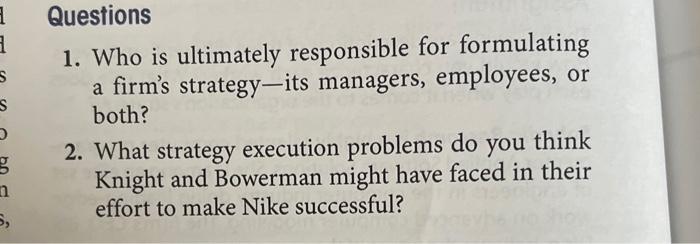
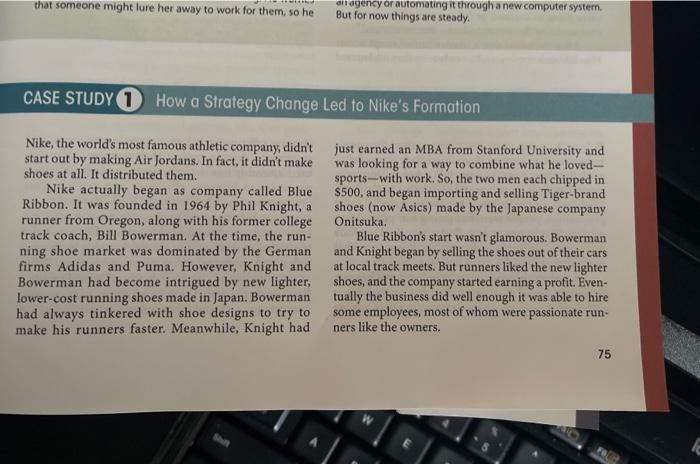
A 1 5 s Questions 1. Who is ultimately responsible for formulating a firm's strategyits managers, employees, or both? 2. What strategy execution problems do you think Knight and Bowerman might have faced in their effort to make Nike successful? 3 n 5, that someone might lure her away to work for them, so he att agency or automating it through a new computer system But for now things are steady. CASE STUDYI How a Strategy Change Led to Nike's Formation Nike, the world's most famous athletic company, didn't start out by making Air Jordans. In fact, it didn't make shoes at all. It distributed them. Nike actually began as company called Blue Ribbon. It was founded in 1964 by Phil Knight, a runner from Oregon, along with his former college track coach, Bill Bowerman. At the time, the run- ning shoe market was dominated by the German firms Adidas and Puma. However, Knight and Bowerman had become intrigued by new lighter, lower-cost running shoes made in Japan. Bowerman had always tinkered with shoe designs to try to make his runners faster. Meanwhile, Knight had just earned an MBA from Stanford University and was looking for a way to combine what he loved- sports-with work. So, the two men each chipped in $500, and began importing and selling Tiger-brand shoes (now Asics) made by the Japanese company Onitsuka. Blue Ribbon's start wasn't glamorous. Bowerman and Knight began by selling the shoes out of their cars at local track meets. But runners liked the new lighter shoes, and the company started earning a profit. Even- tually the business did well enough it was able to hire some employees, most of whom were passionate run ners like the owners. 75 Part 1 Human Resources Management in Perspective 76 did no pie th ch li 8 Por about a decade Blue Ribbon's strategy worked by the new mission, they were energized and excited well. Business grew, and the company even opened its about it. Their future lay in their own hands, and they own store in Santa Monica, California. But by 1971, would find a way to achieve it. Immediately they began the firm was facing a crisis. Bowerman wanted Onit- formulating new strategies and plans suka to make a lighter shoe he had designed, Onitsuka Knight thinks the culture and agility of the com wasn't interested. Moreover, Knight believed Onitsuka pany were major reasons why Nike became the sue was looking for other distributors to cut Blue Ribbon cess it is today. Most, if not all of its employees were out of the business scrappy competitive types. "Each of us was willing What did Knight and Bowerman do? They to do whatever was necessary to win," he says. "And designed their own shoe called "the Nike" and began if 'whatever was necessary fell outside our area of selling it. Executives at Onitsuka were enraged by the expertise, no problem. Not that any of us thought we move. They immediately stopped selling shoes to Blue wouldn't fail. In fact we had every expectation that we Robbin and sued it to boot. would. But when we did fail, we had faith we'd do it At that point, it looked like it might be the end of fast, learn from it, and be better for it... Taking a the road for Blue Ribbon. There wasn't much of a mar. chance on people you could argue that's what it's all ket for the Nike shoes yet. The company was still young been about." and in debt, and a lawsuit would be expensive to fight. Knight gave Blue Ribbon's employees the bad Questions news. But instead of throwing in the towel, he laid out a new vision and mission for the firm: "This is 1. Who is ultimately responsible for formulating the moment we've been waiting for." Knight recounts a firm's strategy-its managers, employees, or telling them in his bestselling book, Shoe Dog. "No both? more selling someone else's brand. No more working 2. What strategy execution problems do you think for someone else. Onitsuka has been holding us down Knight and Bowerman might have faced in their for years. Their late deliveries, their mixed-up orders, effort to make Nike successful? their refusal to hear and implement our design ideas who among us isn't sick of dealing with all that?... If Sources: Frank Kalman, Nike, Phil Knight and The Power of Shared Purpose. Talent Economy Canuary 25, 2017)http://wwwtalentecon we're going to succeed, or fail, we should do so on our omy.com, Andy Gould, Three Lessons for Entrepreneut from Nike own terms, with our own ideas our own brand "Shoe Dog Phil Knight Motley Foo/Canuary 17, 2017), httpu/fool After the initial shock wore off, relief swept across com; Lara O'Reilly. "Eleven Things Hardly Anyone knows about Nike Blue Ribbon's employees. Not only were they undaunted Business Insider November 4, 2014). httod/www.businessinsider com









 Study Help