







Question: Please be detailed Java and C have two ways to declare real values: float (32 bits) and double (64 bits). Each of these use the
Please be detailed
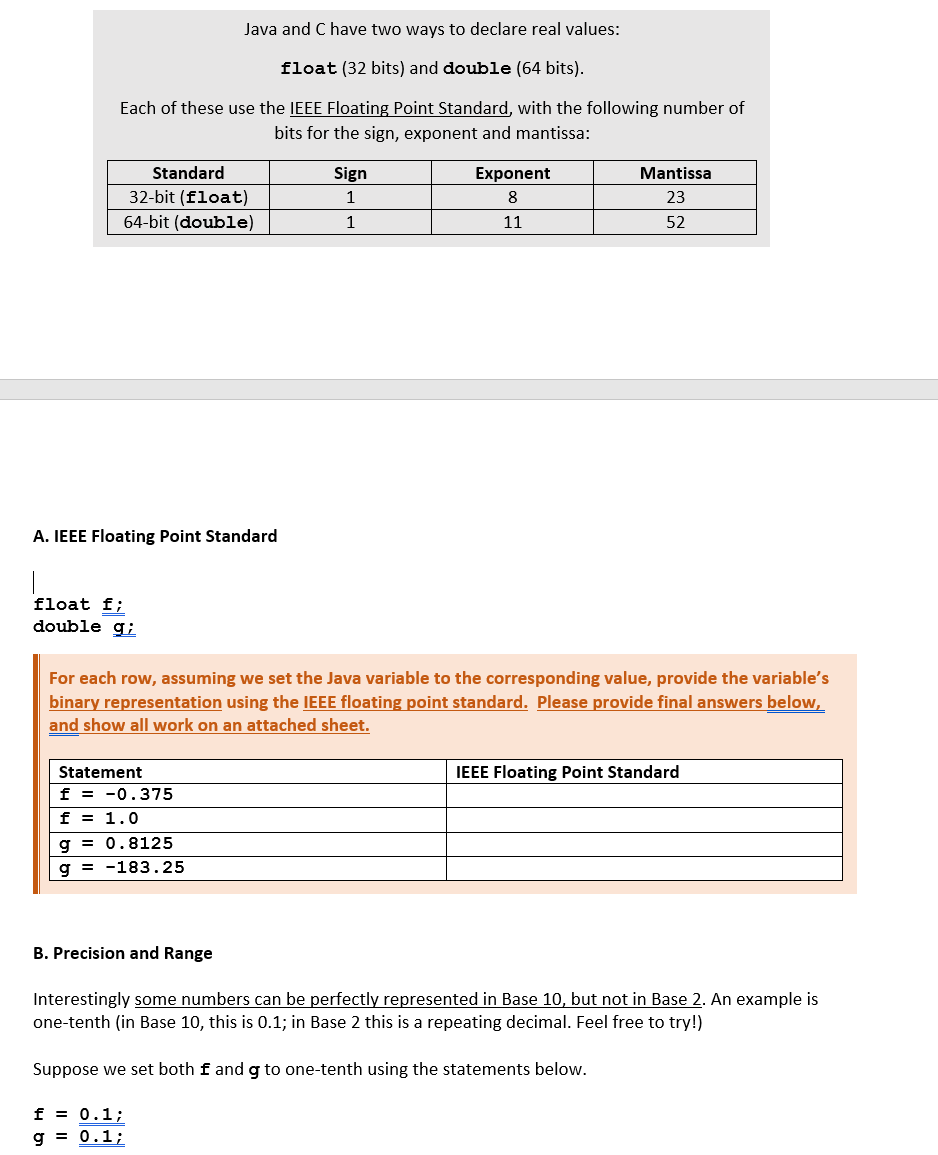
Java and C have two ways to declare real values: float (32 bits) and double (64 bits). Each of these use the IEEE Floating Point Standard, with the following number of bits for the sign, exponent and mantissa: Standard 32-bit (float) 64-bit (double) Sign 1 Exponent 8 Mantissa 23 52 1 11 A. IEEE Floating Point Standard float f; double gi For each row, assuming we set the Java variable to the corresponding value, provide the variable's binary representation using the IEEE floating point standard. Please provide final answers below, and show all work on an attached sheet. IEEE Floating Point Standard Statement f = -0.375 f = 1.0 g = 0.8125 g = -183.25 B. Precision and Range Interestingly some numbers can be perfectly represented in Base 10, but not in Base 2. An example is one-tenth (in Base 10, this is 0.1; in Base 2 this is a repeating decimal. Feel free to try!) Suppose we set both f and g to one-tenth using the statements below. f = 0.1; g = 0.1
Step by Step Solution
There are 3 Steps involved in it

Get step-by-step solutions from verified subject matter experts
 Study Help