







Question: please be detailed, specific, and organized when submitting your response. thank you! You are the sole shareholder and operator of a small incorporated business that
please be detailed, specific, and organized when submitting your response. thank you!
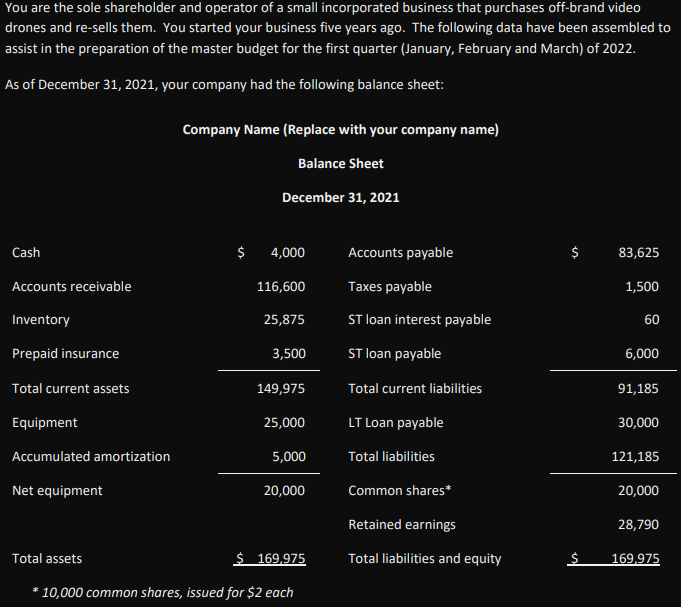
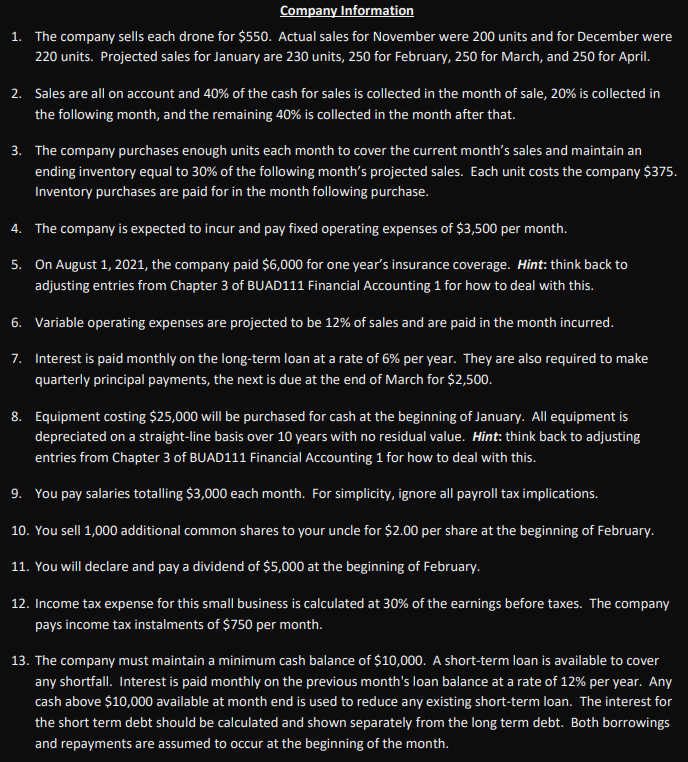
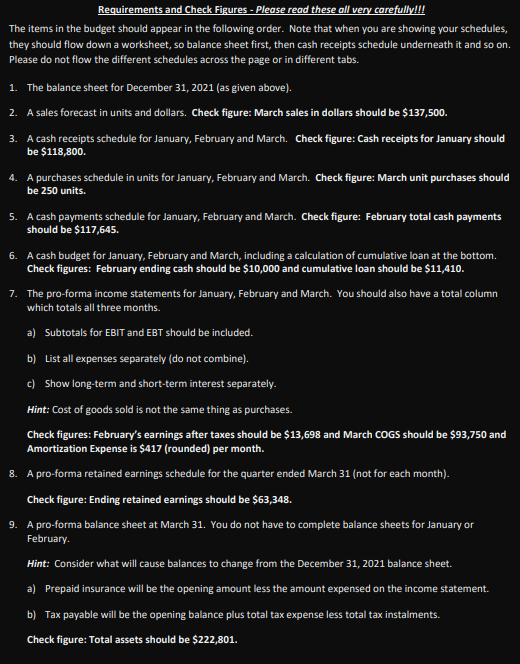
You are the sole shareholder and operator of a small incorporated business that purchases off-brand video drones and re-sells them. You started your business five years ago. The following data have been assembled to assist in the preparation of the master budget for the first quarter (January, February and March) of 2022. As of December 31, 2021, your company had the following balance sheet: Company Name (Replace with your company name) Balance Sheet December 31, 2021 Cash $ 4,000 Accounts payable $ 83,625 Accounts receivable 116,600 1,500 Taxes payable ST loan interest payable Inventory 25,875 60 Prepaid insurance 3,500 ST loan payable 6,000 Total current assets 149,975 Total current liabilities 91,185 Equipment 25,000 LT Loan payable 30,000 Accumulated amortization 5,000 Total liabilities 121,185 Net equipment 20,000 Common shares* 20,000 Retained earnings 28,790 Total assets $ 169,975 Total liabilities and equity $ 169.975 * 10,000 common shares, issued for $2 each Company Information 1. The company sells each drone for $550. Actual sales for November were 200 units and for December were 220 units. Projected sales for January are 230 units, 250 for February, 250 for March, and 250 for April. 2. Sales are all on account and 40% of the cash for sales is collected in the month of sale, 20% is collected in the following month, and the remaining 40% is collected in the month after that. 3. The company purchases enough units each month to cover the current month's sales and maintain an ending inventory equal to 30% of the following month's projected sales. Each unit costs the company $375. Inventory purchases are paid for in the month following purchase. 4. The company is expected to incur and pay fixed operating expenses of $3,500 per month. 5. On August 1, 2021, the company paid $6,000 for one year's insurance coverage. Hint: think back to adjusting entries from Chapter 3 of BUAD111 Financial Accounting 1 for how to deal with this. 6. Variable operating expenses are projected to be 12% of sales and are paid in the month incurred. 7. Interest is paid monthly on the long-term loan at a rate of 6% per year. They are also required to make quarterly principal payments, the next is due at the end of March for $2,500. a 8. Equipment costing $25,000 will be purchased for cash at the beginning of January. All equipment is depreciated on a straight-line basis over 10 years with no residual value. Hint: think back to adjusting entries from Chapter 3 of BUAD111 Financial Accounting 1 for how to deal with this. 9. You pay salaries totalling $3,000 each month. For simplicity, ignore all payroll tax implications. 10. You sell 1,000 additional common shares to your uncle for $2.00 per share at the beginning of February. 11. You will declare and pay a dividend of $5,000 at the beginning of February. 12. Income tax expense for this small business is calculated at 30% of the earnings before taxes. The company pays income tax instalments of $750 per month. 13. The company must maintain a minimum cash balance of $10,000. A short-term loan is available to cover any shortfall. Interest is paid monthly on the previous month's loan balance at a rate of 12% per year. Any cash above $10,000 available at month end is used to reduce any existing short-term loan. The interest for the short term debt should be calculated and shown separately from the long term debt. Both borrowings and repayments are assumed to occur at the beginning of the month. Requirements and Check Figures - Please read these all very carefully!!! The items in the budget should appear in the following order. Note that when you are showing your schedules, they should flow down a worksheet, so balance sheet first, then cash receipts schedule underneath it and so on. Please do not flow the different schedules across the page or in different tabs. 1. The balance sheet for December 31, 2021 (as given above). 2. A sales forecast in units and dollars. Check figure: March sales in dollars should be $137,500. 3. A cash receipts schedule for January, February and March. Check figure: Cash receipts for January should be $118,800. 4. A purchases schedule in units for January, February and March. Check figure: March unit purchases should be 250 units. 5. A cash payments schedule for January, February and March. Check figure: February total cash payments should be $117,645. 6. A cash budget for January, February and March, including a calculation of cumulative loan at the bottom. Check figures: February ending cash should be $10,000 and cumulative loan should be $11,410. 7. The pro-forma income statements for January, February and March. You should also have a total column which totals all three months. a) Subtotals for EBIT and EBT should be included. b) List all expenses separately (do not combine). c) Show long-term and short-term interest separately. Hint: Cost of goods sold is not the same thing as purchases. Check figures: February's earnings after taxes should be $13,698 and March COGS should be $93,750 and Amortization Expense is $417 (rounded) per month. 8. A pro-forma retained earnings schedule for the quarter ended March 31 (not for each month). Check figure: Ending retained earnings should be $63,348. 9. A pro-forma balance sheet at March 31. You do not have to complete balance sheets for January or February Hint: Consider what will cause balances to change from the December 31, 2021 balance sheet. a) Prepaid insurance will be the opening amount less the amount expensed on the income statement. b) Tax payable will be the opening balance plus total tax expense less total tax instalments. Check figure: Total assets should be $222,801
Step by Step Solution
There are 3 Steps involved in it

Get step-by-step solutions from verified subject matter experts
 Study Help