



Question: PLEASE BE SURE TO COMPLETE ALL STEPS OF THE PROBLEM AND SHOW ALL WORK AND EXPLANATIONS TO JUSTIFY THE ANSWERS. PLEASE BE AS DETAILED AS
PLEASE BE SURE TO COMPLETE ALL STEPS OF THE PROBLEM AND SHOW ALL WORK AND EXPLANATIONS TO JUSTIFY THE ANSWERS.
PLEASE BE AS DETAILED AS POSSIBLE FOR ALL STEPS OF THE QUESTION.
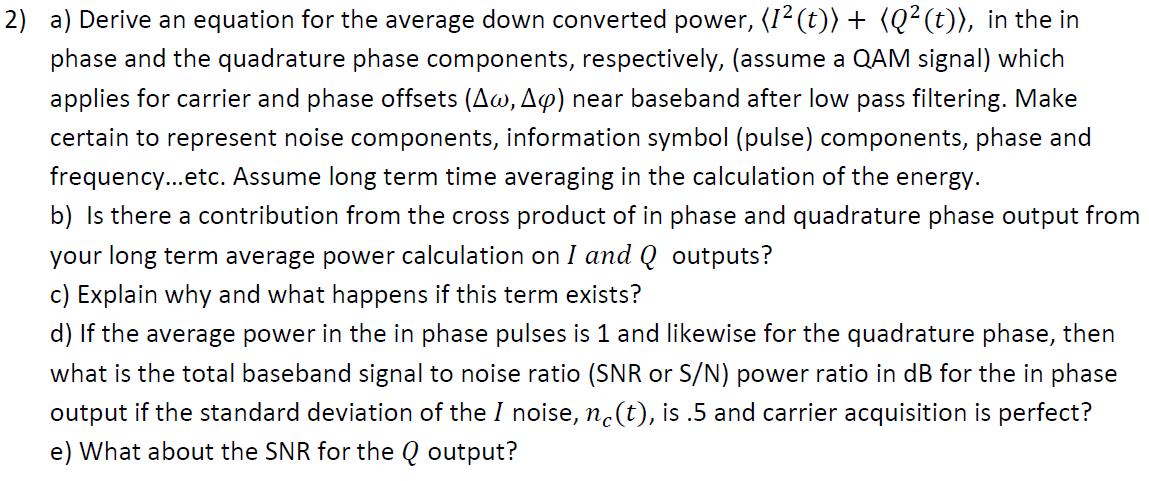
2) a) Derive an equation for the average down converted power, (1(t)) + (Q?(t)), in the in phase and the quadrature phase components, respectively, (assume a QAM signal) which applies for carrier and phase offsets (Aw, Ap) near baseband after low pass filtering. Make certain to represent noise components, information symbol (pulse) components, phase and frequency...etc. Assume long term time averaging in the calculation of the energy. b) Is there a contribution from the cross product of in phase and quadrature phase output from your long term average power calculation on I and Q outputs? c) Explain why and what happens if this term exists? d) If the average power in the in phase pulses is 1 and likewise for the quadrature phase, then what is the total baseband signal to noise ratio (SNR or S/N) power ratio in dB for the in phase output if the standard deviation of the I noise, no(t), is .5 and carrier acquisition is perfect? e) What about the SNR for the Q output? 2) a) Derive an equation for the average down converted power, (1(t)) + (Q?(t)), in the in phase and the quadrature phase components, respectively, (assume a QAM signal) which applies for carrier and phase offsets (Aw, Ap) near baseband after low pass filtering. Make certain to represent noise components, information symbol (pulse) components, phase and frequency...etc. Assume long term time averaging in the calculation of the energy. b) Is there a contribution from the cross product of in phase and quadrature phase output from your long term average power calculation on I and Q outputs? c) Explain why and what happens if this term exists? d) If the average power in the in phase pulses is 1 and likewise for the quadrature phase, then what is the total baseband signal to noise ratio (SNR or S/N) power ratio in dB for the in phase output if the standard deviation of the I noise, no(t), is .5 and carrier acquisition is perfect? e) What about the SNR for the Q output
Step by Step Solution
There are 3 Steps involved in it

Get step-by-step solutions from verified subject matter experts